
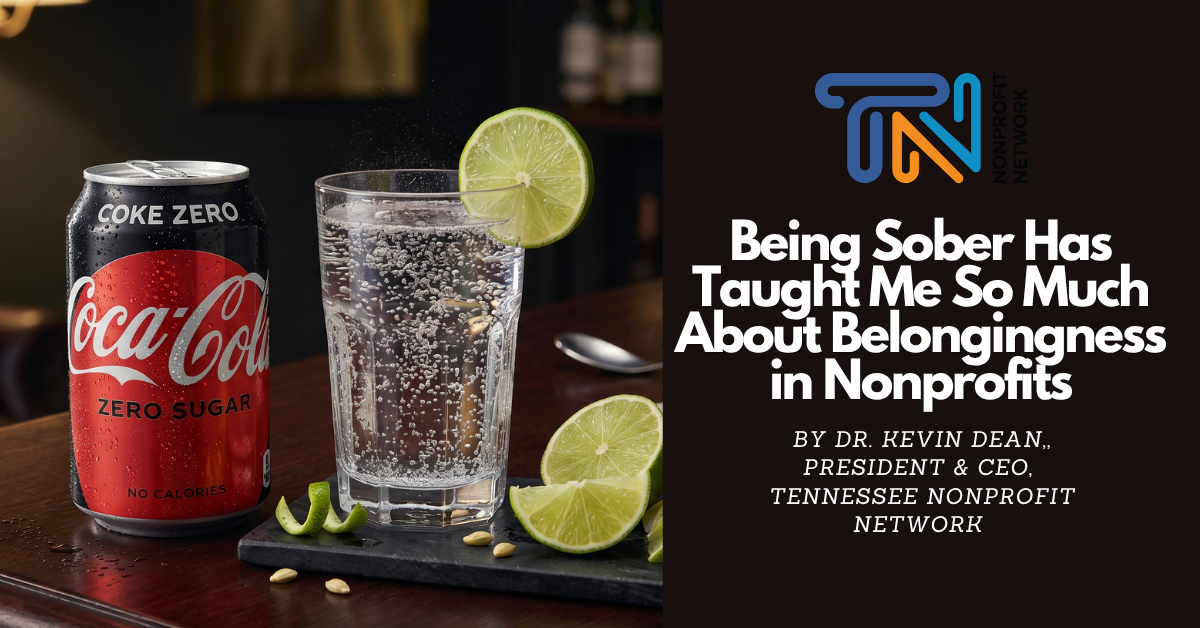
by Dr. Kevin Dean, President & CEO, Tennessee Nonprofit Network
Exactly sixty-four days ago, I decided to be sober. If you assume it required a dramatic, cinematic intervention involving a mahogany table, a box of tissues, and a tearful reading of prepared statements by my closest friends, I have some bad news for you. Instead, it happened quietly, following a routine medical appointment and a sudden realization that my forty-sixth year on this planet should probably involve fewer decisions that make my liver visually resemble a distressed piece of vintage luggage, especially in the wake of new health challenges that aren’t even interesting enough to talk about in this blog post.
At first, telling people about this choice felt like navigating a minefield of social awkwardness. I would clear my throat, brace myself, and utter the words with the tentative energy of a middle manager announcing a budget cut. But human beings are magnificent creatures when caught off guard, and over the past few weeks, my initial discomfort has mutated into a deeply satisfying, slightly sociopathic parlor game. I have started telling people I am sober simply to watch their facial mechanics adapt to the information.
Before we dive into the field guide of human expressions, we need to establish a foundational ground rule of modern civilization: someone else’s sobriety is not a true-crime podcast produced for your entertainment. Even if an individual happened to have a highly cinematic, dramatic road to their sober lifestyle—complete with structural property damage, a public breakdown at a regional association meeting, or a dramatic epiphany delivered by a talking raccoon—it is entirely none of your business. A person’s medical history or personal lifestyle pivot is not an invitation for a forensic audit. When someone hands you a simple fact about their life, they are not offering you a backstage pass to their deepest vulnerabilities. They are just telling you what they want to drink.
The reactions to sharing my sobriety are a masterclass in human psychology, and because we work in the nonprofit sector, where everyone is constantly monitoring their own emotional intelligence, the results are even more exaggerated. When you tell someone in this field that you no longer drink, they do not just hear a personal dietary update. They hear a riddle that they must immediately solve using clues from their own subconscious.
The Taxonomy of Cringeworthy Reactions
Through rigorous empirical observation at various networking mixers, committee meetings, and professional development seminars, I have categorized the four most consistent reactions into a handy field guide:
1. “The Flatulence Gaze”
This is the most common immediate response. When the words leave my mouth, the other person’s face freezes into an expression that suggests I did not just announce my sobriety, but rather that I silently and violently compromised the air quality of the immediate radius by releasing a devastating fart. Their nose wrinkles slightly, their eyes dart to the exit, and they attempt to maintain a polite smile while internally calculating how quickly they can excuse themselves to check on the silent auction items. It is a look of mild, aromatic betrayal.
2. “The Parasitic Twin Expression”
This reaction is far more dramatic. The individual stares at me with wide, unblinking eyes, tilting their head as if I have just informed them that I recently had a large, fully formed parasitic twin surgically removed from the side of my neck. There is a profound, clinical fascination mixed with an underlying horror. They look at me as though I am a completely different species, wondering how I manage to ambulate and hold a clipboard without the lubricating assistance of a mid-tier Chardonnay.
3. “The Immediate Confessional”
This is the reaction that truly highlights the mirror effect of sobriety. The moment I reveal that my glass contains only club soda and a sad, exhausted lime, the other person immediately launches into an unprompted, defensive monologue about their own relationship with alcohol. They feel a sudden, urgent need to audit their own consumption for my benefit.
They will tell me, with intense eye contact, that they really only drink on weekends, or that they only have a glass of Pinot Noir to unwind after a particularly grueling board meeting, or that they actually did Dry January in 2022 and found it very centering. I stand there, holding my water, transformed instantly from a casual acquaintance into an unlicensed, non-judgmental priest receiving the holy sacraments of the hospitality industry.
4. “The Forensic Investigator”
This group bypasses manners entirely and moves straight to the interrogation phase. They assume that a choice to stop drinking must be rooted in a deep, operatic tragedy. They lower their voice, touch my forearm with a heavy display of performative empathy, and begin hunting for the childhood trauma that led me down this dark path.
Was it crack cocaine in the nineties? Was my mother an evangelical prohibitionist? Did a specific, catastrophic incident occur at the annual gala that forced my hand? They want a narrative. They want something out of Requiem for a Dream. They want a story that justifies the heavy sigh they gave when they realized they could not offer me a tequila shot.
Dispelling the Local Legend
You are probably reading this right now, leaning forward, wondering what the actual tea is. Let us address the rumors directly, because I know how the rumor mill operates over lukewarm rubbery chicken dinners.
You might be remembering that one specific evening twenty years ago when I allegedly slurred my words while explaining organizational infrastructure at an open-bar fundraiser. Or perhaps you once saw me in the parking lot after a regional conference with a suspicious white powder covering the tip of my nose. Let me guarantee you, with absolute administrative certainty, that the white substance was powdered sugar from a late-night donut run. My genuine, clinical addiction has always been sweets and Coke Zero, preferably from a fountain instead of a can.
You might also be wondering if my board of directors finally cornered me in an executive session, sliding an ultimatum across the table: get help or get out.
The truth is far more mundane, bordering on the deeply uninteresting. I am sober because I have to be, but also because I want to be. Recent health changes forced me to re-evaluate what I put into my body. My liver, quite frankly, is not the resilient organ it was during my twenties, and I would like to preserve what functionality it has left. Furthermore, I have been prescribed new medications that do not play nicely with alcohol, and I prefer my medical interventions to actually work.
To make matters infinitely worse, I also had to give up coffee. Sweet Jesus, that has been the true test of my mortal soul. Giving up alcohol makes you a social anomaly; giving up coffee in the nonprofit sector makes you a functional pariah. Navigating an 8:00 AM Zoom with a consultant who will. not. shut. up. without a mug of dark roast is a form of spiritual warfare for which no graduate school program can prepare you.
So, there is no grand Hollywood narrative. I did not wake up in a replica of the movie The Hangover, trapped in a Las Vegas hotel suite with a live tiger, a stolen infant, and a missing tooth. I simply went to the doctor, reviewed some lab work, looked at my forty-six-year-old face in the mirror, and decided that it was time to manage my meat-sack of a body with a little more precision.
Thanks for Not Making It Weird, Mariane!
In the midst of this social comedy, I have developed a profound, bordering on religious, appreciation for the rare individuals who do not make my sobriety a public event.
Last week, I attended the National Council of Nonprofits’ Confab in DC and ran into my friend Mariane Doyle, who leads Center for Nonprofit Excellence in Virginia. I had originally decided not to say anything about not drinking because it was personal and those state association folks….they do like to gossip. 🙂 When we met up , I braced myself for the usual routine and told her I was no longer drinking.
Mariane did not blink. She did not give me the “flatulence gaze.” She did not ask if I had spent the last month in a clinical detox facility. She simply smiled, gave me a high five, and told me without an ounce of hesitation that she would stay sober with me for the entire duration of the conference. She didn’t make it a “thing.” She didn’t want the tea. I didn’t feel awkward after. It just was another bullet point to her.
That single interaction felt like stepping out of a cold wind into a heated room. It was an instant, effortless granting of belonging. She did not require me to explain myself, she did not audit her own habits in front of me, and she did not treat me like a fragile clinical specimen. She just adjusted the parameters of our shared environment so that I was entirely included.
That moment stuck with me, not just because it was a relief, but because it made me realize how rare real belongingness actually is. By rejecting a deeply entrenched social norm—the ubiquitous cultural expectation that adults must consume alcohol to network, celebrate, or decompress—I had accidentally become an outsider in small, subtle ways. People were projecting their own anxieties, judgements, and awkwardness onto a personal health choice that had zero impact on their actual lives.
And that is when the inevitable professional disease took over my brain. As I stood there sipping my club soda, I began to wonder: how often do the organizations we run do this exact same thing to the people we exist to serve?
The High Cost of the Hidden Norm
In the nonprofit sector, we spend millions of dollars and thousands of hours discussing diversity, equity, inclusion, and belongingness. We write beautiful value statements. We design elaborate frameworks. But my brief, two-month journey through dry networking has made me realize that belongingness is rarely destroyed by overt hostility. It is eroded daily by the subtle, defensive reactions we display when someone does not conform to our unwritten rules.
When we force someone to navigate an environment where their difference makes people uncomfortable, we are placing an administrative and emotional tax on their presence. We are making them pay for their entry with an explanation.
In our well-meaning efforts to run programs, manage resources, and engage stakeholders, we have built an entire architecture of social norms. When people step outside those norms, our reactions often mirror the exact cringeworthy behaviors I have experienced at happy hours over the past sixty days.
How We Other Our Clients
Consider the experience of a client walking into a human services agency for the first time. They are already in a position of vulnerability, much like I felt during my first few sober social hours. They are entering a space where they do not hold the power.
How often do our intake processes mimic the Forensic Investigator? We do not just ask for their name and immediate needs; we demand their entire multi-generational trauma narrative before we hand over a box of diapers or a food voucher. We require them to explain why they are in the position they are in, forcing them to justify their divergence from the economic norm.
If a client displays frustration, or if they do not speak the specific bureaucratic language of our grant requirements, how often do we give them the “Flatulence Gaze?” We look at them with that polite, frozen nose-wrinkle that says, You are making this uncomfortable for the rest of us. We treat their survival strategies as behavioral problems because they do not match the middle-class professional standards we have decided are correct.
Oh, how I wish we could give up on outdated respectability politics.
How We Alienate Grassroots Donors
The donor cultivation cycle is entirely built on an intricate, often bizarre set of social rituals. We have high-end galas, silent auctions for trips to Tuscany, and exclusive receptions where people mingle with wine glasses balanced precariously on top of tiny plates.
Imagine a grassroots donor from the local neighborhood—someone who can afford to give twenty dollars a month because they deeply care about the mission—walking into one of these high-dollar events. They do not know the unwritten codes of major gift philanthropy. They do not know which staff members to flatter, they do not wear the right casual-chic attire, and they certainly do not understand why people are bidding thousands of dollars on a dusty basket of generic corporate swag.
When they speak up or ask a practical, direct question about where the money actually goes, the room often shifts into the “Parasitic Twin Expression.” People look at them with a mixture of polite horror and deep confusion. The unspoken message is clear: You are welcome to contribute, but please do not disrupt the aesthetic of our benevolence. We make them feel like an administrative anomaly because their wealth—or lack thereof—does not match the traditional philanthropic archetype.
How We Create Volunteer Cliques
Volunteers are supposed to be the community connection point for our organizations, yet volunteer structures are frequently the most aggressively policed social spaces in the sector. Every mature nonprofit has an entrenched inner circle of volunteers—the folks who have been stuffing envelopes, sorting clothes, or docenting tours since the Clinton administration.
When a new volunteer arrives—perhaps a young person looking to fulfill a requirement, or someone from a different zip code trying to give back—they enter an ecosystem dominated by inside jokes, historic grievances, and unwritten operational preferences.
If the newcomer suggests a faster way to organize the database or uses a different tool, the veteran volunteers immediately activate the Immediate Confessional. They do not listen to the suggestion; instead, they launch into a defensive monologue about how they have done it this way for fifteen years, how their system survived the great flood of 2012, and why any change would personally offend the memory of the founder. The new volunteer is left holding their clipboard, feeling entirely isolated, wondering why their desire to help has been interpreted as a personal attack on the institutional legacy.
How We Institutionalize New Staff
The onboarding process for new nonprofit employees is where our cultural rigidity becomes truly dangerous. We hire people for their diverse perspectives, their unique backgrounds, and their fresh ideas. Then, the moment they sit down at their secondhand desk, we spend three weeks systematically erasing everything that made them different.
We douse them in an alphabet soup of acronyms that sound like a military radio transmission. We expect them to immediately understand the complex, unwritten political treaty between the program team and the development department.
If a new staff member challenges an internal norm—asking why we still use a spreadsheet system that appears to have been designed for Windows 95—the leadership team often responds with a collective version of the Flatulence Gaze. We look at them like they have violated a sacred trust. We tell them that they just do not understand our culture yet. We make them feel like an impostor simply because they have not yet developed the institutional calluses that the rest of us carry around as badges of honor.
Practical Adjustments for Everyday Belonging
If we want to build organizations that mirror the Mariane Doyle standard of hospitality rather than a forensic interrogation unit, we have to make active, practical changes. Belongingness is not an abstract philosophy; it is a design choice. Here are a few simple ways we can lower the barrier of entry across our operations.
Streamline Client Intake and Protect Their Privacy
Audit your intake forms with a relentless focus on necessity. Look at every single question and ask: is this information legally required by our funders, or are we just being forensic investigators? If a question is not directly tied to delivering the service or satisfying a compliance mandate, delete it. Stop forcing individuals to recount their worst days or historical family struggles just to receive a basic baseline of support. Let them access services without demanding an administrative confession at the front desk.
De-Escalate the Elite Rituals of Fundraising Events
If you are hosting a reception or a gala, make sure the non-alcoholic options are given the exact same real estate, presentation, and dignity as the alcoholic ones. Do not relegate the sober attendees to a lukewarm pitcher of tap water with a single, exhausted lemon wheel floating in it. Ensure the catering staff hands out a sophisticated, non-alcoholic option with the same enthusiasm they show for champagne. More broadly, demystify the event for grassroots supporters by sending a simple email ahead of time explaining exactly what to expect, what to wear, and where to go. Eliminate the hidden codes of philanthropy so anyone can walk into the room and feel like an insider.
Dismantle the Volunteer Gatekeepers
Break up the high school lunch table dynamic within your volunteer cohorts. Create a formalized system where new volunteers are paired with an intentional ambassador whose sole responsibility is to integrate them, introduce them to the group, and explain the internal context. Establish a clear feedback loop where new ideas from incoming volunteers are treated as valuable data rather than personal threats to the veteran leadership. If a newcomer suggests a new database tool, the response should be exploration, not a defensive speech about the historical preservation of the spreadsheet.
Build an Acronym Dictionary for New Staff
On day one, hand every new employee a comprehensive internal glossary. Define every single acronym, nickname, funder abbreviation, and historical milestone that your team uses in casual conversation. If your team routinely says things like, We need to run this past the workgroup before the next summit, ensure the new staff member doesn’t have to spend their entire first month playing detective just to understand a Tuesday morning staff meeting. Normalize a culture where asking why we do something is met with curiosity instead of the flatulence gaze.
The Architecture of True Belonging
What Mariane Doyle reminded me of at that conference is that belongingness is an active verb. It is not a policy written in an employee handbook; it is a series of small, intentional decisions to lower the barrier of entry for another human being.
True belongingness means that when someone tells you who they are, what they need, or how they choose to navigate the world, you do not require them to submit to an audit. You do not make their divergence from the script your personal project. You do not look at them like an exotic medical curiosity, you do not panic about your own choices, and you certainly do not wrinkle your nose and look for the nearest exit.
You simply accept the information, adjust the space you occupy to ensure they are fully accommodated, and hand them a high five.
As I navigate my third month of sobriety—and my third month of mourning the loss of morning coffee—I am trying to bring that perspective into my daily work. The next time a client, a donor, a volunteer, or a new staff member introduces something unfamiliar into my professional environment, I am going to monitor my own facial mechanics very closely. I am going to make sure I am not giving them the “parasitic twin face.”
In the meantime, if you see me at a sector event over the next few months, please feel free to approach me. You do not need to hide your wine glass behind your back, you do not need to tell me about your uncle who went to rehab in Vermont, and you do not need to ask me about my childhood relationships. Just bring your beverage, I will bring my crisp, cold can of Coke Zero (because I am allowing myself one per day…for now), and we can talk about the indirect cost rate on federal grants like civilized, completely uninteresting adults.