by Dr. Kevin Dean, President & CEO, Tennessee Nonprofit Network
Negotiation in the commercial sector is frequently depicted as a high-stakes contact sport. It involves glass skyscrapers, expensive tailored suits, power lunches where people eat expensive steaks, and the casual throwing around of phrases like “leverage” and “hostile takeover.” The goal is simple: maximize profit, crush the competition, and secure a bonus that could fund a small island nation. (Actually, I have no idea how it really is, but I’ve seen The Wolf of Wall Street and assume that’s how all for profit company cultures are like.)
In the nonprofit sector, negotiation looks slightly different. It usually takes place in a drafty, basement conference room illuminated by flickering fluorescent lights, around a laminate table surrounded by a mismatched assortment of office chairs donated by a local law firm during the Clinton administration. The stakes are not millions of dollars in stock options; they are whether the organization can afford the two-ply toilet paper this quarter or if staff will remain stuck using industrial single-ply sandpaper. The power lunches consist of lukewarm tap water and leftover sandwich meat from last night’s gala.
Yet, despite the lack of corporate glamour, nonprofit professionals negotiate constantly. In fact, they negotiate far more than their corporate counterparts because scarcity is woven directly into the fabric of the sector. When resources are abundant, you do not need to negotiate; you just buy more of whatever you need. When resources are practically invisible, every single asset becomes a battleground.
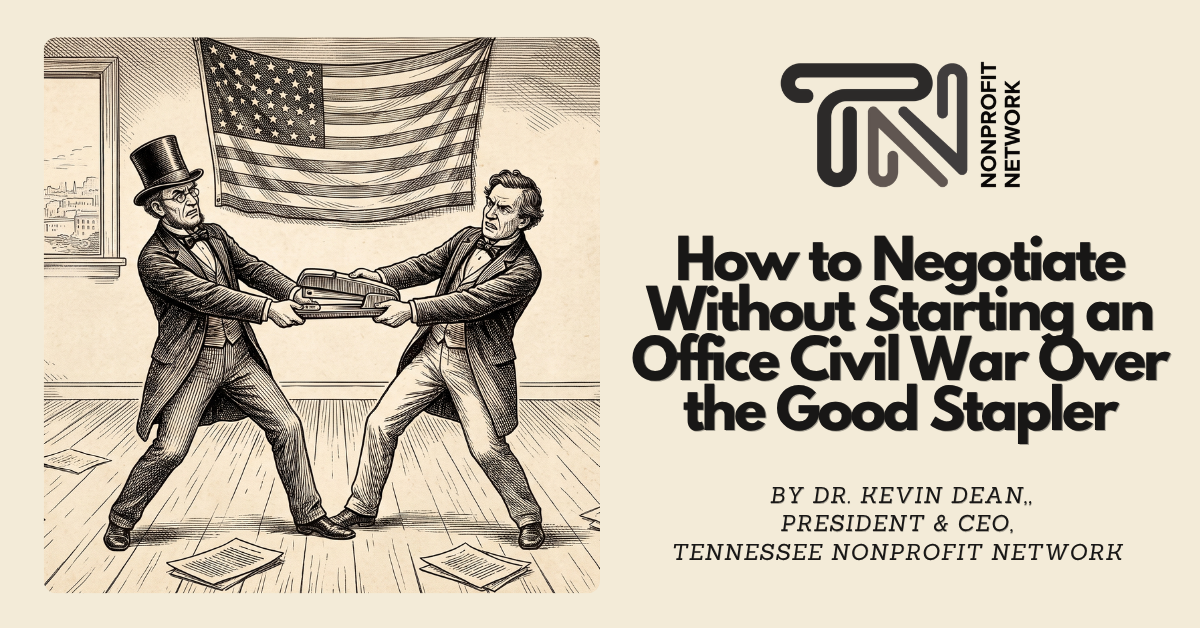
We negotiate with donors who want their name on a building for a fifty-dollar donation. We negotiate with board members who have not read the organizational bylaws since 2004 but possess very strong opinions about the color scheme of the newsletter. We negotiate with local government officials who want us to solve generational poverty on a grant budget of four thousand dollars. And, most brutally, we negotiate with our own colleagues over who gets to use the single functioning stapler left in the building.
Because we are deep in this environment of constant compromise, we often treat workplace negotiation as a survival mechanism where the primary strategy is emotional endurance. The winner of the argument is simply the person who can sit through a four-hour committee meeting without needing a bathroom break or a snack. This approach is exhausting, inefficient, and guarantees that every internal decision leaves half the staff feeling deeply resentful.
Fortunately, negotiation theory offers an alternative known as principled negotiation. Originally developed through the Harvard Negotiation Project, this framework strips away the aggressive tactics of corporate deal-making and replaces them with a logical, merit-based system. When translated into terms that match our unique operational reality, the four components of principled negotiation provide a survival guide for navigating internal conflict without losing your sanity.
Separate People from the Problem
When resources are chronically low, human friction is naturally high. When a program budget is cut or a project is delayed, our immediate instinct is to externalize our frustration and find a human scapegoat. It is remarkably easy to decide that the primary obstacle to organizational progress is a specific colleague who has chosen to make your life miserable.
Enter Greg from finance. Greg routinely rejects mileage reimbursement forms because the font size on the scanned receipt is slightly too small, or because the form was submitted on a Tuesday instead of a Monday afternoon. After a few months of this, you stop viewing Greg as a colleague who processes numbers. You begin to believe Greg wakes up at 5:00 AM specifically to plot the financial ruin of your youth literacy program. You convince yourself that his entire existence is dedicated to bureaucratic gatekeeping.
Principled negotiation suggests that Greg is not actually the problem. The problem is a rigid, outdated organizational procurement policy written during a previous administration that requires three physical signatures, a notary, and a blood oath to release fifty dollars for program supplies. Greg is not acting out of malice; he is acting out of fear of an upcoming external audit that could freeze the organization’s federal funding.
When you separate the person from the problem, you stop viewing your colleagues as cartoon villains. Instead of attacking each other across a table, you change the geography of the conflict. You sit on the same side of the table and attack the systemic issue together.
Instead of starting a meeting with, “Greg, your reimbursement policy is ruining our program delivery,” you phrase it as, “The current reimbursement processing timeline creates a cash-flow gap for our field staff. How can we redesign this form to satisfy the audit requirements while speeding up the delivery of funds?”
Greg is just a human trying to survive an audit. You are just a human trying to buy markers for an after-school program. Once you realize you are both fighting the same clunky institutional system rather than each other, the tone changes from an adversarial shouting match to a collaborative problem-solving session.
Focus on Interests, Not Positions
A position is what someone says they want. An interest is the underlying reason why they want it. In nonprofit circles, we love to entrench ourselves in positions because we believe our specific methods are inherently tied to our organizational mission. This leads to classic operational gridlock.
Consider two program directors fighting bitterly over the use of the office laptop on a Thursday afternoon.
Director A states: I must have the laptop from 1:00 PM to 4:00 PM. This is their position.
Director B states: Absolutely not, I must have the laptop during those exact hours. This is their position.
If they remain trapped within their positions, the negotiation becomes a classic zero-sum game. They will either engage in a passive-aggressive battle of calendar invites, or they will reach a terrible compromise where they split the time in half. This leaves both directors with ninety minutes of computer access, which is not enough time for either of them to finish their work, resulting in two half-completed projects and double the resentment.
If they step back and focus on interests, the conversation shifts entirely. Director A needs the laptop because they are traveling off-site to a community center to log field notes directly into a secure database that cannot be accessed from a personal phone. Their interest is remote database access. Director B needs the laptop because they are running a slide presentation for a major prospective donor in the main conference room at 2:00 PM. Their interest is displaying visual media to an external stakeholder.
The interest is not the physical plastic case of the computer itself; it is the completion of a specific task. By identifying the underlying interests, they can invent solutions that do not involve cutting the laptop in half. Director A can use a tablet or write notes on a legal pad to input later while remaining off-site, or perhaps use a temporary login bypass. Director B can run their presentation using a projector connected to a different desktop monitor or borrow a board member’s device for an hour.
When you stop arguing about what people want and start asking why they want it, you discover that positions are rigid, but interests are remarkably flexible.
Invent Options for Mutual Gain
The typical nonprofit brainstorming session is a minefield of premature judgment. Someone suggests a novel way to coordinate volunteer schedules or a fresh approach to community outreach, and three people immediately jump in to explain exactly why the board of directors, the database software, or the fundamental laws of physics will not allow it. We are so conditioned to hearing the phrase, We tried that in 2014 and it failed, that our brains automatically shut down creative thinking to avoid social embarrassment.
Principled negotiation requires a strict separation between the act of inventing options and the act of judging them. You must deliberately multiply the total number of possibilities on the table before you allow anyone to make a final decision.
If you are negotiating a joint grant application with a partner agency across town, do not spend the first meeting arguing over who has to do the heavy lifting for the quarterly reporting metrics. Instead, set a timer for fifteen minutes and write down every single option available, no matter how impractical it sounds initially.
Can you split the data entry by quarterly blocks? Can you trade graphic design hours for report writing? Can a dedicated volunteer handle the administrative data portal entirely? Can you use a shared spreadsheet to automate the aggregation process?
By forcing the group to generate a wide variety of possibilities before making a final choice, you expand the size of the available pie instead of fighting over who gets the largest crumb. You remove the pressure of immediate commitment, which allows people to suggest creative workarounds they would normally keep to themselves out of fear of criticism.
Insist on Objective Criteria
When internal organizational negotiations lack objective benchmarks, the final decision almost always defaults to the will of the individual with the highest title, the loudest voice, or the highest tolerance for conversational exhaustion. This is precisely how organizations end up purchasing a highly complex database system that costs thousands of dollars and requires a computer science degree to operate, simply because a single board member liked the color scheme of the sales brochure at a conference.
To prevent decisions from being dictated by personal whims or political maneuvering, you must insist that the final agreement rest on objective criteria. This means relying on independent standards, market rates, legal precedents, or documented industry benchmarks that exist completely outside the emotional context of the meeting room.
If your team is debating a salary adjustment for a newly expanded staff role, do not base the final number on who looks the most visibly exhausted at the staff retreat or who complains the loudest about their rent. Look at regional salary surveys for organizations with similar budget sizes.
If you are choosing an event venue for the annual fundraising gala, do not pick a specific ballroom just because it is owned by a cousin of a prominent donor and you want to be polite. Use a standardized evaluation rubric that scores every single venue on cost per square foot, proximity to public transit, accessibility compliance, and built-in audiovisual capabilities.
Objective criteria effectively remove the emotional weight from the conversation. The discussion is no longer an argument about who is right, who is more dedicated to the cause, or who has more organizational power. It shifts the focus entirely to what the data demonstrates, allowing everyone to save face while aligning with an external standard of fairness.
Summary of Lessons Learned
Shifting from an adversarial approach to principled negotiation reveals several fundamental truths about organizational dynamics:
- Conflict is rarely personal: Most workplace disputes are driven by systemic friction, ambiguous policies, or scarce resources, rather than individual malice.
- Demands mask underlying needs: What people initially demand is rarely the only way to satisfy their actual operational requirements.
- Premature criticism stifles innovation: Judging ideas too quickly forces people back into defensive, rigid positions.
- Data beats stamina: Relying on objective benchmarks prevents decisions from being hijacked by organizational politics or emotional exhaustion.
How to Apply this Framework at Work
To turn these four theoretical components into daily habits, you can implement a practical step-by-step approach during your next internal meeting or dispute.
First, perform an emotional scan before entering the room. Identify your own personal biases regarding the individuals involved. Explicitly state the systemic problem on a whiteboard before the discussion begins, ensuring that the issue is visually separated from the names of the staff members in the room.
Second, ban positions from the conversation for the first twenty minutes. When a colleague states, We need to use this specific software, ask an open-ended question focused on utility: What specific problem does this software solve for your team, and what will happen if we do not use it? Force the conversation to stay anchored in needs rather than specific brands or methods.
Third, establish a judgment-free sandbox during brainstorming sessions. When generating options for a project or a budget dispute, use a rule that explicitly forbids the use of the word but or the phrase we tried that before. Write down every single alternative without comment, and only allow evaluation to begin after at least five distinct paths forward have been documented.
Finally, never enter a final decision-making phase without establishing a rubric. Agree on the baseline criteria before you begin looking at the specific options. If the team agrees on the evaluation standards while calm, they cannot easily manipulate the metrics later to favor their personal preferences when the discussion heats up.
Negotiation stops being a source of constant workplace anxiety and becomes a practical tool for building operational efficiency when you follow the principled negotiation techniques in this blog. You will save time, protect staff relationships, and ensure that the limited energy of your organization is spent on community impact rather than internal politics. At the very least, it might finally help your team clear out the communal refrigerator without starting an office civil war.