by Andrea Hill, Chief Development and Partnerships Officer, Tennessee Nonprofit Network
In our last chapter, the impossible had happened: we had successfully convinced our board of directors to vote in favor of a monumental statewide expansion. Our ambitious plan, which was nearly a year in the making, was officially approved. But that vote wasn’t the finish line; it was the starting gun. We were a small team with a massive goal: to officially launch as Tennessee Nonprofit Network by January 1, 2024. The transition from a regional organization to a statewide one required us to move with incredible speed. In fact, we had to move at lightning speed, and for the best possible reason: the nearly 40,000 nonprofit organizations—small, medium, and large, in metro and rural communities across Tennessee—needed us to.
We were all a little nervous about having to scale up so quickly. Time was of the essence, especially with funders playing a “wait and see” game with us. If we took too long to get established, they’d walk away. If we made big blunders, they would walk away. We had a lot to prove in a short amount of time. Our President & CEO, Dr. Kevin Dean, explained to all of us that we would be working together to make this happen. We were going to be the team we needed to be in the moment. He was a big fan of X-Teams.
For those not familiar, an X-Team is a type of organizational team designed to operate with a strong external focus. Unlike traditional teams that work in a bubble, X-teams are constantly reaching out, gathering information, and building relationships outside their own walls. This helps them stay agile, innovative, and deeply connected to the needs of the community they serve. Because our timeline was so condensed, we had to modify the standard X-Teams format to go even faster. We called them “Fast X-teams.” We had an extended discovery process that required us to gather a lot of information very quickly from as many resources as possible, then making a strategic decision on how to best move forward. From our membership model to our consultant directory to our programming, there was no stone left unturned!
Mapping Success: A Collective and Continuous Effort
To meet this vital need, we couldn’t afford to drift; we had to map out an immediate plan for success. We put all of our regular programming on hold for two months while the staff was assigned to different Fast X-teams. It felt a lot like scientists racing to find a vaccine for COVID, except our finish line was a January 2024 kickoff!
This multi-element plan was rooted in sound process and people. We focused on elevating internal leaders, utilizing our staff’s existing expertise and lifting them up as the leaders they truly are. We went back to the basics, stepping back from our daily tasks to focus on quality and mastering the strong foundation we had already built. Our strategy for the “big ask” was centered on a strategic tour. We would develop our strategic documents by gathering feedback, doing lots of research, framing, and then reframing what our direction should be. Hearing from our members, potential members, community partners, funders, and other leaders provided valuable inputs into how we presented, managed, and implemented our work. This collective development and implementation consistently wove the PDSA (Plan-Do-Study-Act) continuous improvement lens through it all. We knew there was always a better way to support the nonprofit community, and we are still updating and innovating our approach.
Our Secret Recipe: The Fast X-Teams Model
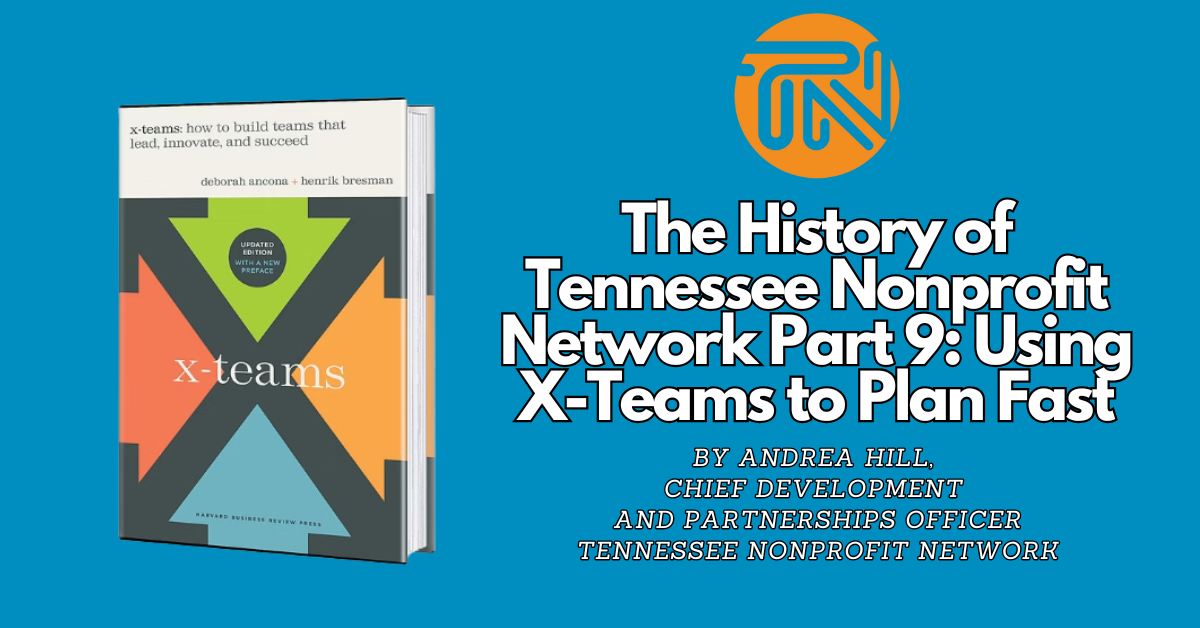
So how exactly did we move so fast while ensuring deep thought and quality outputs? We adopted the principles from the book X-teams: How to Build Teams that Lead, Innovate, and Succeed by Deborah Ancona and Henrik Bresman. The X-teams model was critical because it helped us get outside the walls of our organization and consider our mission as it is seen externally. It gave us a framework to mindfully walk through the process and be sure we focused on the whos, whats, whens, wheres, and most importantly, the whys.
We implemented a rigorous, nine-step process:
- Define the X-teams needed. We had teams focused on everything from sponsorships and public policy to our CRM, training calendar, and governance.
- Assign Roles within the X-teams. Leadership roles were not tied to titles, allowing others across the organization to step up and drive the work. Dorian Hines, for example, led one X-Team and managed April Carter, his supervisor, and Dr. Dean, April’s supervisor! Titles didn’t matter!
- Establish the Why. Defining our initial purpose and vision for each team was paramount to reaching a consensus on the ultimate outcome.
- Research/Community. Teams conducted extensive research, looking at the community and existing resources to create a genuine “way forward.” We made ourselves experts before crafting a plan.
- Ideate. This was the opportunity to dream outside the box, imagine multiple possibilities, and create a process that allowed for creativity while remaining realistic.
- Draft Initial Plan. We focused on getting to the immediate opportunities for implementation, with a focus on design, costs, and timeline, without letting perfection delay progress.
- Test Assumptions/Gather Feedback. We took the time necessary to make sure we settled on the best course of action, celebrating being wrong and revising based on community feedback.
- Present Plan/materials for approval. We came back to Kevin for a quick review and final approval, which was an efficient step as he had been updated throughout the process.
- Implementation! This phase involved a few revisions and reworks, and for the most part, we have kept all the processes implemented from the early days. Even after launch, we have continued to further refine our programming and support services.
Case Study: The Corporate Investment Programs & Events Guide
If you’re like me, you appreciate proof that a system works. I led one of our Fast X-teams focused on developing our Corporate Investment Programs & Event Guide. Walking through the X-team steps—from defining the team (Step 1) and establishing the Why (Step 3), to the ideation (Step 5) and testing assumptions (Step 7)—allowed us to produce a high-quality, comprehensive document.
The guide now clearly outlines TNN’s purpose, including how we strengthen the sector through training, technical assistance, research, and public policy. It details how corporate investment solidifies a commitment to improving Tennessee’s nonprofit sector and provides tangible ways to partner, listing programs like Day on the Hill & Advocacy Summit, Tennessee Nonprofit Conference, and Regional Summits, among many others.
This guide is just one example of how the Fast X-teams structure enabled us to channel our urgency into effective, mindful, and implementable action. We remain committed to continuous improvement, ensuring that every move TNN makes helps create the momentum for good that our Tennessee communities need.
(Now, as the Chief Development and Partnership Officer, I cannot miss the opportunity to make the ask, right?! If you are interested in investing in the work that TNN is doing across the state, please review our Corporate Investment Programs & Events Guide, or feel free to reach out to me via email at ahill@tnnonprofits.org to discuss the partnership opportunity that works best for you. Remember, your investment helps us support the nonprofit sector here in Tennessee.)
The next step was to officially expand, but we’ll save that for the next chapter!