by Dr. Kevin Dean, President & CEO, Tennessee Nonprofit Network
Over the last year, I’ve spent an inordinate amount of time on selection committees. I have spent hours upon hours reviewing applications, cover letters, grant applications, cohort applications, grant applications, and more followed by hundreds of hours on Zoom discussing the finalists. This is a perfect way to use my skill of having big sassy opinions, of which I have many. Whether I’m reviewing grant applications, vetting candidates for a nonprofit executive position, or sorting through conference breakout session proposals, I’ve noticed a trend that makes me want to throw my laptop into the Mississippi River: we are drowning in AI slop.
Before I say anymore, let me be clear: I am not condemning your use of AI. I realize that AI can be a great equalizer in many respects. What I’m not saying here is not to use it. What I am saying here is “learn to do it better.” Your fundraising, your job search, and your consulting will improve if you do!
I’m currently on a grant selection committee where we are legitimately struggling to determine who should receive funding. It isn’t because the pool is overflowing with brilliant, competitive ideas. It’s because multiple applications from entirely different organizations are saying the exact same thing while simultaneously saying absolutely nothing. It’s like reading a telemarketing script written by a corporate robot that only knows 300 distinct words. (If I read the obvious AI-written phrase, “fostering collaboration,” one more time my head will burst.) Instead of using AI as an additive to enhance their unique mission, these organizations are letting the machine drive the bus, and the bus is headed straight into a canyon of mediocrity.
I see the same thing on the search committee for a nonprofit executive role. Cover letters are supposed to be your moment to shine—the place where you stand out from the crowd of 200 other applicants. Instead, people are choosing to blend in like a beige wall in a beige room. When every cover letter sounds like it was birthed from the same digital petri dish, the candidates become a blur of “transformational leadership” and “passionate advocacy.” If I can’t tell your personality apart from a chatbot’s, why would I hire you to lead a room full of humans?
Then there are the breakout session proposals for our conference. Oh my lord. Out of 125 proposals, at least 30% of them sound identical. They don’t tell us what the session will actually be, what the outcomes are, or who should sit in the chairs. They are just a word salad of buzzwords like synergy, sustainability, and impactful floating in a digital void. Consequently, they end up in the trash can. I don’t want to attend a session on “Leveraging Synergistic Frameworks for Impact.” I want to know if there will be handouts and if I’ll actually learn how to fix my broken budget.
I call all of this “AI slop.” The words are technically English, but they are hollow. It is a bland, lukewarm regurgitation of what already exists on the internet, served up as a digital gruel that satisfies no one.
To understand why this is happening, we have to remember what tools like Gemini and ChatGPT actually are: Large Language Models (LLMs). Think of them as hyper-advanced, incredibly confident autocomplete systems. They don’t “know” things; they predict the next most likely word in a sentence based on massive datasets. Because they are trained on the “average” of human writing, their default setting is, by definition, aggressively average. Your job is not to be average. Your job is to stand out. Relying 100% on AI will do the exact opposite.
Unlike us, these models don’t have souls. They don’t have our lived experience. They haven’t had to explain to a donor why a project failed or felt the specific, localized exhaustion of a Chattanooga summer gala. They lack the nuanced critical thinking required to convey a complex message to stakeholders who care about human impact. They can mimic the structure of a sentence, but they cannot feel the weight of the mission.
I’m not condemning the use of AI entirely—it’s a tool, not a demon. However, I highly recommend reading Vu Le’s blog, NonprofitAF, where he has laid out the human rights violations and ethical concerns of AI companies. We should all be aware of the “black box” we are feeding. But if you are going to use it, for the love of all that is holy, use it right.
AI will not replace the humanity in your writing. It will only process what you feed it. If you want a thoughtful response, you have to provide a thoughtful, long, and highly descriptive prompt. You have to wear your critical thinking hat before you hit enter. For now, these models are mirrors. If you give them a vague, lazy prompt, they will give you vague, lazy slop.
A Field Guide to the Slop vs. the Sauce
To keep your documents out of my trash can, you have to move past the “Help me write a…” stage of prompting. Here is how to tell the difference between AI slop and a prompt that actually has some seasoning. I also want to say that when you write with assistance from AI, you should typically expect to revise multiple times. If you use the first thing it spits out, you may want to stop and re-read it.
Grant Applications
The AI Slop Prompt: Write a grant section about our commitment to diversity, equity, and inclusion.
The Slop Result: “We are committed to fostering a diverse and inclusive environment where everyone feels valued. Our organization strives to promote equity in all our programs and operations to ensure a better future for the community we serve.” (Translation: We copied this from a HR handbook from 2012.)
The Better Way: “Draft a 300-word DEI statement for a local community foundation. Specifically mention that our board is now 60% representative of the neighborhood we serve, a change we made after a 2023 internal audit. Discuss our ‘no-degree-required’ hiring policy for frontline staff and how we prioritize vendors owned by people of color in Memphis. Use a tone that is humble but firm about our progress.”
The AI Slop Prompt: Describe the goals for our new homeless shelter expansion.
The Slop Result: “The goal of the expansion is to increase capacity and provide enhanced services to individuals experiencing homelessness. We aim to maximize our impact and provide comprehensive support to those in need.”
The Better Way: “Write a description for our shelter expansion project. The goal is to add 20 ‘low-barrier’ beds specifically for individuals with pets, as this is the primary reason people currently refuse our services. Explain that 15% of our current waitlist cited pet ownership as a barrier. Use a compassionate, data-driven tone that emphasizes ‘meeting people where they are’ rather than forcing them to choose between a bed and their dog.”
Executive Cover Letters
The AI Slop Prompt: Write a cover letter for a Development Director role.
The Slop Result: “I am a highly motivated fundraising professional with years of experience in donor relations. I am confident that my background in securing major gifts will make me an asset to your nonprofit.”
The Better Way: “I am applying for a Development Director role at a mid-sized nonprofit. I once turned a $500 annual donor into a $50,000 legacy gift by spending two years listening to their stories about their late spouse. Write a cover letter that focuses on ‘relationship-first’ fundraising. Mention that I loathe transactional gala culture and prefer small-room cultivation. Keep it punchy, authentic, and a little bit irreverent.”
The AI Slop Prompt: Help me write a cover letter for a Chief Operating Officer position.
The Slop Result: “As an experienced operations leader, I specialize in optimizing processes and driving organizational efficiency. I am an expert in strategic planning and cross-functional team management.”
The Better Way: “I am applying for a COO position at a statewide network. My specialty is cleaning up messy back-end systems that were ignored during rapid growth. Use an organized, ‘no-nonsense’ tone. Mention that I successfully migrated a staff of 40 from paper-based tracking to a fully digital workflow in six months without anyone quitting. Explain that my leadership style is ‘the calm in the storm.’ Avoid using the word ‘journey’.”
Conference Session Proposals
The AI Slop Prompt: Write a session proposal about nonprofit board governance.
The Slop Result: “This session will explore the roles and responsibilities of nonprofit boards. Attendees will learn about best practices for board engagement and how to ensure effective oversight for their organizations.”
The Better Way: “Write a proposal for a session titled ‘Your Board is Bored: How to Stop Lecturing and Start Leading.’ The target audience is Board Chairs who are tired of 2-hour meetings where nothing happens. The session should include a mock ‘speed-dating’ exercise for committee assignments. Use a high-energy, humorous tone that acknowledges how painful board meetings can be. List three takeaways: 1. The 10-minute consent agenda hack. 2. Turning financial reports into stories. 3. How to fire a board member who hasn’t shown up since 2019.”
The AI Slop Prompt: Write a session proposal about fundraising trends in 2026.
The Slop Result: “Join us for a look at the latest trends in fundraising. We will examine how technology and changing donor demographics are shaping the future of philanthropy and what you can do to stay ahead.”
The Better Way: “Draft a proposal for a session titled ‘The End of the Gala as We Know It.’ The session is for small shops with limited budgets. Focus on recurring giving and peer-to-peer advocacy over high-stress events. The tone should be slightly provocative and challenging to the status quo. Outline a case study where an organization cancelled their annual dinner and saw a 12% increase in net revenue through direct mail and coffee dates.”
The Finish Line
Ultimately, if you’re using AI to do the thinking for you, you aren’t actually leading; you’re just a human-shaped conduit for a data center in Northern Virginia. We work in the nonprofit sector because we believe in the power of human connection, the nuance of community needs, and the messy, beautiful reality of making the world better. None of that can be captured by a predictive text algorithm that thinks “collaboration” is the only verb in the English language. (And everyone is “fostering” something and has an “unwavering commitment”)
When I sit on these committees, I’m not looking for the most polished, grammatically perfect, robot-adjacent prose. I’m looking for a heartbeat. I’m looking for the specific, gritty details that prove you actually know the people you serve and that you’ve put some skin in the game. AI is a great starting block, but it’s a terrible finish line. Use it to outline, use it to check your spelling, or use it to brainstorm catchy titles that aren’t “Synergy 101.” But when it comes to the core of your message, put down the chatbot and pick up your own voice. Otherwise, your application, your cover letter, and your brilliant session idea will continue to find their way into the only place where AI slop truly belongs: the circular filing cabinet under my desk.
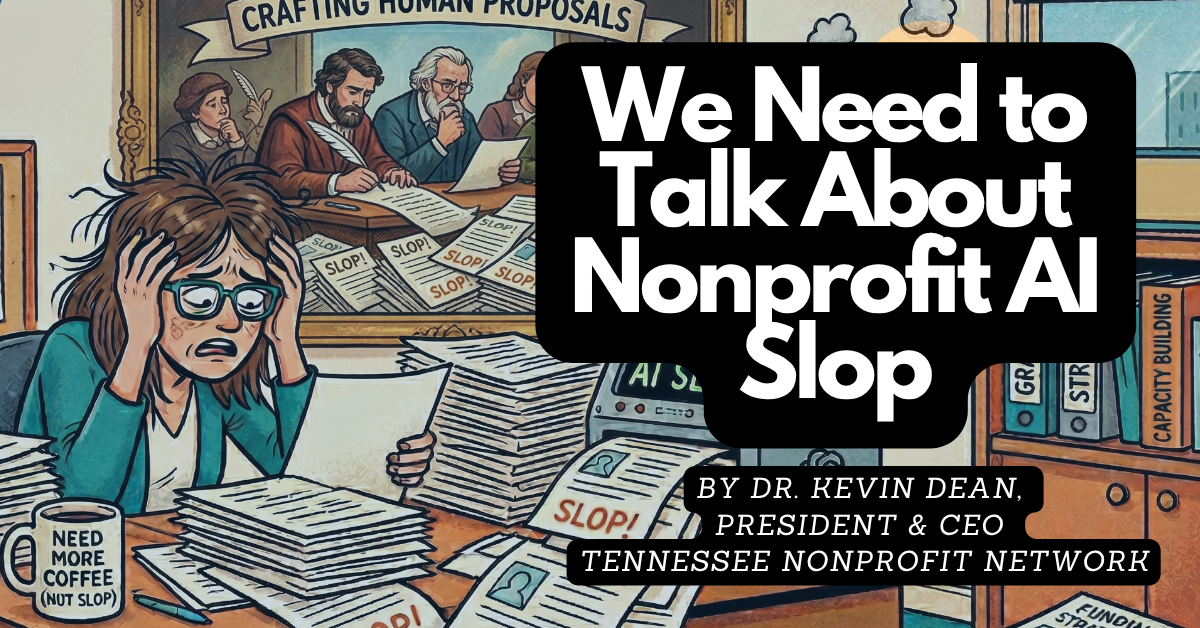
PS. Yes, I am totally aware that the woman in the cartoon has three hands. It is a perfect AI-created picture to go with this article.