
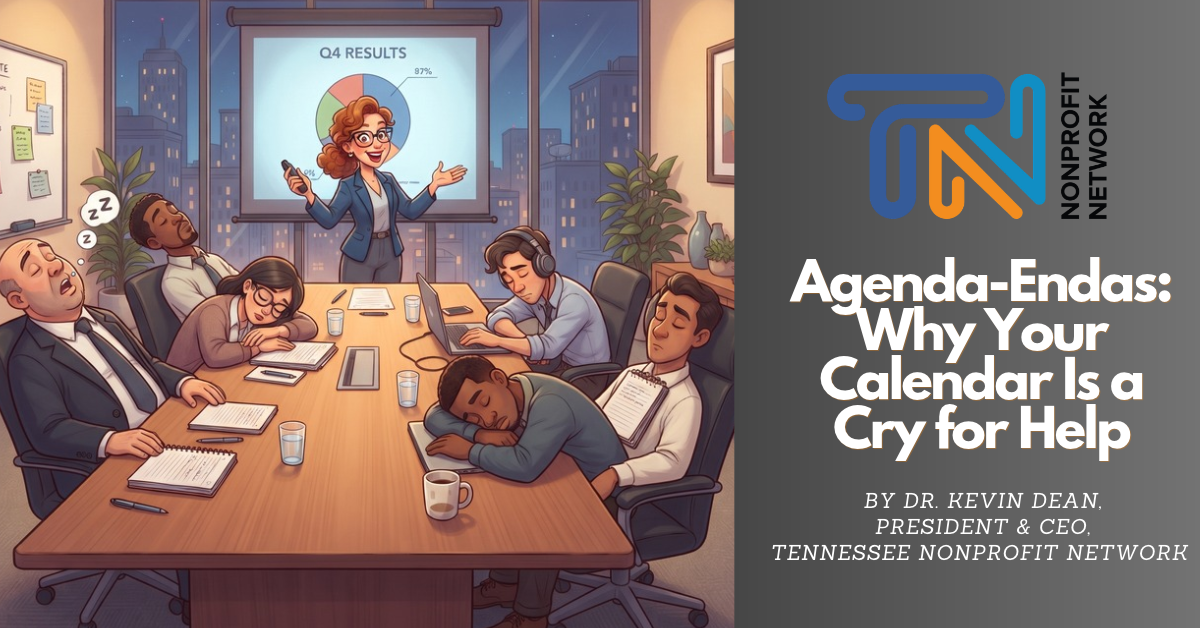
The Conference Room Industrial Complex is a marvel of modern administrative architecture. We have reached a point of evolutionary sophistication in the nonprofit sector where calendar invites do not merely occupy time; they bend space, consume oxygen, and reproduce asexually.
Let’s have a meeting about the meeting that we are meeting with that other organization about because of the meeting they had about a meeting with a funder!
This is not a hypothetical sentence fragment typed during a caffeine crash; it is an exact transcription of a Tuesday afternoon in the third sector. We are a community of dedicated professionals so deeply terrified of making a unilateral decision that we will gladly form a coalition, charter a subcommittee, and schedule three check-ins just to verify that everyone agrees the printer paper should remain white.
Somewhere along the way, we confused motion with progress. We treated the conference room table like an altar where we sacrifice productivity to the gods of consensus. But if we are ever going to reclaim our sanity—and perhaps finish writing a grant application before fiscal year-end—we need to accept a radical, disruptive proposition: meetings are tools, not a lifestyle.
To help us recover from our collective addiction to the calendar invite, management theory has helpfully narrowed down the legitimate reasons for human beings to gather in a room (or a pixelated grid) to exactly four. If an upcoming gathering does not fit one of these four boxes, you are not having a meeting; you are participating in a group therapy session for people who miss high school homeroom.
Reason 1: To Create
Creation is the messy, chaotic birth of something new. This is the blank-slate session where ideas are thrown against the wall, whiteboards are desecrated with multi-colored dry-erase markers, and nobody cares if your proposal sounds slightly unhinged because we are in the “divergent thinking” phase.
In the sector, a true creation meeting happens when you are designing a brand-new initiative from scratch—like figuring out how to launch a pilot program without any budget, infrastructure, or sleep. The energy here is generative. People are talking over each other, building on half-baked concepts, and realizing that yes, perhaps we can tackle that community need if we just stop trying to use twenty-year-old database software.
The fatal error occurs when people mistake an information-sharing update for a creation meeting. You do not need eight people in a room for ninety minutes so that three of them can read bullet points off a slide deck that could have easily been an email. If nothing is being built, invented, or brainstormed from the ground up, put the dry-erase markers down and step away from the conference phone.
Reason 2: To Decide
Deciding is where democracy gets uncomfortable. This is the operational bottleneck where options are narrowed down, trade-offs are weighed, and someone finally has to take ownership of a choice.
A decision meeting requires a quorum, clear parameters, and a willingness to accept that not everyone is going to get their favorite color scheme for the annual report. You are here to pick an option, assign an owner, and set a deadline. It is crisp. It is efficient. It occasionally leaves someone slightly miffed, which is a reliable indicator that an actual decision has occurred rather than a polite circle-jerk of mutual agreement.
Yet, we spend ninety percent of our “decision” meetings pretending to decide things while secretly laying the groundwork to delay the decision until the next meeting. We say, “Let’s take this back to our respective teams for feedback,” which is code for, “I am too conflict-averse to vote yes today, so let’s inflict this on ten more people next Thursday.” True decision-making requires courage. If you leave the room with the exact same ambiguity you walked in with, you didn’t have a decision meeting; you had an adjournment disguised as consensus.
Reason 3: To Align
Alignment meetings are the administrative equivalent of tuning an orchestra before the curtain goes up. You are not writing new sheet music (Creation), and you are not voting on whether to play Mozart or Metallica (Decision). You are simply making sure that all fifty instruments are pointed in the same direction and tuned to the same concert pitch.
These sessions are vital when an organization is rolling out a major shift—a statewide expansion, a new strategic plan, or a massive public awareness campaign where messaging drift could cause total confusion. Everyone needs to know who is doing what, when they are doing it, and whether their departmental silos are accidentally torpedoing the neighbor’s project.
The danger zone here is the status update masquerading as alignment. If your alignment meeting consists of six program managers taking turns listing every single email they sent since Wednesday, you have strayed into the wasteland of performative busywork. Alignment is about strategic synchronicity, not proving to the executive team that you were awake during the previous forty-eight hours.
Reason 4: To Relate
Humans are social animals, and organizations are made of humans—a biological inconvenience that technical manuals routinely overlook. Relate meetings are designed for connection, empathy, onboarding, team cohesion, and checking in on the psychological well-being of the staff.
When your team has just survived a brutal audit, an exhausting gala season, or a grueling legislative session, holding a space simply to exhale, debrief, and humanize one another is essential. It builds the trust capital that you will inevitably draw on when the next crisis hits.
The tragedy of the modern workplace is that we have systematically sterilized the “relate” meeting while simultaneously injecting forced camaraderie into every other meeting. We spend the first twelve minutes of a tactical budget review doing awkward icebreakers about our favorite childhood vacations, and then we wonder why everyone is exhausted by noon. Keep relational connection intentional. If you need to bond, grab a coffee or host a dedicated social check-in. Do not force your budget projection spreadsheet to double as a feelings circle.
The Path Forward
If we evaluate our weekly calendars against these four criteria—Create, Decide, Align, and Relate—we will quickly discover that roughly seventy-five percent of our scheduled gatherings are actually instances of a fifth, unlisted category: Meetings to Discuss the Possibility of Scheduling a Future Meeting.
The next time a calendar invite lands in your inbox with a vague description like “Touchbase regarding stakeholder alignment on the preliminary framework,” pause. Ask yourself which of the four categories it serves. If it doesn’t fit, decline it with a clear conscience, take back your afternoon, and go do the actual work.