by Dr. Kevin Dean, President & CEO, Tennessee Nonprofit Network
Every few years, a new buzzword drops into the sector, scattering across funding guidelines like confetti. Currently, the undisputed heavyweight champion of the world is collaboration. Funders talk about it the way wellness influencers talk about morning meditation. It sounds peaceful. It sounds elegant. It implies a beautiful, frictionless world where organizations seamlessly merge their resources to solve massive, generational challenges over a catered lunch.
To anyone actually operating a direct service nonprofit, however, the word collaboration causes an immediate, involuntary muscle twitch.
We all understand the theory. If Organization A provides housing and Organization B provides job training, combining forces should create a flawless pathway to self-sufficiency. It makes perfect sense on a colorful slide deck presentation. But in the actual, everyday trenches of the sector, the mandate to collaborate often translates to something else entirely: an uncompensated, high-stakes group project where your organization is expected to do all the work, carry all the liability, and hope the funding portal does not crash at 11:59 PM.
The Group Project Nobody Signed Up For
In a perfect world, an invitation to collaborate would come with an extra operations manager, a temporary legal team, and a giant pot of administrative funding. In reality, direct service nonprofits bear the full responsibility for navigating these complex inter-agency relationships with absolutely zero institutional support.
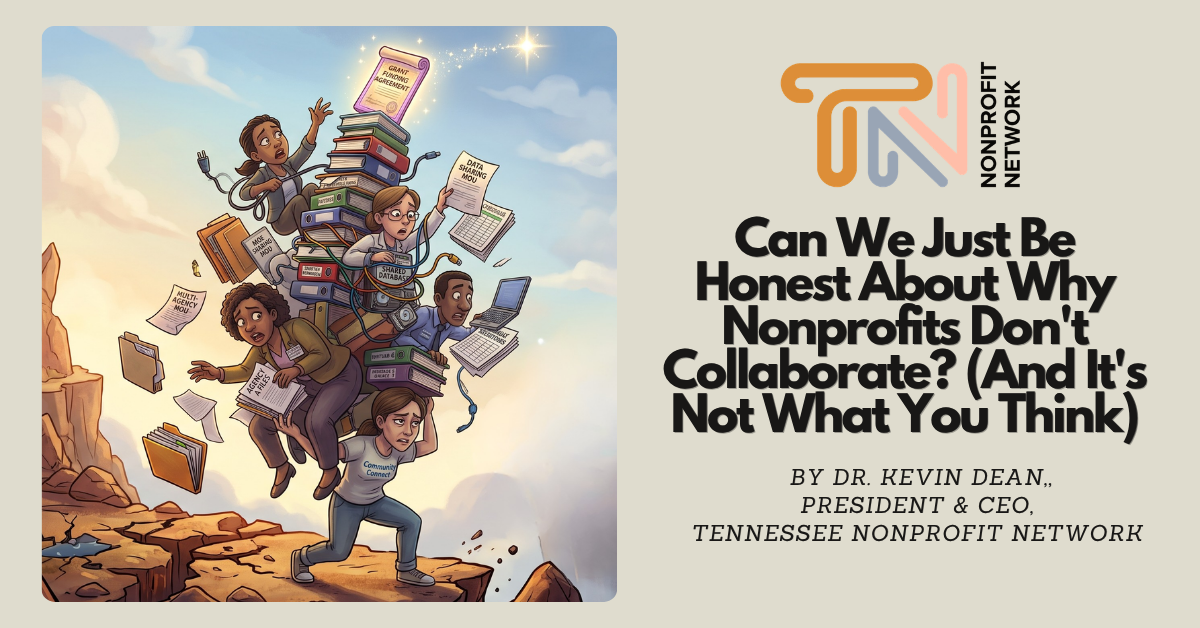
Think back to high school biology. You remember the group project where you were paired with the person who never showed up, the person who wanted to talk about their band, and the person who openly panicked every time the teacher walked by? That is precisely what forced collaboration feels like, except the grade you receive determines whether or not you can keep your office lease next year.
Direct service providers are already running at maximum capacity. Case managers are managing double the recommended caseloads, program directors are filling in for vacant positions, and executive directors are trying to figure out why the office printer is making a sound like a jet engine. Yet, when a funding opportunity requires a multi-agency partnership, these exact same overworked individuals are suddenly expected to become international diplomats, corporate lawyers, and organizational psychologists overnight.
You must navigate the delicate ego ecosystems of multiple service providers. You have to schedule meetings across four different organizational calendars, knowing full well that half the attendees will be thirty minutes late because an emergency happened at their shelter or food pantry. You are tasked with defining the scope of a massive, shared project with nothing to guide you but a vague request for proposals and a prayer. There is no external facilitator. There is no neutral third party to referee the discussions. It is just you, a lukewarm cup of coffee, and a mounting sense of existential dread.
The Pre-Proposal Gauntlet: A Study in Bureaucratic Absurdity
Evaluating the sheer amount of work required just to reach the point of being allowed to ask for money reveals a staggering logistical mountain. Small, capacity-limited nonprofits must figure out an exhausting list of operational variables long before a single dollar is ever guaranteed.
First, you have to find a partner. In the nonprofit ecosystem, this feels strangely like trying to find a roommate on the internet. Everyone puts on their best face. Every organization claims to have robust data tracking, a highly trained staff, and perfect operational alignment. It is only later, during the third planning meeting, that you discover their data tracking system is actually a single legal pad kept in the back of a van, and their highly trained staff is a part-time intern who is leaving for graduate school in three weeks.
Once you have secured your partners, you enter the operational and legal labyrinth. How is this partnership actually going to function? Who is legally responsible if something goes wrong? If a program participant falls through the cracks, whose insurance policy covers it? Because small nonprofits rarely have a dedicated legal team sitting on retainer, this stage usually involves an executive director downloading a Memorandum of Understanding template from Google at midnight, staring at the screen, and trying to guess the legal definition of indemnification.
Then comes the delicate art of drafting the ask. You have to look into a crystal ball to determine exactly what results the funders are looking for this quarter. Funders often want grand, sweeping, systemic transformations that can be neatly visualized on a bar graph for their annual board meeting. They want you to eliminate food insecurity in three zip codes. Meanwhile, your actual capacity involves two reliable volunteers and a budget that IRS compliance officers examine with a magnifying glass.
The gap between what the funder expects and what your organization can realistically produce is wide enough to float an aircraft carrier through. Yet, the pre-proposal process demands that you write a 40-page narrative convincing everyone that this gap does not exist. You must create a logic model that looks like a blueprint for a space shuttle, mapping out inputs, outputs, short-term outcomes, and long-term systemic shifts, all while knowing that your actual daily operations depend entirely on whether or not the main building’s air conditioning unit decides to survive the summer.
High-Risk, Low-Reward Roulette
The raw economics of this situation are brutal: it is a high-risk, incredibly costly endeavor just to get to the starting line of a submission.
Every hour your staff spends sitting in a steering committee meeting discussing the theoretical alignment of your missions is an hour they are not spending helping people. You are investing dozens of hours of senior leadership time—the most expensive resource your organization possesses—into a complete gamble. You are paying people to write letters of support that everyone knows are just polite fiction, to design shared budgets that look like advanced calculus, and to format narratives according to a set of rules that change every single funding cycle.
And what happens after you expend all this administrative capacity? The funder may look at your beautifully crafted, deeply researched, meticulously aligned collaborative proposal and simply say no.
They might decide they are no longer interested in your specific issue area. They might change their strategic priorities mid-stream and decide to fund a completely different initiative. Or, in what is perhaps the most devastating scenario, they might tell you they love the concept, but they have decided to award you only thirty percent of the requested budget while fully expecting you to deliver one hundred percent of the results. You are left standing there with a broken budget, an impossible set of deliverables, and three partner organizations staring at you, wondering who is going to tell the staff that the project is a go, but nobody is getting a raise.
The Post-Award Nightmare: Congratulations, You Won the Burden
Picture a scenario where a genuine miracle occurs: the stars align, the portal doesn’t crash, and the collaborative proposal is actually funded.
The celebration lasts for approximately four minutes. Then, reality sets in.
When a multi-agency grant is awarded, the funder rarely writes separate checks to every organization involved. Instead, they select one lucky organization to act as the lead applicant. If that organization is yours, congratulations: you are now an unpaid fiscal agent, a project manager, and a compliance officer.
You are now entirely responsible for the funding flows. This means you have to chase down the other partner organizations for their monthly invoices. You will spend a significant portion of your professional life sending polite yet increasingly desperate emails asking for financial documentation, only to receive a blurry smartphone photo of a handwritten receipt from an office supply store.
Then comes the reporting. Every funder has a bespoke reporting template designed by someone who apparently harbors a deep, personal hatred for simplicity. You must coordinate metrics from multiple organizations that utilize entirely different data systems. Your organization might use a sophisticated database, while Partner A uses a basic spreadsheet, and Partner B tracks everything via sticky notes stuck to a computer monitor. It is your job to synthesize this administrative chaos into a clean, professional report that proves your collaborative is achieving systemic synergy.
If a partner fails to deliver their data on time, or if their numbers do not add up, your organization is the one that looks bad to the funder. You bear all the reputational and financial liability, but you possess absolutely none of the actual authority to make the other organizations do their paperwork on time. It is a management nightmare where you have all of the accountability and none of the control.
A Mild Proposal for a Saner Future
Nonprofits do not avoid collaboration because they are territorial or selfish. They avoid it because the current funding architecture treats collaboration as a luxury that costs nothing to implement, rather than a complex, resource-intensive operational strategy.
If we want to see real, effective partnerships across the sector, the system has to change.
First, we need intentional collaboration opportunities, the very structure of which should be co-created with nonprofit organizations and funders sitting at the same table before the request for proposals is ever written. Funders need to ask us what it actually takes to work together, and we need to be honest about the costs. If a funder wants a collaborative project, they should explicitly fund the infrastructure required to run it. They should pay for the project manager, the legal fees for the contract design, and the administrative hours spent in alignment meetings.
Second, the sector desperately needs better tools available to track and report as a collaborative. We are currently trying to solve deeply complex social challenges using administrative technology that feels like it was coded during the late nineties. We need shared, accessible, intuitive data platforms designed specifically for multi-agency tracking—tools that allow organizations to securely share data without requiring a degree in computer science to navigate.
If the infrastructure actually supported the relationship, you would see an immediate explosion of collaborative funding requests. Nonprofits would naturally gravitate toward partnership because it would actually help them scale their impact, rather than doing it under administrative duress to satisfy a checklist on a grant application. Until those tools and structures exist, however, we will keep attending the mandatory steering committee meetings, editing the downloaded templates, and pretending that a shared spreadsheet is a perfectly valid substitute for actual institutional support.