
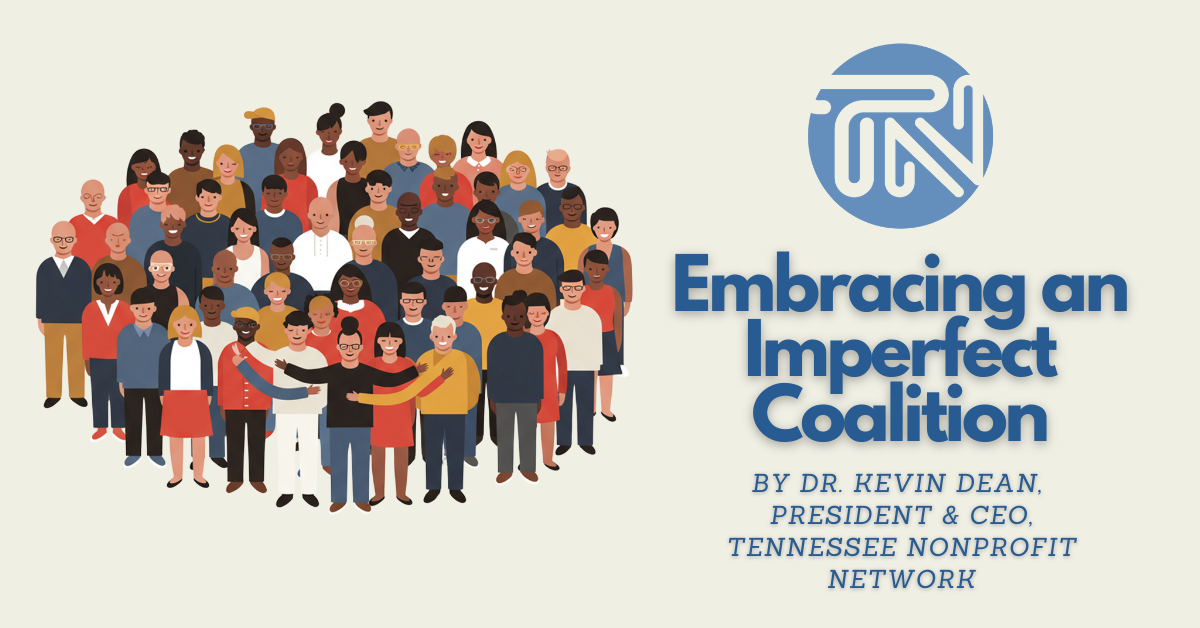
by Dr. Kevin Dean, President & CEO, Tennessee Nonprofit Network
The history of transformative success is rarely a story of ideological purity. Instead, it is often a messy, pragmatic narrative where mutual contempt is temporarily shelved in the face of a greater, more immediate threat. To understand why collaboration in the modern nonprofit sector must transcend personal grievances and political purity tests, one need only look back at the most improbable and consequential alliance of the 20th century: the wartime partnership forged between the United States and the Soviet Union.
The Alliance of Necessity
Before, during, and after the Second World War, the ideological chasm separating the United States and the Soviet Union was perhaps the deepest in modern geopolitics. The United States represented capitalist democracy, individual liberty, and free-market principles, while the Soviet Union embodied communist totalitarianism, centralized command economies, and state control. Their fundamental differences were so profound that the ensuing distrust and rivalry defined the next half-century, immediately manifesting as the Cold War once their common enemy was vanquished.
Yet, this shared, immediate threat—the expansionist, genocidal aims of Nazi Germany and the Axis powers—forced a brutal, pragmatic alignment. Both the US and the USSR recognized that Hitler’s ambitions posed an existential risk that transcended their mutual animosity. This recognition became the foundation for the “Big Three” of the Allied Powers, formed starting in 1941 following the Nazi invasion of the USSR.
The partnership was transactional and essential. The Soviet Army bore the overwhelming brunt of the fighting on the Eastern Front, tying up the vast majority of German land forces—a sacrifice of staggering proportions that directly facilitated Allied victories in the West. Simultaneously, the US provided a lifeline of essential military equipment, food, and industrial supplies to the USSR through the Lend-Lease Act, sustaining the Soviet war machine when it was most vulnerable. This alliance was constantly strained by mistrust, differing war aims, and fundamental disagreement over the shape of the post-war world. It was an alliance built purely on necessity, devoid of affection or ideological harmony, but it was, without question, the decisive factor in achieving victory against Nazi Germany. The lesson is simple: when the threat is existential, pragmatism is the highest virtue, and the common enemy is the only common ground required.
The Nonprofit Sector’s Crisis of Purity
The nonprofit sector, despite its noble and mission-driven mandate, currently operates with a luxurious, counterproductive devotion to ideological and operational purity. This sector is not a monolithic entity; it is a sprawling, ideologically mixed bag, encompassing everything from faith-based organizations to environmental justice advocates, from arts foundations to hyper-local social service providers.
In this diverse ecosystem, the fragmentation that plagues collective impact often stems from factors that are trivial in comparison to the sector’s shared challenges. It is common to witness organizations refusing collaboration because they disagree with a specific policy platform adopted by a potential partner, because they are on ideologically opposite ends of the political spectrum regarding a nuanced issue, or, perhaps most damningly, because they simply dislike the executive director or founder of the other entity.
This self-imposed division—this belief that a coalition must pass an absolute purity test of values, politics, and personalities—is a critical failure of perspective. It confuses the means (organizational alignment) with the end (mission impact). While accountability and alignment are crucial, the current level of internal conflict and rejection based on minor ideological discrepancies is a luxury the sector can no longer afford.
The Existential Threat and the Divided Front
Today, the nonprofit sector faces a cocktail of enormous, collective challenges that mirror the existential nature of the threat faced by the Allies in 1941. These issues are too large, too complex, and too systemic to be fought, much less won, by siloed organizations.
First, public perception and anti-nonprofit rhetoric have created a hostile operating environment. Whether fueled by political polarization or generalized distrust in institutions, the legitimacy and necessity of the sector are under constant attack, eroding public trust and political goodwill.
Second, economic pressures are compounding rapidly. Chaotic and unpredictable executive orders create regulatory instability. Inflation drives up the cost of delivering services, diminishing the value of every dollar raised. Simultaneously, decreasing corporate and individual support—a predictable casualty of economic anxiety and competing societal crises—leaves organizations struggling to maintain basic operations, let alone expand impact.
These factors form the modern Axis powers arrayed against the sector’s collective ability to serve its communities. When organizations stand divided—when a climate change group refuses to partner on a resource-sharing initiative with a local housing provider because they disagree on the carbon tax, or when a food bank rejects a grant from a foundation whose political leaning is unpopular—they are effectively ceding territory to the common enemies. They are choosing ideological comfort over strategic survival. They are losing the war because they are unwilling to form the necessary, imperfect coalition.
We are at a moment in time where putting aside ideological purity tests is not a suggestion for improvement, but a prerequisite for winning. To survive the current operational and perception challenges, the sector must recognize that the immediate goal of neutralizing these collective threats supersedes the gratification of ideological alignment.
The Pragmatic Parallel: Holding Your Nose
The call for imperfect coalition building is not an idealistic plea; it is a deeply pragmatic one, rooted in the lived experience of every professional.
Consider the reality of working with an organizational stakeholder who is personally, politically, or ethically repulsive. Have you ever had a board member, a boss, or a major donor whose politics you abhorred, whose demeanor you detested, or whose past actions gave you pause? If you have worked in the sector for any length of time, the answer is undoubtedly yes.
In those moments, you hold your nose. You offer a strained smile while shaking their hand. You execute the strategic objective—you secure the funding, you push the mission forward, you maintain the organizational stability—because you recognize that the individual’s flaws, however glaring, are subordinate to the mission’s necessity. Your personal feelings do not dictate your professional action; instead, your commitment to the organization’s survival and impact dictates your temporary tolerance.
Why, then, can we not extend that same pragmatic sacrifice to an external nonprofit partner?
If one organization has unmatched expertise in policy advocacy, and another has unrivaled boots-on-the-ground volunteer capacity, a partnership between them is a force multiplier, regardless of whether their executive directors see eye-to-eye on every social issue. To prioritize the personal or minor ideological misalignment is to commit an act of strategic malpractice. It elevates ego and tribalism above the very mission that justifies the organization’s existence.
The Necessity of Embracing Imperfection
The postwar world, defined by the hostility of the Cold War, was only possible because the US and the USSR embraced their imperfect coalition for a finite, urgent purpose. They understood that the end of the alliance did not negate the necessity of its existence.
Nonprofits must adopt this same strategic ruthlessness. Embracing an imperfect coalition means:
- Defining the Common Enemy: Clearly articulating the immediate, large-scale challenges (e.g., funding cuts, anti-nonprofit legislation, inflation impact) that are shared across all missions, regardless of ideological focus.
- Evaluating Capacity, Not Character: Selecting partners based on their capacity, reach, resources, and expertise. Does Organization X have the data infrastructure you lack? Does Organization Y have the lobbying power you need? If so, the partnership is necessary, and the personal or ideological differences become secondary operational hurdles, not mission roadblocks. (And no, I am not taking this to the extreme, and you shouldn’t either, lest you miss the point of this blog post. If a hate group has sound financial management policies, I am not suggesting you align with them if your finances are a mess.)
- Establishing Transactional Boundaries: Creating coalitions with clear, limited, and measurable objectives. The partnership does not have to be a lifelong marriage; it can be a temporary, necessity-driven transaction aimed at defeating a specific collective threat.
The fight to maintain public trust, secure sustainable funding, and deliver vital services in this climate is the sector’s Eastern Front. Failure is an existential retreat. The only true purity test for a nonprofit coalition should be its effectiveness in achieving its mission. We must learn to hold our nose and offer our hand, because the victory—the successful execution of the mission—is the only moral imperative that truly matters.