by Dr. Kevin Dean, President & CEO, Tennessee Nonprofit Network
My name is Kevin, and I have the attention span of a heavily caffeinated chihuahua.
I admit it freely. I’m easily distracted. But honestly, who isn’t in this day and age? It feels less like a personal failing and more like a necessary survival skill when navigating a world that demands your attention from a dozen directions at once. And for those of us toiling in the nonprofit sector? Forget about it. We’re essentially operating inside one giant, flaming mess of chronic underfunding, staff burnout, and shifting community needs.
Like many leaders in this space, I spend my days doing the administrative equivalent of a three-ring circus: triaging a perpetually overflowing email inbox, putting out metaphorical fires, and staring blankly at our strategic plan, wondering if it has any meaning left at all. We have to change directions every five minutes, it feels like, just to keep up. My time, therefore, is precious. It is a non-renewable resource that I guard fiercely.
Yet, despite being a certified introvert who happily communicates via email and text, I am genuinely committed to reaching out, finding time to be in spaces with other leaders, and continuing my professional development. I am not a huge believer in the power of a one-time training—the retention rate is dismal—and especially in the wake of the pandemic, I am actively seeking alternative ways to learn and be in community.
But alas, when you step outside the traditional classroom setting, you almost inevitably trip over the perennial favorite: the panel discussion.
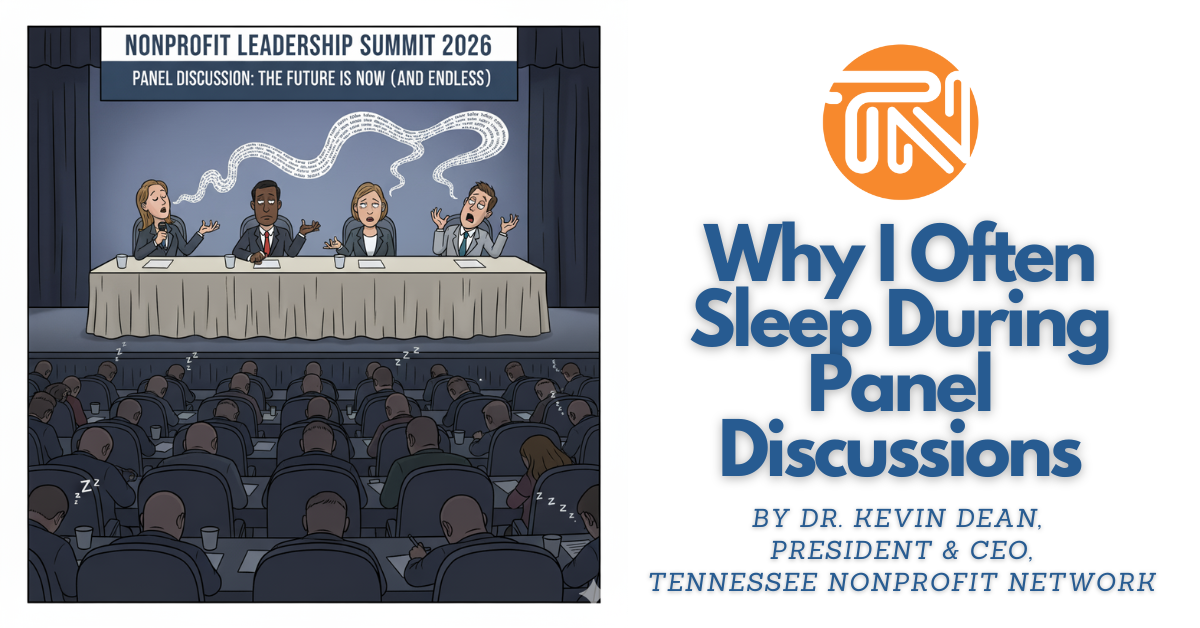
Oh, how the nonprofit sector loves a panel discussion! It is the default setting for almost any conference, luncheon, or leadership gathering. We trot out three or four earnest-looking people, give them a microphone, and hope for illumination. The problem? That hope is extinguished faster than a birthday candle in a hurricane.
Admittedly, TNN hosts panel discussions a lot, and it’s become a part of our Immersion Series. It works mostly. Sometimes, it doesn’t. We’re still trying to perfect it. In the last nine years in this job, there have been times when I have been a moderator or a panelists and have thought, “Heck yeah! This is a brilliant, spicy panel!” Other times, I have thought, “Get me off this stage right now before more people start snoring!”
Have you noticed how you forget at least half of the panel discussions you attend? The content evaporates like morning mist. This isn’t a glitch; it’s a feature of the standard, mediocre format: a moderator asks a question, the three panelists all answer, and they typically start with the most intellectually lazy phrase in professional development: “I echo what Angela said.”
If I wanted to listen to three people agree in slightly different cadences, I would simply stand in a hallway and ask three colleagues about the weather. But my time is not a garbage disposal for lukewarm consensus.
The core problems with the vast majority of panel discussions are not minor flaws; they are existential threats to the format’s utility.
- They are Boring: Let’s start with the obvious. A two-minute answer is fine. A five-minute, rambling, stream-of-consciousness soliloquy on a topic everyone already understands is an act of intellectual aggression.
- They are a Platform for Self-Promotion: Too often, the questions serve as thinly veiled excuses for the panelists to recite their latest book title, mention their corporate sponsor, or detail their recent, highly successful (and conveniently relevant) project. There is a difference between effective storytelling and blatant self-aggrandizement, and most panels blur that line into illegibility.
- The Panelists Are Excessively Long-Winded: Time is a flat circle to some people, and they will wax poetic for twenty minutes on a single question. Meanwhile, the audience is checking emails, refreshing social media, and calculating how many minutes of their precious life they can reasonably donate to this meandering monologue.
- The Questions are Too Safe: They are softballs lobbed gently across the plate—easy to hit, but completely unmemorable. They seek affirmation, not insight.
- The Lack of Diverse Thought: Why have three panelists who are all in alignment? If everyone is saying the same thing, the setup is a waste of time.
We know why panel discussions persist. They are much easier for event hosts to put together, and they are often cheaper than hiring a single, high-caliber keynote speaker. But here is the age-old lesson: you get what you pay for. Cheap and easy usually results in forgettable and dull.
If we must cling to the format, then let’s at least make it painless and engaging. It is possible to rescue the panel discussion from its own mediocrity. It requires effort, foresight, and a willingness to embrace productive discomfort.
Here are ten recommendations on strengthening panel discussions so that they actually deliver value, not just filler:
- Ask Provocative Questions: No, you don’t have to ask someone, “What would you do if you saw someone slap a puppy?” But the questions must go deeper than surface-level affirmation. Instead of the insipid, “What does nonprofit leadership look like in 2026?”, ask, “What challenges do nonprofit leaders face in 2026 that we are fundamentally unprepared for?” Force them to address the mess.
- Make Questions Specific and Actionable: Abstract questions breed abstract, philosophical answers. Good questions yield tangible results. An excellent example: “What single, concrete action should nonprofit leaders be doing today to prepare their boards for the inevitable demographic shifts of 2026?”
- Challenge Entrenched Thinking and Disrupt the Status Quo: The panel should not be an echo chamber. Have panelists who are known for challenging people’s comfortable, established perspectives. We need disruption, not consensus.
- Ensure Diverse Perspectives are on the Panel: If they all agree, it’s boring. Full stop. Diversity doesn’t just mean demographics; it means diversity of thought, experience, and institutional context. It doesn’t have to be a screaming debate, but bringing in different ideas and varying perspectives makes it exponentially more interesting, especially when it challenges the audience’s preconceived notions.
- Focus on Lived Experience, Storytelling, and Data: These are the three best and most engaging components of a good panel. Frame the questions around these elements, and find folks who embody the ability to weave them together. This provides the emotional, intellectual, and empirical grounding the audience needs.
- Give the Questions to the Panelists in Advance: This is non-negotiable. It prevents the waxing poetic that wastes everyone’s time. It forces them to prepare focused, concise answers. And on the panelist side: keep your answer to two minutes or less. The moderator must enforce this with a gentle but firm hand.
- Don’t Waste Time with Softball Questions: Time is of the essence, and that’s not just a cliché for a leader trying to run a flaming-mess of a nonprofit. Get to the point. The first question should be the hardest, most interesting one.
- Don’t Let Panelists Self-Promote or Self-Aggrandize: The moderator’s job is to ruthlessly redirect. If a panelist starts telling a long, self-congratulatory story that does not directly and immediately serve the question, cut in with a polite redirection like, “That’s a fantastic point on [X topic]. Let’s bring it back to [Y actionable advice].”
- Center Adult Learning Principles: One of the key components of adult learning is that adults learn best when they can immediately use the information they obtain. If people don’t walk away with something they can do as soon as they get back to the office, they will probably forget they were even there. The panel’s objective must be a transfer of actionable knowledge.
- When in Doubt, Consider a Fireside Chat: Seriously. One brilliant person’s perspective—one who has deep information and expertise—is better than having three people saying the same thing. The phrase “I echo what [X] said” should never, ever be uttered in a professionally hosted panel discussion. If it is, the host failed in their curation.
I’m not saying abolish panel discussions. I’m saying let’s work strategically to make them better. The panel discussion, as currently practiced, is a tax on a leader’s time. We are committed to professional growth, but we are desperate for formats that respect the preciousness of our time and the magnitude of the issues we face. It’s time to move beyond the easy, cheap option and curate discussions that are as messy, challenging, and insightful as the sector we serve.