In the popular imagination, a Tennessee nonprofit is a quaint operation run by three retirees in cardigans, operating out of a church basement with a budget held together by bake sales, masking tape, and aggressive optimism. To be fair, 66.2 percent of Tennessee nonprofits do operate with annual revenues below $50,000. Because of that, we tend to treat the entire sector like a polite civic hobby—something nice to pat on the head during gala season while the “real” economy of auto plants, construction firms, and downtown Nashville bachelorette industrial complexes does the heavy lifting.
The math, however, tells a vastly more inconvenient story for anyone who enjoys condescending to tax-exempt organizations. According to the September 2026 More Than Mission economic impact analysis by ThinkTennessee and the University of Tennessee’s Boyd Center for Business and Economic Research, the state’s 39,263 registered nonprofits are not a decorative side dish to the state economy. They are the load-bearing walls.
Nonprofits as Essential Infrastructure
When politicians talk about infrastructure, they usually mean things you can pour concrete on or pose next to in a shiny hard hat. Nobody holds a ribbon-cutting ceremony for an organization that helps rural patients navigate insurance paperwork or keeps a food bank’s industrial freezers humming. Yet Tennessee nonprofits are present in all 95 counties—averaging 54 organizations per 10,000 residents—and pump $55.1 billion in annual spending into our communities. That equates to $7,795 spent per Tennessee resident every year, with nonprofits spending at least $1,000 per capita in 58 of our 95 counties, and surpassing $20,000 per resident in Davidson, Meigs, and Washington counties. While Shelby and Davidson counties host more than 5,000 nonprofits each, the per-capita weight of the sector is arguably felt heaviest in rural communities like Grundy, Pickett, and Humphreys counties, where they each top 60 nonprofits per 10,000 residents.
This civic plumbing is currently absorbing a massive shock resulting from Washington’s recent enthusiasm for downsizing. According to Think Tennessee’s June 2026 analysis of federal staffing and funding trends, federal executive actions trimmed Tennessee’s federal civilian workforce by 10.2 percent between December 2024 and December 2025—a loss of 2,622 jobs, including 509 positions at the Department of Veterans Affairs and 1,206 at the Department of the Treasury. When there are fewer federal workers around to answer the phone or process a veteran’s claim, and roughly $400 million in AmeriCorps grants are abruptly canceled, the people who still need help do not magically evaporate. They walk through the doors of local nonprofits.
At the same time, federal policy changes from the July 2025 spending bill and expiring Affordable Care Act (ACA) enhanced premium subsidies are setting off a slow-motion domino effect. Think Tennessee reports, citing the Kaiser Family Foundation, that an estimated 210,000 Tennesseans are projected to lose health insurance coverage by 2034—including 24,000 losing TennCare due to stricter eligibility rules and more frequent paperwork reviews, and 180,000 losing ACA Marketplace coverage after average premiums jumped 32.6 percent in January 2026. Meanwhile, expanded SNAP work requirements and noncitizen restrictions have already coincided with a drop of roughly 100,000 Tennesseans from food assistance rolls between July 2025 and May 2026, with the Urban Institute estimating that 374,000 Tennessee families (53.4 percent of recipients) will ultimately lose some or all of their benefits. When families lose healthcare and grocery money, nonprofits are the emergency seawall keeping local communities from flooding.
The Great Disappearing Act: If Nonprofits Vanished Tomorrow
Let us indulge in a brief, terrifying thought experiment. Suppose every nonprofit in Tennessee decided tomorrow morning to pack up its clipboards, turn off the lights, and leave the state to fend for itself.
First, the state government’s celebrated budget surplus would experience a violent encounter with reality. For a sector famously defined by its tax-exempt status, nonprofits generate an astonishing amount of money for the state treasury. According to the Think Tennessee and Boyd Center analysis, economic activity driven by the nonprofit sector generates $2.9 billion in state and local tax revenue every single year—comprising $1.6 billion in sales taxes from employee purchases and $1.2 billion in other operational taxes like hotel and gasoline taxes. That represents 12.6 percent of total Tennessee tax collections in FY2024–25. Take nonprofits away, and the state loses roughly one-eighth of its tax base right as it faces an estimated $354 million in new annual obligations ($192 million in administrative expenses starting in FY2027 and $162 million in benefit cost-shares starting in FY2028) from federal SNAP cost-shifts identified by the Sycamore Institute and Think Tennessee.
Even a partial retreat is enough to trigger a local crisis, and that retreat is no longer hypothetical. According to Think Tennessee’s analysis of IRS Form 990 data, 2,187 Tennessee nonprofits received $4.6 billion in government grants between 2020 and 2024. Strip those government grants away without replacement revenue, and 72.5 percent of those organizations would immediately fall into an operating deficit. Worse yet, across 24 Tennessee counties—primarily rural communities like Lake, Lauderdale, Haywood, Hardeman, McNairy, Hardin, Wayne, Perry, and Grundy—every single government-funded nonprofit (100 percent) would be operating in the red.
This isn’t a distant storm cloud; it is already raining in the lobby. In a Spring 2026 survey conducted by Think Tennessee and Tennessee Nonprofit Network, 60.9 percent of participating nonprofits reported receiving government funding, and 59.1 percent of those recipients reported that at least one of their federal, state, or local funding streams had already been cut or eliminated within the past year. If those organizations go under, there is no backup quarterback waiting on the sidelines to feed hundreds of thousands of families, staff rural clinics, or keep communities afloat.
Economic Might and Workforce Development
It is time to retire the notion that working at a nonprofit is an act of economic martyrdom, or that the sector is merely a consumer of charitable dollars rather than a generator of wealth.
According to the Think Tennessee and Boyd Center report, Tennessee nonprofits directly employ 361,188 people. That accounts for 10.7 percent of the state’s entire nonfarm workforce—more than double Tennessee’s entire Construction workforce (164,000 jobs) and virtually tied with the state’s vaunted Manufacturing sector (363,500 jobs). Over three-fourths (77.4 percent) of these direct jobs are concentrated in the bedrock industries of human capital: Health (153,163 employees, or 42.4 percent), Education (65,683 employees, or 18.2 percent), and Human Services (60,673 employees, or 16.8 percent).
And that is before the multiplier effect kicks in. When nonprofits spend $21.9 billion on direct payroll ($17.0 billion in wages and $4.8 billion in employee benefits) and buy goods and services from local Tennessee vendors, they support an additional 148,956 indirect jobs ($18.9 billion in income) and 214,980 induced jobs ($18.3 billion in household spending income) as workers buy groceries, cars, and homes. Altogether, the nonprofit sector supports 725,124 jobs—an astonishing 21.5 percent of all nonfarm employment in Tennessee—and generates $59.0 billion in total income, equivalent to 11.9 percent of the state’s personal income.
Beyond their own massive payrolls, nonprofits are the quiet engine behind the rest of Tennessee’s workforce development. Every corporate recruiter and chamber of commerce executive in Tennessee knows that you cannot attract and retain workers for auto plants or corporate headquarters if those workers lack healthcare, education, job training, child care, and basic human services. Nonprofits do not just support more than one in five jobs across Tennessee; they train, heal, educate, and stabilize the workforce so the other four can show up on Monday morning.
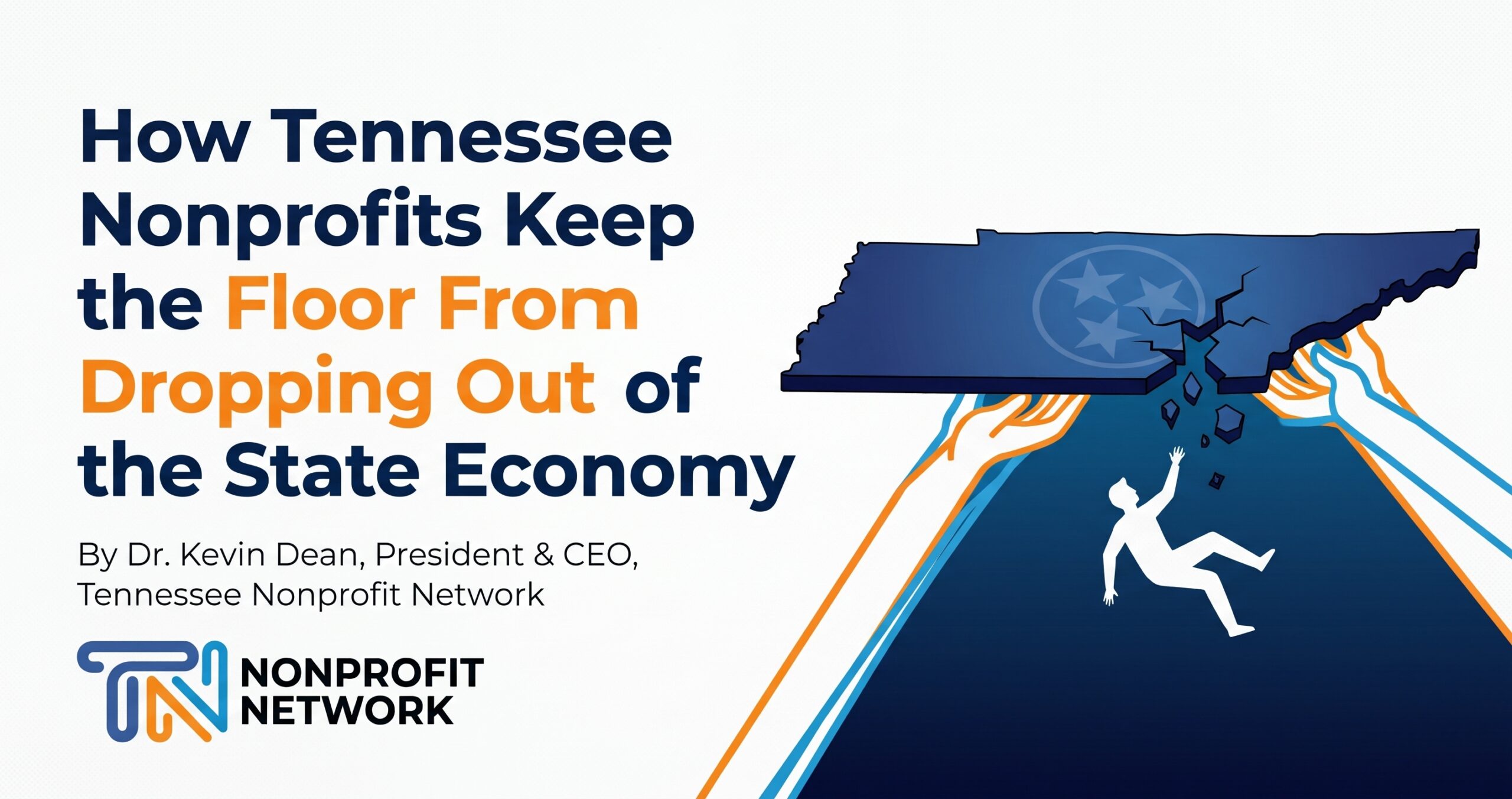
Treating Tennessee’s nonprofit sector like an optional charity project is a bit like treating the foundation of your house as a decorative accent. You can ignore it when the weather is nice, and you can certainly cut the budget for maintaining it—right up until the moment the living room floor drops into the crawlspace.