by Dr. Kevin Dean, President & CEO, Tennessee Nonprofit Network
If you pull out a map of Tennessee, you will notice something deeply impractical: our state was shaped like a long piece of geometric gum. It takes nearly eight hours to drive from the Mississippi River to the Appalachian Mountains. That is longer than it takes to drive through six whole states in New England, though to be fair, New England states are mostly the size of a standard parking lot.
I know this distance in my bones. Every time I have to drive from Memphis to Knoxville or Chattanooga for work, I am reminded of the physical expanse of our homeland. Thank God for my regular stop at Buc-ee’s in Crossville—where I can fuel up on Beaver Nuggets, buy a smoker, and lose my mind in the world’s cleanest rest stop—and my subscription to Audible, because those drives are long.
As I traverse the state, I am also reminded of how culturally distinct we are. We are broken up into three Grand Divisions—West, Middle, and East—and our major cities operate on completely different frequencies.
My Memphis aggressive directness doesn’t always work well with the “Nashville Nice” way of doing things, where everyone smiles warmly while quietly writing a polite passive-aggressive note in their head. Meanwhile, my relentless sarcasm doesn’t always land in a very earnest, forthright place like Knoxville, where people look at me with genuine concern, as if I’ve lost my way on the hiking trail of life.
Nonprofit leaders outside of Nashville love to complain about the astronomical cost of living there and the slightly “uppity” vibe the city can give off as it builds another glass tower. Meanwhile, the rest of the state seems convinced that if they step inside the city limits of Memphis, they will immediately be mugged, murdered, or forced to eat at a barbecue joint.
I have lived in Memphis my entire life—46 years of eating dry-rub ribs and dodging potholes—so I am a living testament to the fact that you will not die if you come here. I’ve also met many Nashvillians who are remarkably down to earth and not at all uppity, though I do wince every single time I pay what feels like $600 an hour for parking downtown, or get stuck on I-440 for a duration that exceeds the total runtime of Christopher Nolan’s The Odyssey.
These stories we tell about how different we are isn’t helping anyone. We are all Tennesseans, and we need to start acting like it if our sector is going to truly thrive!
For years, sector leaders across the state haven’t paid much attention to the other regions. “They aren’t like us over here,” we say, safely isolated in our own geographic silos. We assume that Knoxville’s challenges have nothing to do with Memphis’ problems, and that everyone’s struggles in Lake County are the exact opposite of what urban folks are dealing with.
That is a complete myth. And it is a costly one.
The Illusion of Separation: What the Data Actually Says
We like to believe our regional boundaries isolate our problems. The data tells a much more sobering, unified story.
When you strip away local flavor—the music, the topography, the choice of pulled pork vs. beef—the systemic pressures facing our communities look remarkably identical from the Mississippi River to the Blue Ridge Mountains.
1. The Poverty Reality
Take poverty and economic security. In Shelby County, the poverty rate hovers around 17.5%. That sounds like an urban crisis until you look at the rural counties in West and East Tennessee. Lake County, sitting right on the river at the tip of West Tennessee, faces a poverty rate of over 32%. Over in Appalachian East Tennessee, counties like Hancock and Pickett face poverty rates between 25% and 31%.
Urban or rural, West or East, the underlying math of family financial distress is identical. A single parent struggling to pay for childcare in Memphis faces the exact same economic machinery as a family struggling with underemployment in the mountains.
2. The Literacy Crisis
Consider childhood literacy. Statewide, over 21% of Tennessee adults read below a 3rd-grade level, and nearly 38% read below an 8th-grade level. In 52 of Tennessee’s Appalachian counties, more than two out of every three adults read below an 8th-grade level.
While we are rightly concerned about the reading levels of the kids on our immediate block, we sometimes forget that the reading levels on the other side of the state matter just as much to our collective future.
Here is why:
- Federal and State Funding Formulae: Federal educational block grants, workforce development dollars, and state allocations are tied directly to statewide performance metrics. When reading scores drop in one corner of the state, it drags down statewide averages, impacting federal funding streams that support programs everywhere.
- Corporate Attraction and Economic Growth: When a major employer considers moving to Tennessee—whether they are looking at BlueOval City in Haywood County, an electric vehicle plant in Middle Tennessee, or a tech hub in East Tennessee—they evaluate the overall health, literacy, and readiness of the statewide workforce pool. A talent pipeline broken in one region stifles economic development for the entire state.
We are an interconnected economic engine. If one cylinder is misfiring in Lake County or Cocke County, the whole vehicle loses horsepower on I-40.
The Hazard of Local Tunnel Vision
It is easy for nonprofit leaders to fall into the trap of hyper-local isolation. We get so overwhelmed by the fire in our own backyard that we forget to check if the fire department two towns over has invented a better hose.
Innovation does not spring eternal within the boundaries of a single neighborhood or municipality. At some point, we have to look outside our street, our community, our town, and our county to see what others are doing.
There are brilliant, highly effective programs showing real impact across Tennessee right now, and too often, we don’t even know they exist because we don’t talk across grand divisions.
A Personal Lesson in Looking Outside Your Backyard
Years ago, when I was a first-time executive director, I was facing a operational mountain that felt impossible to climb. We were struggling to scale our volunteer delivery model, and our local resources were tapped out.
Instead of trying to reinvent the wheel in isolation, I reached out to a similar organization in Nashville. I arranged an in-person meeting with their leadership—this was back before Zoom, when you actually had to drive down I-40 and navigate Nashville traffic to talk to someone.
We sat down, drank some coffee, and built a genuine relationship. That single meeting changed the trajectory of my organization.
They ended up sending their team down to train all of our volunteers using their innovative model. Armed with that new operational capacity and collaborative framework, we jointly applied for a large national grant—and won it.
Everyone won. Our clients got better services, their organization expanded its footprint, and our community received vital national funding. None of that would have happened if I had stayed inside my local shell, grumbling about “Nashville uppity ways.” And we actually paid them to train our volunteers. Imagine if they had passed on the check because they were scared of being immediately carjacked.
Policy, Power, and the Mandate for Statewide Coalitions
There is another urgent reason we must bridge our geographic divides: public policy.
For years, many nonprofits treated policy and legislative work like a radioactive substance. But advocacy has become one of the most vital tools in our toolbox. While 501(c)(3) organizations must strictly remain nonpartisan, the law explicitly allows us to lobby within statutory limits and advocate aggressively for the communities we serve.
Here is the political reality of Tennessee: you cannot achieve meaningful, statewide policy change by standing alone in one grand division.
Our General Assembly represents 95 distinct counties, ranging from high-density urban centers to deeply rural agricultural districts. If a nonprofit in Memphis wants to see systemic reform in early childhood education, housing, or mental health access, it cannot rely solely on the Shelby County legislative delegation.
To pass meaningful legislation or secure state budget appropriations, you need a coalition that spans the state:
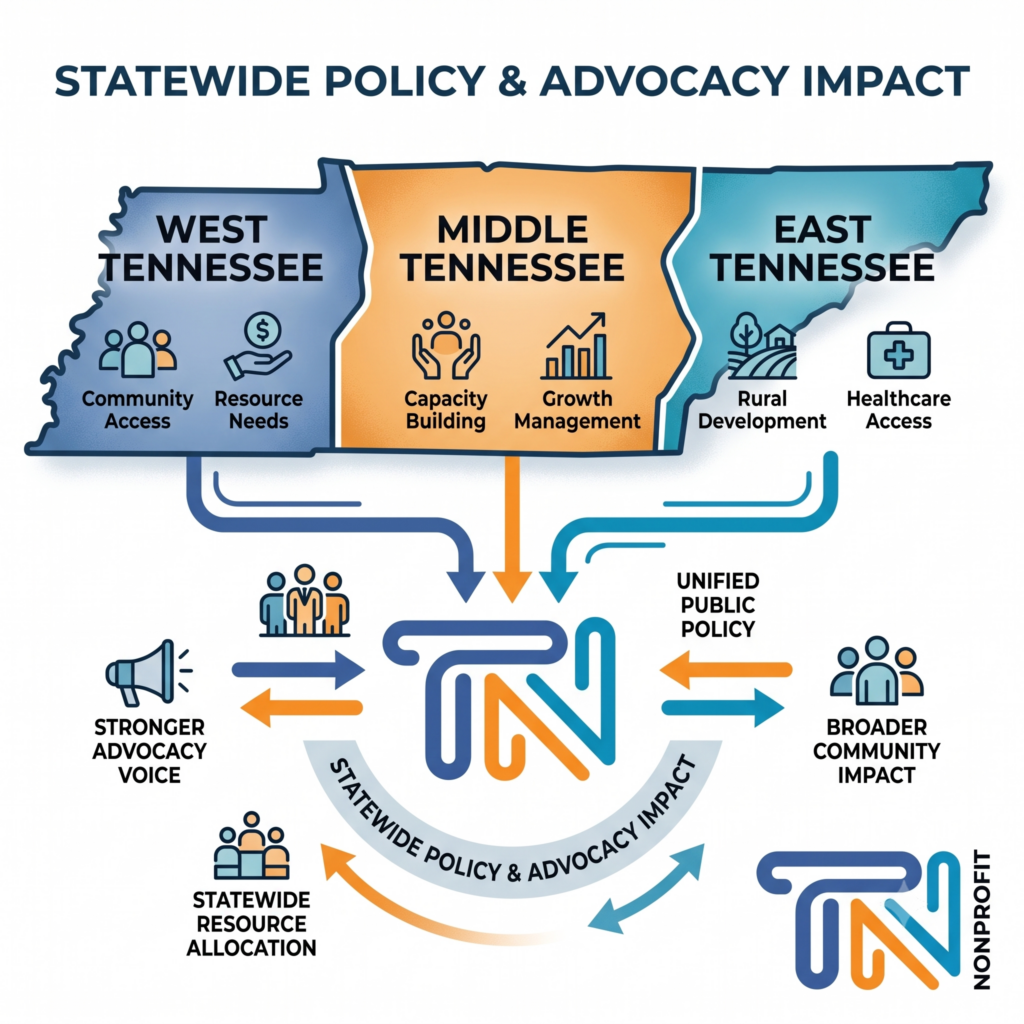
A policy push that only benefits urban centers will stall. A policy proposal that only addresses rural infrastructure will face pushback. But when a coalition of nonprofit leaders from Memphis, Jackson, Nashville, Cookeville, Chattanooga, and Knoxville walk into the Cordell Hull Building together, the dynamic changes entirely.
When lawmakers see rural and urban leaders standing shoulder-to-shoulder, holding the exact same data, advocating for the exact same policy solution, it stops being a regional squabble. It becomes a statewide imperative.
How We Lock Arms Across the 95 Counties
Breaking out of our regional silos takes deliberate effort. It requires us to trade territorialism for curiosity. Here is how we can start building a connected sector across Tennessee:
1. Practice Active Sector Curiosity
Stop assuming that an idea from another part of the state won’t work in your town. If a nonprofit in Johnson City has solved a retention issue for community health workers, call them. If a program in Jackson has cracked the code on youth workforce initiatives, ask for their playbook. Show up to state events (yes, shameless plug…like our Tennessee Nonprofit Conference) and other opportunities to connect.
2. Share Data Across Lines
We need to stop hoarding our metrics and start aggregating our story. When we present unified data on the economic impact of Tennessee’s non-profit sector—which generates billions in economic activity and employs tens of thousands of Tennesseans—we command serious attention from decision-makers.
3. Show Up for Each Other
The next time a major statewide summit, policy day, or regional training occurs, make the drive. Yes, I-40 can feel endless. Yes, you will have to sit through traffic. But the relationships built over a coffee at Honest Coffee Roasters in Nashville or a dinner at Nami in Knoxville or a cocktail at Bourbon & Barley in Jackson are the exact connections that fuel future grant applications, legislative wins, and program innovations.
We are All Tennesseans
At the end of the day, our state’s geography is long, but our shared mission is identical.
Whether we speak with a West Tennessee drawl, navigate Nashville hustle, or live in the shadow of the Smoky Mountains, we are all working to build a stronger, healthier, more equitable state. What happens in one part of Tennessee inevitably impacts us all.
So the next time you fire up your car for an eight-hour drive across the state, load up a good audiobook, map out your Buc-ee’s stop, and remember: we aren’t three separate states pretending to be one. We are single sector, 95 counties strong, and we are far better together than we ever could be apart.