By Bev Vitali PhD, Leadership and Capacity Building Fellow, Tennessee Nonprofit Network
Spoiler: you have more choice than you think, and your team and your mission are counting on you to use it.
Earlier this month, I spent a day in Gatlinburg with 35 nonprofit CEOs, talking about the one thing almost none of us are good at: protecting our own capacity.
At one point, I asked everyone to line up shoulder to shoulder along one edge of the stage. The rule was simple: take one step forward for every item I read that you had done. Then I started down my list, with items like these:
- Taken a call during your child’s baseball game?
- Walked out of a team meeting to take a call from a funder?
- Stayed late to finish a project you had already handed to someone on your team?
At first, feet shuffled forward with a few sheepish grins. A few items later, the grins gave way to embarrassed laughter. Then the laughter faded into something closer to recognition. This wasn’t just funny anymore. It was a problem. I kept reading, and the line kept moving. Before long, some of those leaders were teetering at the far edge, toes hanging over the lip of the stage. None of them landed in that precarious spot because they had done something wrong. They got there the way most of us do: one generous yes at a time, until one more step would have sent them over the edge. And every one of those steps was a choice, even if it didn’t feel like one at the time.
“I don’t have a choice”
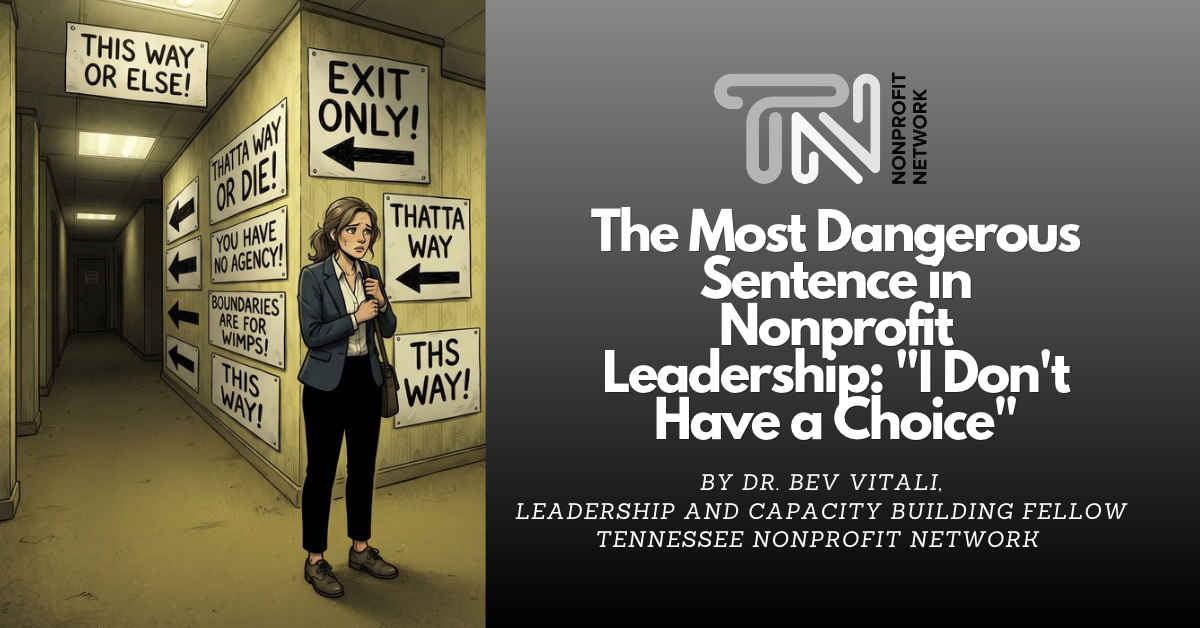
What I heard more than anything else that day was some version of “I don’t have a choice.” The board expects it. The funder needs it. There’s no one else to do it. I understand that feeling. I also know that leading while burned out is not a noble sacrifice. It costs us our health and our judgment. It costs our teams a leader who is present and clear. And in the end, it shortchanges the mission we care so much about.
It costs our people in another way, too. Christina Maslach, who has studied burnout since the 1970s, compares it to the canary in the coal mine. When the canary stops singing, you don’t send it to a resilience workshop. You fix the air in the mine. As CEOs, we may be the canary. But for our staff, we are the mine. When we run on empty, we quietly teach everyone around us to do the same.
Running on empty isn’t a lack of choices. It’s a choice we keep making by default, often without noticing. The good news is that we can choose differently, and it starts with where we draw the line.
Drawing the line with C.L.E.A.R.
Brené Brown found that the most compassionate people she studied were also the most boundaried. A boundary is simply what’s okay and what’s not okay. Without one, generosity slowly curdles into resentment.
Adam Grant’s research draws a similar conclusion. Generous people show up at both the bottom and the top of the success ladder. The ones at the bottom are what he calls “selfless” givers: they care deeply about others but give little weight to their own needs, so they keep saying yes until there’s nothing left. The ones at the top are “otherish” givers: just as generous, but they protect their own time and priorities too. The difference isn’t how much they give. It’s whether their giving has a boundary.
Still, understanding why boundaries matter is one thing. Finding the right words, especially with a board chair or a major funder, is another. So for the retreat, I developed a simple framework for saying no, or “not like this,” with clarity and care. I call it C.L.E.A.R.:
- Claim it. Own the limit: “I need…” rather than “I’m sorry, but…”
- Locate the value. Name what the boundary protects: your leadership, your team, the mission.
- Explain briefly. One sentence. A long explanation invites negotiation.
- Affirm the relationship. Make clear it’s about capacity, not about the person.
- Restate the ask or offer. End with what you can do.
Here’s what that might sound like with a board member who emails late at night expecting a same-night reply: “I want to be responsive to you, and I also need something to change. When I answer messages late, I show up less sharp for the decisions that need my full attention. I won’t be checking email after 7 p.m. on weeknights. This isn’t about you or your questions; they matter to me. If something is truly urgent, text me and I’ll call you within the hour.”
Notice what it doesn’t do. It doesn’t apologize, over-explain, or blame. It names a limit and offers a path forward. That’s generosity with a boundary: still generous, just not at the expense of the leader the organization needs.
Choosing to put ourselves first
By the end of the day, I heard something I don’t often hear from nonprofit CEOs: leaders committing, out loud, to put themselves first. Not as a step back from their teams or their missions, but as a step toward leading them well for the long haul.
So the next time you hear yourself say “I don’t have a choice,” pause and ask: What is one line I could draw this month, with my board, a funder, my staff, or myself?
You have more choice than you think. Boundaries aren’t what stand between you and your generosity. They’re what keep you on the stage, so your generosity can last for the long haul.
Sources: Adam Grant, Give and Take (2013); Christina Maslach and Michael Leiter, The Burnout Challenge (2022); Brené Brown, Rising Strong (2015).