
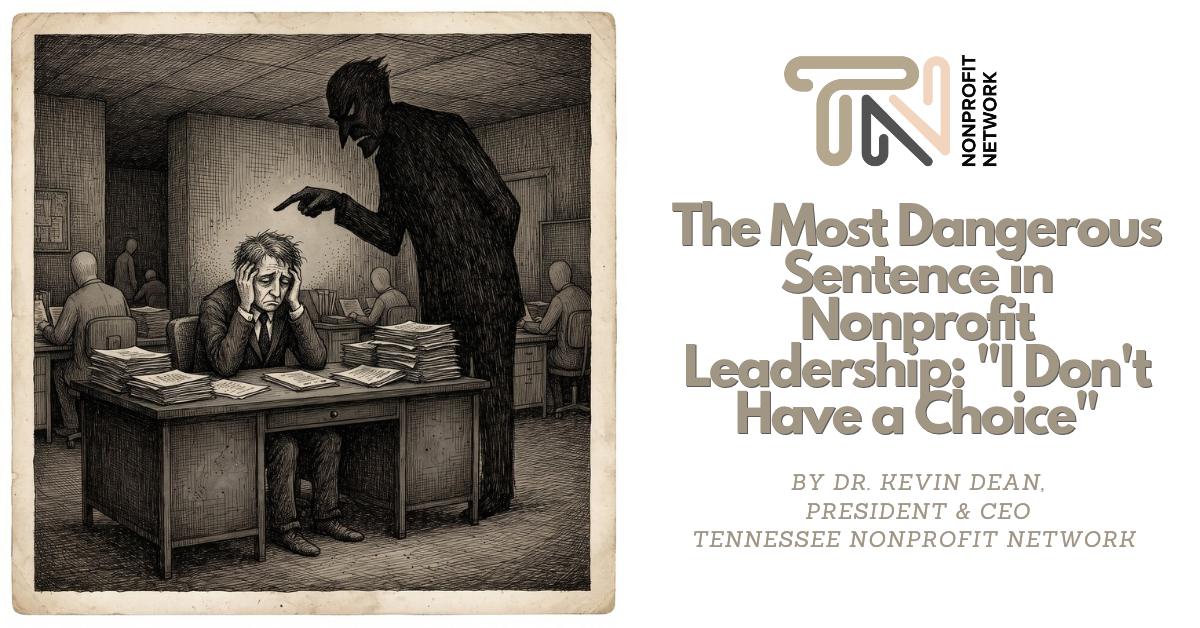
by Dr. Kevin Dean, President & CEO, Tennessee Nonprofit Network
If you work in the nonprofit sector, you probably signed up to make the world a little less terrible. You did not sign up to spend your Tuesday afternoons crying in your car because someone weaponized the word “impact” during a 45-minute monologue about your font choices.
Nonprofits have a unique talent for disguising workplace mistreatment as dedication. When the work is tied to helping people, saving animals, or strengthening communities, it becomes remarkably easy for bad behavior to hide behind good intentions. Nobody wants to be the person who complains about a hostile supervisor when there is a grant deadline on Friday and a community depending on the outcome.
What Emotional Abuse Looks Like in a Nonprofit
Emotional abuse at work rarely looks like someone throwing a stapler across a conference room. In a nonprofit, it is usually quieter, more polite, and wrapped in mission-adjacent language. It often includes:
- Weaponizing the mission: Framing basic boundaries, like taking a lunch break or logging off at 5:30 p.m., as a lack of commitment to the people you serve.
- Moving the goalposts: Changing expectations after a project is finished, then expressing deep disappointment that you cannot read minds.
- Public humiliation disguised as “coaching”: Delivering harsh, personal criticism in front of peers or board members under the banner of transparency and growth.
- Strategic exclusion: Leaving you off critical emails, uninviting you from meetings that directly affect your role, or making decisions about your department without telling you.
- Gaslighting: Insisting that a conversation never happened, that you are “too sensitive,” or that everyone else on the team is thriving under the exact same conditions.
Toxic Office vs. Abusive Office: Is There a Difference?
People use “toxic” and “abusive” interchangeably, which is understandable, much like people use “busy” and “productive” interchangeably. There is, however, a meaningful difference.
A toxic office is usually a systemic mess. It is defined by chronic disorganization, unclear roles, poor communication, unsustainable workloads, and leadership that has no idea how to manage people. Everyone is miserable, including the people at the top, and the chaos is distributed fairly evenly.
An abusive office is targeted. According to the Workplace Bullying Institute, workplace bullying is repeated mistreatment that is threatening, intimidating, humiliating, or involves work sabotage. While a toxic workplace hurts everyone through neglect or incompetence, an abusive workplace involves an intentional pattern of control, belittlement, and psychological harm directed at specific individuals. In the nonprofit world, the two often coexist: a chronically under-resourced, chaotic environment creates the exact conditions where an abusive leader can operate unchecked.
The Numbers Behind the Closed Doors
If you think this is rare in the social sector, the data suggests otherwise.
- According to the 2024 Workplace Bullying Institute U.S. Survey, 32.3% of adult Americans, roughly 52.2 million workers, report being directly bullied at work. When you include witnesses, 46% of the workforce (74.8 million people) is affected. Workplace Bullying Institute+ 1
- Top-down mistreatment remains the norm: 55% of workplace bullies are bosses or supervisors, while 29% are peers. Workplace Bullying Institute
- Accountability is lopsided. Targets have a 62% chance of losing their jobs through termination, constructive discharge, or being forced to quit, while perpetrators face negative consequences only 27% of the time. Workplace Bullying Institute
- Coworker support is bleak. Only 2% of coworkers actively intervene to support a targeted colleague. Workplace Bullying Institute
Inside nonprofits specifically, structural strain compounds the problem. A 2024 Center for Effective Philanthropy study found that 76% of surveyed nonprofit leaders reported staff burnout is impacting their ability to achieve their mission, and by 2026, leaders reporting burnout as “very much” a concern jumped to 46%. Meanwhile, sector data shows that staff shortages (53%) and role creep (44%) are top stressors, and only 45% of nonprofit professionals plan to stay in their current role.
The Toll on People and Culture
For the individual on the receiving end, emotional abuse is not something you simply leave at the office. The American Psychiatric Association notes that workplace bullying leads to insomnia, gastrointestinal distress, high blood pressure, headaches, anxiety, depression, and symptoms of post-traumatic stress disorder. Over time, targets begin to doubt their own competence, even when they have years of strong performance reviews to prove otherwise.
For the organization, the damage is equally severe. High turnover drains institutional knowledge and forces remaining staff to absorb even more work. Absenteeism rises, productivity drops, and psychological safety evaporates. When employees realize that speaking up gets them labeled “not a team player,” they stop offering ideas, stop flagging problems, and start updating their resumes. A nonprofit cannot build healthy communities externally while quietly dismantling the people who run it internally.
How to Spot Emotional Abuse at Work
Because emotional abuse thrives on ambiguity, it helps to look for patterns rather than isolated bad days. Pay attention if you notice:
- A constant knot in your stomach before specific meetings or when a particular name pops up on Slack.
- Rules that only seem to apply to you, or standards that shift depending on who is in the room.
- Feedback that attacks your character (“you are difficult”) rather than your work (“this report needs another section”).
- A revolving door in one specific department, accompanied by vague explanations about how departing staff “just weren’t a culture fit.”
- Feeling isolated from peers, as though people are friendly in private but strangely quiet when you are targeted in public.
Caring deeply about a mission does not require you to accept mistreatment as part of the compensation package. Good work deserves good leadership, and no cause on earth is served by breaking the people trying to advance it.