by Dr. Kevin Dean, President & CEO, Tennessee Nonprofit Network
If you want to witness the cutting edge of data manipulation, you do not look at Wall Street trading floors or international banking cartels. You look inside the staff supply closet at the downtown branch of the Horizon Youth Initiative on a rainy Thursday evening.
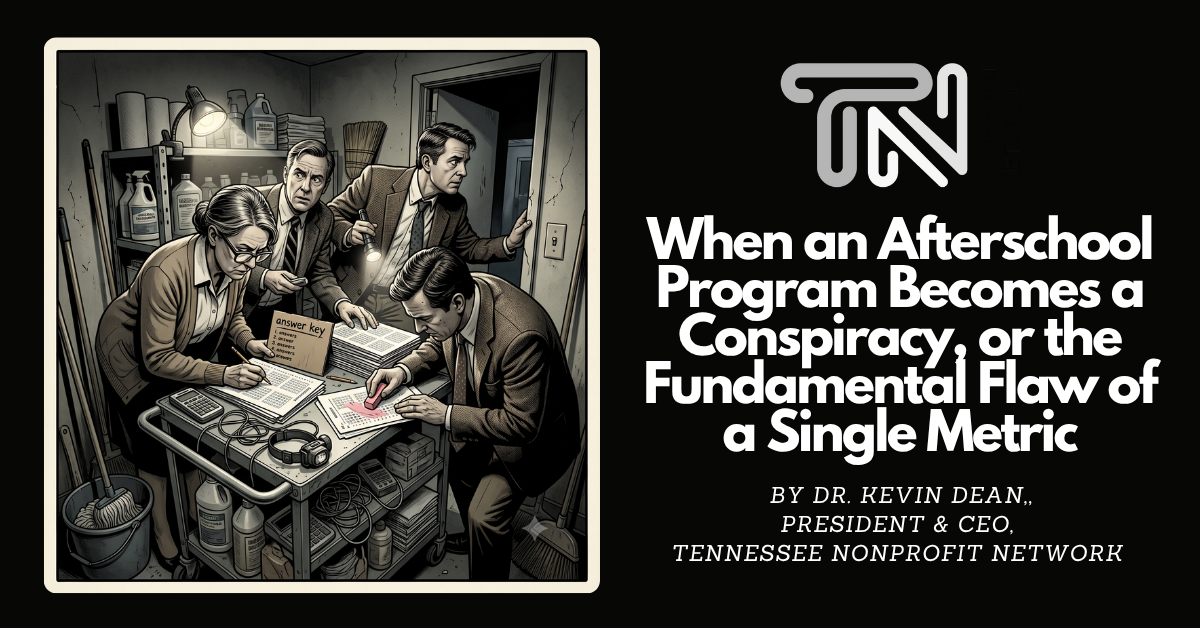
At 5:45 PM, fifteen minutes after the official conclusion of the daily afterschool literacy enrichment program, the epicenter of institutional panic was hidden behind boxes of bulk-ordered construction paper and defective glue sticks. Three full-time program coordinators were huddled over a row of cheap tablets, their thumbs moving across the touchscreens with the frantic speed of competitive gamers. Outside the closet, thirty-five elementary school students were eating processed cheese crackers under the loose supervision of a single volunteer. Inside, the staff was running a covert data ring. Yes, a conspiracy had formed, and it was like the nonprofit version of a heist movie.
Sarah, a program coordinator holding a master’s degree in child development, was rapidly tapping through a digital quiz titled Module 7: Advanced Phonetic Synthesizing.
Marcus, keep an eye on the door, she whispered, without breaking her typing rhythm. If the regional director comes back from her meeting, tell her we are doing an inventory of the safety scissors.
Marcus did not look up from his own screen. “I can’t look at the door. I’m currently logged in as an eight-year-old named Malik, and if I don’t pass this comprehension module on the first try, our site’s average mastery score drops below ninety-two percent.
Across the room, their colleague Elena was cursing under her breath. “This ****ing third-grade reading comprehension passage is about the agricultural practices of ****ing ancient Mesopotamia. Why are we testing eight-year-olds on the Tigris and Euphrates?”
“Because,” Sarah muttered, “the family foundation that gave us four hundred thousand dollars hired an external evaluation consultant who believes that Mesopotamia is the key to closing the achievement gap. Now stop talking and start reading. We have twelve more children to impersonate before the database portal closes at midnight.”
The Perfect Metric and the Impossible Reality
The crisis at the Horizon Youth Initiative did not begin with bad intentions. It began three years earlier with a pristine, color-coded dashboard presented in a glass-walled conference room.
The organization had secured a multi-year grant from the Vanguard Philanthropy Group, a funder deeply committed to what they called data-driven venture altruism. The Vanguard trustees were tired of hearing stories about children feeling safe, making friends, or learning to love books. They wanted hard numbers. They wanted to see a measurable return on their philanthropic investment.
After six months of committee meetings, logic models, and theory-of-change mapping, both parties agreed on a single, definitive metric of success: The Digital Literacy Aptitude Index, or DLAI.
The agreement was simple. Every child enrolled in the afterschool program would use a proprietary tablet app for thirty minutes a day. The app would assess their progress through ninety-six distinct modules. By the end of the fiscal year, ninety percent of the participants had to demonstrate advanced mastery. If the organization hit the target, the grant would be renewed with a ten percent bonus. If they missed it by even a single percentage point, the funding would evaporate, the staff would be laid off, and the neighborhood afterschool program would cease to exist.
To the business executives sitting on the Vanguard board, this seemed like an elegant exercise in accountability. It took a complex, messy social problem—intergenerational educational inequality—and reduced it to a single, easily trackable figure that could be viewed on a mobile device during a weekend retreat.
To the front-line staff on the ground, it was a slow-motion catastrophe.
The software was designed for compliant children sitting in quiet rooms with high-speed internet connections. The Horizon program operated in a rented church basement where the Wi-Fi dropped whenever someone used the microwave, and the participants were seven-year-olds who had already spent seven hours sitting still in a public school classroom.
When handed the tablets, the children did not systematically synthesize phonetics. They tried to use the plastic cases as skateboards, pressed the volume buttons until the devices muted, or simply clicked the first multiple-choice option on every question until the app locked them out.
By February, the mid-year report revealed that only fourteen percent of the students were achieving advanced mastery. The regional director panicked. She held a mandatory staff meeting and delivered a clear, unvarnished message: the numbers must go up, or everyone should update their resumes.
The staff did what any rational group of human beings does when faced with an impossible demand coupled with the threat of immediate unemployment. They stopped focusing on teaching children how to read, and they started focusing on how to beat the system.
The Mechanics of the Hustle
The cheating began small. A coordinator would sit next to a struggling child and point directly to the correct answer on the screen. It was technically an infraction of the testing protocol, but it felt like an act of survival.
When that proved too slow, the staff graduated to collective testing. A coordinator would stand at the front of the room with a whiteboard, writing down the answers to the modules while thirty children tapped simultaneously.
The final evolution was the supply closet operation. The children were completely removed from the equation. It was cleaner, faster, and did not require convincing a room of tired third-graders to care about Mesopotamian irrigation systems. The staff developed a rotation system. Two coordinators would supervise the playground, while the third would slip downstairs to act as a phantom army of high-performing eight-year-olds.
By May, the data dashboard looked miraculous. The Horizon Youth Initiative was reporting a ninety-six percent advanced mastery rate. The Vanguard Philanthropy Group was overjoyed. They featured the program in their annual report, praising the nonprofit for its relentless focus on measurable outcomes.
The undoing of the conspiracy came down to a matter of statistical probability.
An junior data analyst at the foundation was reviewing the raw log files for the final evaluation report. He noticed an unusual pattern in the timestamp data. According to the server records, a seven-year-old child named Dante had completed a forty-five-minute critical thinking assessment in eleven seconds. Furthermore, Dante had maintained this superhuman pace across six consecutive modules, all of which were completed between 6:15 PM and 6:18 PM on a Friday evening.
A deeper dive into the metadata revealed that thirty-two different children, representing widely divergent initial reading levels, were all completing advanced modules at identical speeds, utilizing the exact same IP address, which was traced directly to a router labeled Janitor Closet Router 2.
The fallout was swift. The funding was pulled, the executive leadership resigned, and the local newspaper ran a prominent feature article detailing how an organization dedicated to youth development had essentially run a digital sweatshop for fraudulent test scores.
The Social Science of the Closet: Campbell’s Law
The temptation when reading about a situation like the Horizon Youth Initiative is to blame the character of the individuals involved. It is easy to view Sarah, Marcus, and Elena as cynical actors who lacked personal integrity.
But that interpretation completely misses the point. The staff at Horizon were not necessarily corrupt people; they were people placed in a corrupt system. Sure, what they did was morally questionable, but so was the metric. They were caught in the grip of a well-documented social phenomenon known as Campbell’s Law.
Formulated in 1976 by the social scientist Donald T. Campbell, the principle states that the more any quantitative social indicator is used for social decision-making, the more subject it will be to corruption pressures and the more apt it will be to distort and corrupt the social processes it is intended to monitor.
In simple terms: when a measure becomes a target, it ceases to be a good measure.
Human systems are highly adaptive. When you tell an individual or an organization that their survival depends entirely on making a specific number move in a specific direction, they will make that number move. Whether the actual reality behind the number changes is entirely secondary. If the easiest way to change the number is to improve the program, they will try to do that. But if the system makes actual improvement impossible, they will find another way to manipulate the data.
This distortion pressure occurs across every sector of human activity where metrics are weaponized:
- If you judge a police department solely on the number of arrests made, officers will stop investing in community relationship building and start arresting citizens for low-level, easily prosecutable offenses.
- If you judge an emergency room solely on waiting times, hospital staff will reclassify waiting areas as observation beds to stop the clock, without actually seeing patients any faster.
- If you judge corporate sales representatives entirely on the number of new client accounts opened, they will open accounts for fictional businesses to hit their targets.
The tragedy of the single metric is that it fundamentally destroys the very thing it is trying to measure. In the case of Horizon, the fixation on the literacy index destroyed the actual literacy program. Hours that should have been spent reading stories aloud, helping children sound out words, or fostering an environment where books felt joyful were instead sacrificed to the frantic maintenance of a digital facade.
The Strategic Errors of Modern Funding
The Horizon scandal provides a case study in how the current philanthropic funding model actively encourages data fraud. Nonprofits operate within an ecosystem where funders hold almost all the financial leverage. This imbalance creates three distinct structural vulnerabilities that lead directly to the tyranny of the single metric.
The Illusion of Simplicity
Many funders enter the social sector from the worlds of finance, technology, or corporate management. They bring with them an understandable desire for clarity and efficiency. In a business context, success can often be tracked via a few core indicators: net profit margins, customer acquisition costs, or shareholder return.
When these individuals transition to philanthropy, they attempt to apply the same conceptual framework to social problems. They demand a single, elegant metric that can summarize complex human behavior.
But human development is not an assembly line. You cannot run a neighborhood through an algorithm and get a predictable output. An afterschool program is dealing with children who may have skipped lunch, whose families might be facing eviction, or who are coping with learning differences that do not map onto a standardized digital app. To pretend that all of these shifting, chaotic variables can be captured by a single percentage point is an act of intellectual arrogance.
The Bureaucratic Displacement of Mission
When a quantitative indicator is tied to funding renewal, the internal culture of a nonprofit shifts almost overnight. The compliance department becomes more important than the program department.
At Horizon, the program coordinators spent an estimated forty percent of their working hours managing the tablet software, troubleshooting log-in errors, creating data recovery spreadsheets, and generating compliance reports. This is time that was directly stolen from the children.
The organization gradually stopped being a youth development agency and transformed into a data collection engine designed to satisfy a distant funder. The ultimate goal was no longer to help a child navigate the world; the ultimate goal was to ensure the child completed the daily digital assessment loop.
The Incentive for Creaming
Perhaps the most insidious consequence of the single metric is that it forces nonprofits to abandon the very people who need them most. This process is known in sociology as creaming or cherry-picking.
If an organization is required to hit a ninety percent success rate to survive, it cannot afford to take risks. If a child enters the afterschool program with severe behavioral trauma, a total lack of foundational literacy skills, or a chaotic home life that causes frequent absences, that child represents a direct threat to the organization’s funding.
The rational, survival-driven response for the nonprofit is to deny that child admission. Instead, they will recruit children who are already relatively stable, whose parents are highly involved, and who are likely to score well on the assessment anyway. The organization hits its target, the funder gets a beautiful report, and the most vulnerable population in the community is left completely unserved.
A Framework for Sanity: Lessons for Nonprofits and Funders
If the social sector is to avoid future supply-closet conspiracies, both the organizations doing the work and the institutions writing the checks must change how they define accountability. True evaluation requires moving away from the lazy reliance on single quantitative targets and embracing a more sophisticated approach to measuring human progress.
1. Build Multi-Dimensional Evaluation Portfolios
No single data point should ever have the power to destroy an organization. High-stakes testing is as destructive in the nonprofit sector as it is in the public education system. Instead, evaluation must be treated as a portfolio of diverse indicators. A healthy evaluation system must balance three distinct categories of data:

If the Vanguard Philanthropy Group had used a portfolio approach, they would have looked at Horizon’s perfect digital test scores alongside the fact that staff turnover was sixty percent and parent satisfaction was dropping because children hated the tablet sessions. The anomalies would have been caught early, not as a criminal scandal, but as a programmatic misalignment.
2. Funders Must Invest in the Process, Not Just the Dashboard
Accountability cannot be outsourced to an app. If a funder wants to know if their investment is working, they need to leave the boardroom and look at the actual operation.
They need to ask better questions:
- Are the children safe, fed, and supervised by stable, emotionally regulated adults?
- Is the staff-to-student ratio low enough to allow for meaningful human connection?
- Does the organization have the community trust required to retain families over multiple years?
These factors are difficult to quantify, they do not fit neatly into a spreadsheet, and they cannot be viewed on a real-time data dashboard. But they are the actual foundation of social impact. A funder who understands the reality of the work knows that a program with a seventy percent attendance rate and a deeply dedicated staff is infinitely more valuable than a program with a ninety-nine percent digital mastery rate achieved by terrified employees huddled in a closet.
3. Nonprofits Must Practice the Courage of Rejection
The ultimate responsibility for preventing data corruption lies with nonprofit leadership. Executive directors and board members must stop signing contracts that require them to promise miracles they cannot deliver.
When a funder presents an unrealistic, metric-obsessed grant agreement, the organization must have the institutional courage to negotiate or walk away. It is better to operate a smaller, underfunded program with integrity than to run a massive, well-endowed initiative built on a foundation of structural dishonesty.
When leaders capitulate to absurd metric demands, they are not protecting their organization; they are volunteering their front-line staff for a high-stress game of survival that invariably leads to ethical compromise.
The Messy Reality of Change
The downtown branch of the Horizon Youth Initiative is under new management now. The tablets are gone, packed into cardboard boxes and stacked in the corner of the basement, where they serve as an expensive reminder of a failed era.
On a recent afternoon, the main hall was loud, chaotic, and entirely unmeasurable. A group of third-graders was sitting in a circle, taking turns reading a dog-eared picture book about a dragon. They were not moving through digital modules. They were stopping to look at the illustrations, arguing about whether dragons can breathe underwater, and occasionally dropping their cheese crackers on the carpet.
An external data analyst looking at the room would have found very little to log into a database. There were no real-time progress bars, no aptitude indices, and no optimized outcome projections.
But if you looked closely at the far corner, you would see a child who had refused to speak to any adult for the first three months of the school year. He was sitting next to a new program coordinator, quietly pointing to a picture of a green dragon and trying to sound out the word wing.
It was a small, fragile, non-linear piece of human progress. It was messy, it was slow, and it was completely real. And most importantly, nobody had to lock themselves in a supply closet to make it happen.