
by Dr. Bev Vitali, Leadership and Capacity Fellow, Tennessee Nonprofit Network
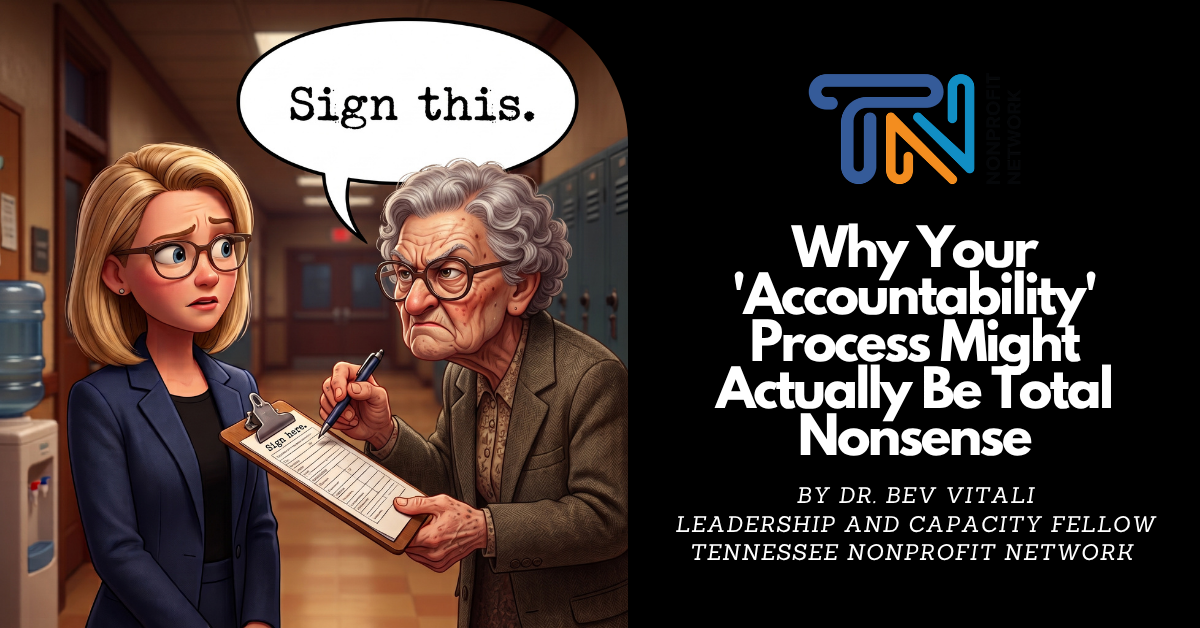
I was standing in the hallway at a past employer, catching up with a coworker, when my supervisor walked up, handed me a clipboard, and said, “Sign here.”
It was my annual review. Not a conversation — a signature. She’d written it up, printed it, and caught me in the hallway to sign. No sit-down. No “here’s what stood out to me this year — can we talk through it?” Just a form and a pen, and the expectation that I’d sign and go on with my day.
So… I signed it. And I remember standing there afterward, still holding the pen, wishing she had simply told me what she’d actually observed — what had gone well, what hadn’t, and why it mattered.
That moment has stayed with me longer than almost any specific piece of feedback I’ve ever received — because there wasn’t any. What I got instead was something crossed off her to-do list. What I needed was an honest account of what she’d seen.
What Was Actually Missing
It would be easy to file this away as a story about a bad boss, or a single rushed afternoon. But the more I’ve sat with it over the years — and the more nonprofit leaders I’ve since trained — the more I’ve come to believe the hallway wasn’t the failure. The hallway was just where the failure became visible.
The real failure had happened months earlier, in every conversation that didn’t take place. My supervisor never told me, in the moment, what she noticed — what I’d handled well, what had missed the mark, or what it meant for the team. The review wasn’t a moment of accountability. It was the absence of accountability, formalized and printed on letterhead.
That’s the trap so many managers fall into, and I don’t think it comes from indifference. Most of the nonprofit managers I’ve trained care deeply about their people. But they’ve inherited a model of accountability that treats it as an event: something that happens once a year, gets documented, gets signed, and gets filed. When accountability is treated as an event, it becomes something done to people rather than something built with them.
Accountability Is a Relationship, Not a Record
Here’s the reframe I’d offer, born out of that hallway and confirmed by nearly every leadership engagement I’ve had since: real accountability isn’t the review. It’s the ongoing practice of naming what’s happening — good and bad — while there’s still time to do something about it.
A signature on a form can capture what happened. It can’t capture why, what it meant, or whether the person signing still trusts their manager is actually paying attention. Those things only happen in dialogue — the kind that happens across a year, not in the thirty seconds it takes to catch someone in a hallway.
I’ve seen this play out from the other side, working alongside nonprofit executive directors and their staff. Employees would often tell me they knew what was expected of them, but no one ever told them how they were actually doing against it — until the year-end paperwork showed up. Accountability had become something that happened to them once a year, instead of an ongoing conversation about where things stood.
What Accountability Looks Like Done Well
The organizations and leaders I respect most treat accountability as a practice, not a paperwork cycle. A few things distinguish them:
They build in regular, low-stakes check-ins. Not a formal review — a fifteen-minute conversation, held often enough that no single conversation carries all the weight. Problems get named while they’re still fixable, not after the fact.
They make it two-way. Accountability isn’t just a manager assessing an employee. The best conversations I’ve been part of include the employee naming what they need from their manager, too. Documentation becomes a record of a dialogue — not a substitute for one.
They separate evaluation from the ongoing conversation. Compensation and performance ratings will always require some formal documentation. But naming what’s actually happening, in real time, deserves its own space — not five rushed minutes tacked onto a compliance form once a year.
They ask before they tell. The simplest shift a manager can make is starting these conversations with a question instead of a conclusion: Can I share something I noticed? It costs nothing and changes everything about how the rest of the conversation lands.
One framework I’ve developed to teach leaders how to have these conversations is PRICE — a structure for the accountability conversations that should have been happening all along:
- P – Permission — asking if it’s okay to share something. It’s not that a manager needs permission to give feedback — it’s that asking lowers the brain’s threat response, keeping the listener out of fight-or-flight long enough to actually take in what’s said.
- R – Reality — naming what actually happened, without spin. Sticking to specifics rather than generalizations keeps the conversation about the situation, not the person’s character.
- I – Impact — what your behavior meant to the work or the team. This is what turns an observation into something worth talking about — without it, “reality” is just a list of events.
- C – Curiosity — not a step in this process as much as a posture that runs through the whole conversation: the willingness to ask rather than declare. Questions invite the other person into the conversation instead of putting them on the receiving end of a verdict.
- E – Explore — working out together what happens next. Landing on next steps collaboratively makes the other person a participant in the outcome, not just a recipient of it.
Notice what’s missing from that list: a form. A signature line. A clipboard in a hallway.
Back to the Hallway
I think about that hallway more than I probably should. Not with resentment — I’ve long since let go of that — but because it taught me, early and viscerally, what accountability is not. It is not a clipboard. It is not a signature. It is not something you can hand someone in a hallway.
If I could go back and say something to that manager now, it wouldn’t be about the review itself. It would be this: I wasn’t asking you to tell me I was good. I was asking you to tell me what you actually saw. I was asking for you to help me grow.
Is someone on your team standing in the hallway right now, waiting to be handed something to sign? You can change what happens next.