
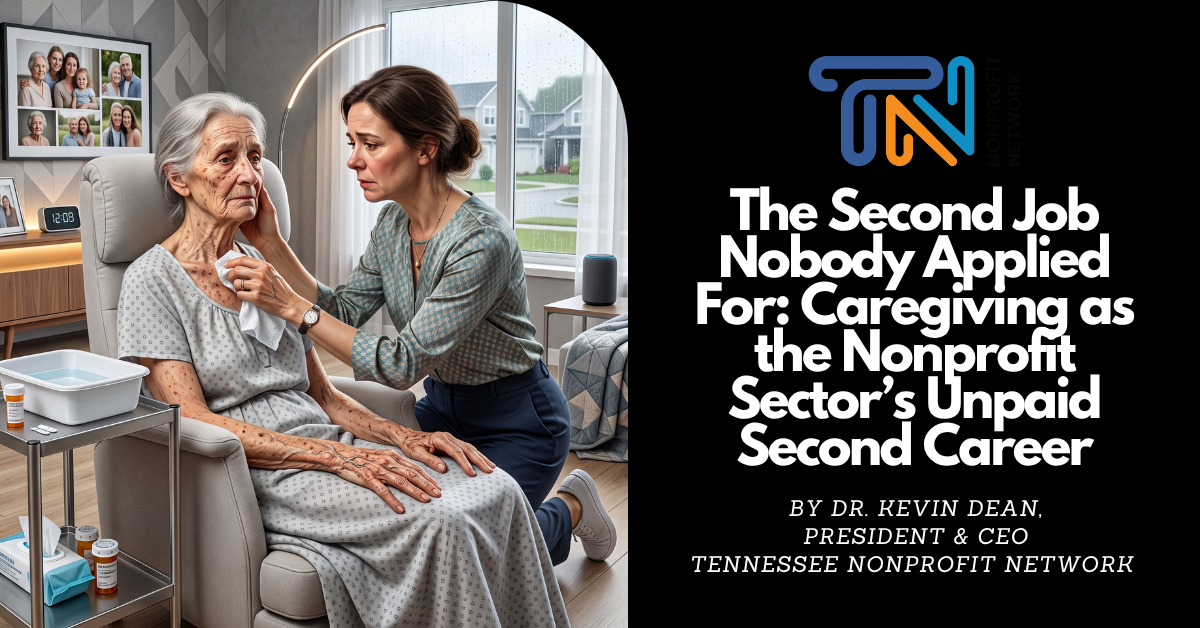
by Dr. Kevin Dean, President & CEO, Tennessee Nonprofit Network
Every few months, a well-rested productivity consultant will post a diagram explaining that an orderly life divides neatly into three equal eight-hour blocks: eight hours for professional labor, eight hours for sleep, and eight hours for personal rejuvenation. It is the kind of clean math that only makes sense if you have never had to manage a staff budget while coordinating a home health aide’s arrival schedule, or if your household chores magically resolve themselves while you sleep.
That neat schedule has always been completely disconnected from reality in the nonprofit world. Staff members already stretch modest budgets, juggle multiple job titles before noon, and attend evening community meetings that feel like a town hall meeting out of Parks and Recreation. But over the last several years, another demand has quietly expanded into whatever spare bandwidth was left. It is caregiving, and for a huge portion of the workforce, it has become a relentless, round-the-clock second career.
We are a sector built on care, yet we rarely have honest conversations about how domestic caregiving is essential, astronomically expensive, and deeply debilitating. We spend our workdays designing community safety nets and managing social support systems, while privately struggling under the weight of our own domestic responsibilities, often with no safety net of our own to lean on. I absolutely understand this weight: I’ve been doing it now for years, and 2026 has been especially hard.
The Financial Arithmetic of Institutional Care
To understand why so many kitchen tables have been turned into secondary triage stations, you only have to look at the numbers behind long-term institutional care.
If you have ever had to research the price of placing an aging parent or relative into a reputable assisted living facility, the experience feels a lot like walking into a luxury car dealership with twenty dollars in your wallet. Nationally, the median cost of an assisted living facility hovers around $5,900 to $6,200 a month, which works out to roughly $71,000 to $74,000 a year. If your family member develops dementia and requires a secure memory care unit, that monthly bill routinely shoots past $8,000.
Now look at what the average nonprofit employee has saved for retirement. Across the nonprofit and human services sector, where compensation has historically lagged behind the private market, the median retirement savings for a worker is roughly $38,000.
Let the sheer absurdity of that comparison settle for a second. If a typical nonprofit employee emptied their entire life’s retirement account down to the very last dollar, it would purchase approximately six and a half months of basic assisted living care for one relative before every cent was gone. That assumes they do not buy groceries, do not pay their own rent, and do not need a single prescription during that half-year. For almost everyone working in community-based organizations, outsourcing care to a facility is simply off the table. It is mathematically impossible.
Policy Gaps, Flat Wages, and the Cost of Living
This economic reality is made much harsher by the wider policy environment. The cost of living continues to climb, and housing prices in most cities make finding an affordable home feel like winning the lottery. At the same time, nonprofit wages have remained largely flat, hemmed in by restrictive grant funding agreements and philanthropic norms that penalize organizations for operational overhead.
Public policy, meanwhile, treats domestic care as a private inconvenience rather than a basic public infrastructure need. The United States remains one of the few industrialized nations without universal paid family and medical leave. Government programs like Medicaid will help cover long-term care only after a family has spent itself down to the point of near-destitution, navigating a maze of five-year asset lookbacks and extensive waiting lists. When public systems fall short and private care is priced out of reach, the family living room becomes the only eldercare facility left.
Four Generations Under One Roof and Kinship Care
This dynamic is why so many households are expanding into multi-generational hubs, not out of trendiness, but out of necessity.
Take my friend Sarah, who works full-time as a nonprofit program director while managing four generations under a single roof. On any given Tuesday morning, Sarah’s house is a high-wire act of competing human needs. Her eighty-eight-year-old grandmother needs help navigating the hallway with a walker and sorting six different morning prescriptions. Her mother, recovering from a severe stroke, needs hands-on help getting dressed and completing physical therapy exercises. Meanwhile, Sarah is seated at the dining room table trying to facilitate a board committee meeting over Zoom, angling her laptop camera just right to crop out the boxes of medical supplies stacked against the wall.
Down the hall, Sarah’s teenage daughter is getting ready for school, while in the den, Sarah is caring for her cousin’s three-year-old toddler. When her cousin lost her apartment six months ago, Sarah took the child in to ensure he would not enter the foster care system.
In Sarah’s living room, a plastic tricycle regularly bumps into an aluminum walker, while Sarah edits a grant proposal with one hand and cuts soft fruit into bite-sized pieces with the other.
Then there is Marcus, a nonprofit development director who stepped in to take custody of his two young grandchildren when his adult daughter entered an intensive rehabilitation facility. Marcus thought his days of buying diapers, packing lunchboxes, and attending parent-teacher conferences were decades behind him. Instead, he spends his lunch breaks meeting with school counselors and his evenings reading bedtime stories, followed by two hours of writing donor appeal letters late into the night.
People are not taking in their grandchildren, their cousins’ toddlers, or their aging parents out of a sudden desire for communal living. They are doing it because childcare costs can rival college tuition, because family members are falling through systemic cracks, and because walking away is simply not an option.
The Terrifying Reality of Mental Health and Addiction Care
Caregiving is often portrayed in soft-focus commercials as a gentle, heartwarming series of quiet moments by a sunny window. Anyone who has cared for a loved one living with severe mental illness or substance use disorder knows that the reality is entirely different: it is genuinely terrifying. I know this from experience.
Living with someone in the middle of active addiction or a severe psychiatric crisis is a daily exercise in raw fear and constant hyper-vigilance. It means sleeping with one ear open, dreading what sound you might hear in the hallway at two in the morning, and dreading the silence even more when you do not hear anything at all. It means finding hidden paraphernalia behind the bathroom cabinet and feeling your stomach drop. It means hoping that they’re still breathing as you check someone’s chest in the middle of the night.
It means navigating acute manic episodes, deep clinical depression, or psychosis where you have to make impossible choices in a split second: do you call emergency services and risk a dangerous confrontation, or do you try to de-escalate the crisis yourself while keeping everyone else in the house safe? You spend evenings hiding car keys, locking away household medications, and driving down dark streets looking for someone who walked out the door in an altered state.
The next morning, you log into your staff meeting, put on a calm face, and debate the formatting of an upcoming newsletter, all while your chest is still tight from the adrenaline of the night before. You carry the sustained shock of a medical crisis in total secrecy, knowing that the stigma around mental health and addiction makes it almost impossible to talk about openly with colleagues.
A Legacy Born from the Void
The irony of nonprofit staff struggling under domestic caregiving is that the nonprofit sector itself was originally founded on hands-on care work.
When Clara Barton organized the American Red Cross in 1881, she was stepping directly into a void left by institutional neglect. Seeing the total breakdown in medical care and basic supplies for wounded soldiers and disaster victims, she recognized that organized civil society had to mobilize where formal government systems failed.
Decades later, during the Great Depression, Dorothy Day and Peter Maurin founded the Catholic Worker Movement and opened houses of hospitality. Day’s radical idea was that shelter, food, and human care were not cold administrative services to be handed off to distant bureaucracies. They were personal, everyday responsibilities that human beings owed to one another in community.
Throughout the nineteenth and twentieth centuries, early settlement houses provided child care for working mothers, mutual aid societies pooled small change to ensure neighbors received a dignified burial, and community clinics treated patients turned away from private hospitals.
Yet as the modern sector grew more professionalized, care work was gradually pushed into the background. Society began treating care as an infinite, free resource that families and mission-driven workers would provide endlessly, quietly absorbing every financial and emotional shock without complaint.
How Organizations Can Make Caregiving Easier
If nonprofit leaders want to retain great people and prevent burnout from hollowing out their teams, we have to move beyond thirty-minute webinars on self-care and generic emails about work-life balance. Organizations need to make practical, structural changes:
- Measure Output, Not Desk Time: Evaluate staff members on the quality and timeliness of their work rather than the exact hours they spend sitting in a chair. If a program manager needs to take a parent to an oncology appointment on Tuesday morning and finishes their reports at eight that night, let them do so without requiring special explanations or apologies.
- Expand Leave Policies Beyond the Nuclear Family: Traditional bereavement and family leave policies often define family through a very narrow lens. Modern policies should reflect the reality of today’s households by covering grandparents, grandchildren, nieces, nephews, cousins, and chosen family.
- Normalize Asynchronous Communication: Caregivers cannot always guarantee uninterrupted availability during standard office hours. Shifting routine project updates and questions to asynchronous channels allows staff to respond when their caregiving duties permit, rather than interrupting urgent family care for a meeting that could have been handled in writing.
- Dismantle the Martyrdom Expectation: Leaders need to model healthy boundaries by avoiding after-hours emails and being honest about their own family responsibilities. When leadership is open about doctor visits, eldercare needs, and school pickups, it removes the stigma for staff who are quietly struggling.
Practical Empathy: How We Show Up for Each Other
On an individual level, we also need to rethink how we support friends and coworkers who are carrying heavy caregiving loads.
The standard response when a friend is going through a hard time is to say, “Let me know if you need anything.” While well-intentioned, that phrase puts the work of project management right back on the person who is already exhausted. A caregiver rarely has the mental bandwidth to take an inventory of their needs, come up with a task list, and assign chores to others.
If you want to offer real support, focus on removing the friction:
- Offer Specific, Low-Friction Help: Drop off a meal in a disposable container so they do not have to worry about washing and returning a dish. Offer to sit with their family member for two hours on a weekend afternoon so the caregiver can leave the house and take a walk. Offer to pick up groceries or run a specific errand.
- Give Grace Without Guilt: If a caregiving friend takes days to answer a text or has to cancel dinner plans at the last minute because a family situation flared up, do not take it personally. Send a brief message letting them know you care about them, with an explicit note saying they do not need to reply.
- Listen Without Giving Advice: Caregivers are constantly given unsolicited medical advice, diet tips, and holistic remedies by well-meaning acquaintances. What they usually need is not another article to read or a new supplement to research, but a trusted friend who will listen to their fears and frustrations without trying to fix everything.
Caregiving is demanding, unglamorous, and often deeply isolating work. It is sustained by millions of people who wake up tired, manage domestic emergencies all day, and keep going because their families have nowhere else to turn. Acknowledging that caregiving is a demanding second job—and meeting it with honest conversation, sensible workplace policies, and genuine empathy—is the least we can do for the people who spend their lives holding everyone else together.