
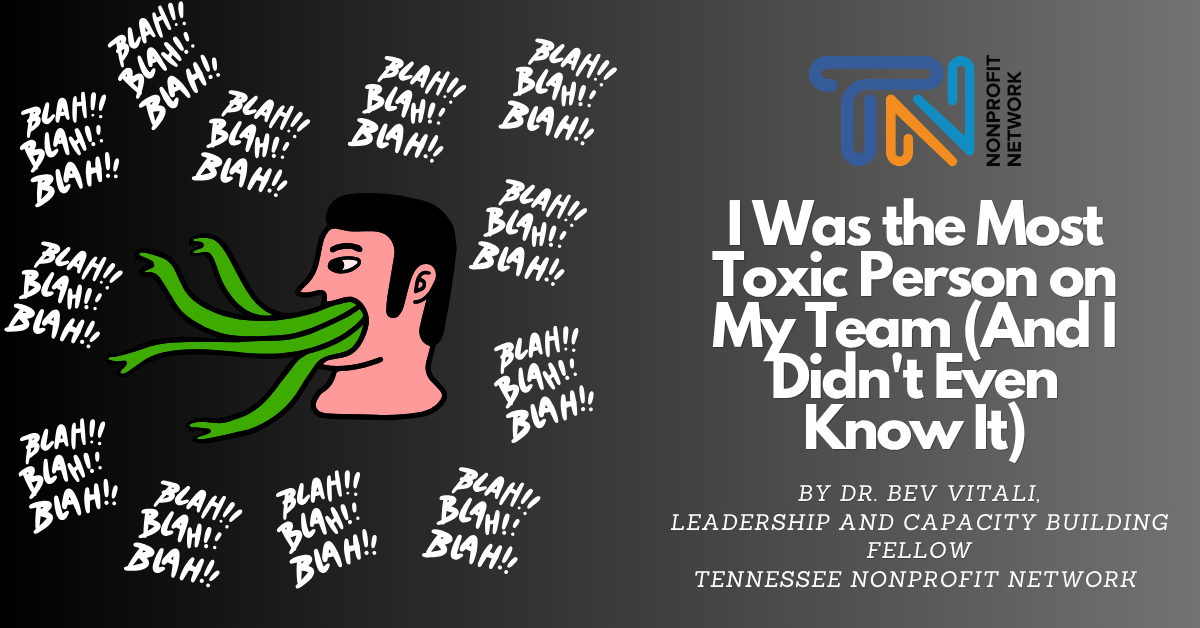
by Dr. Bev Vitali, Leadership and Capacity Building Fellow, Tennessee Nonprofit Network
“If you don’t have anything good to say about someone, come sit by me.”
That was basically the unspoken culture at an organization I once worked for — one going through a lot of change. The gossip was rampant, and I understood why: change makes people uncertain, and uncertain people look for something solid to hold onto, even if that something is a rumor. I wasn’t just watching it happen, either. I was right in the middle of it, trading rumors like everyone else. Some of what we were spreading around was even true. That was beside the point. What mattered was the toxicity it created, and how that toxicity made an already hard season of change so much worse.
I remember driving home some days feeling like the day had left something on me I couldn’t wash off. I knew what I was doing wasn’t helping anyone — not the organization, not my colleagues, not the change we were supposedly trying to get through together.
Since then, I’ve paid attention to what researchers have found about gossip and its effects on leaders and organizations. Looking back, what strikes me most is how ordinary it all felt in the moment. Nobody thought of themselves as spreading gossip. We thought of ourselves as caring, or venting, or just trying to make sense of a confusing time. That’s what makes gossip such a stubborn habit for leaders to break: it rarely shows up looking like what it is. It shows up dressed as something else entirely.
We Don’t Call It Gossip Anymore
Nobody on your team walks into your office and says, “I’d like to gossip about a colleague.” Instead, we hear:
- “I’m just processing.”
- “I’m just concerned.”
- “I just think you should know.”
- “I just need to vent.”
- “I’m not trying to start anything, I just…”
Each of those phrases can be completely legitimate. They can also be gossip with better PR. The tell isn’t the language — it’s the intent and the audience. A useful (and uncomfortably direct) definition: gossip is discussing someone’s faults or flaws with someone who has no ability to help solve the problem. Talk to the person who can address it, and you’re leading. Talk to everyone except that person, and you’re gossiping — even if every word of it is true.
That distinction matters because most leaders don’t think of themselves as gossips. They think of themselves as caring, or thorough, or simply informed. But intent and impact are different things, and culture is built on impact.
Why It Feels So Good — And Why That’s the Problem
Researcher Brené Brown names something in Braving the Wilderness that every leader should sit with: common enemy intimacy. It’s the false sense of closeness we get when the only thing two people share is disapproval of a third. It feels like connection. It is, in Brown’s words, counterfeit — a fast, easy bond that leaves nothing real behind it, and often leaves the relationship worse off than before.
This is exactly why gossip is so hard to root out of a workplace: it works, in the short term. Sharing a piece of insider information makes us feel important, included, connected. Talking about “them” is the fastest way to manufacture an “us.” But a team bonded by common enemies isn’t actually bonded — it’s just temporarily allied, and the alliance can turn on anyone, including you, the moment you leave the room.
Brown’s BRAVING framework for building trust includes an element she calls “Vault”: the discipline of knowing what’s yours to share and what isn’t. It’s a question every leader can ask before a conversation: Is this mine to share?
What About Rumors That Aren’t About Anyone?
Not all toxic talk fits neatly into “gossip,” and it’s worth naming the gap. “I heard we might be merging with another organization.” “I heard layoffs are coming.” Nobody’s character is being discussed, so it doesn’t technically meet the definition above — but it can spread through a team just as fast, and do just as much damage, especially when nobody actually knows if it’s true.
Here’s what I’d recommend: treat organizational rumors with the same filter, just pointed in a different direction. The question isn’t “is this mine to share about a person” — it’s “do I actually know this to be true, and am I the right source to repeat it?” If the honest answer is “I heard it secondhand and I’m not sure,” or “this is something that should be communicated from someone above me in the organization,” the move is the same as with any gossip: take the question to someone who can actually answer it, instead of speculating with everyone who can’t.
But the bigger responsibility here sits with leadership, not with individual staff. Uncertainty doesn’t stay empty — if leaders don’t fill it with real information, people will fill it with rumor, every time. You don’t have to have every answer to get ahead of this. As a leader you can state, “I don’t know yet, but here’s what I do know, and here’s when I’ll tell you more” beats silence almost every time.
Three Questions Before You Say the Next Sentence
Whether you’re the one sharing or the one being pulled into a conversation, three questions can do a lot of the work:
- Am I recruiting a team, or solving a problem? If the real goal is getting someone to agree that I’ve been wronged, that’s not processing — that’s building a coalition.
- Is this mine to share? Feelings are always fair game to process. Someone else’s story, situation, or struggle often isn’t yours to tell, even if you’re a bystander in it.
- Does this help, or does it just spread? If there’s no path from this conversation to a solution — no follow-up conversation with the person who can actually change something — it isn’t feedback. It’s just noise with someone else’s name attached to it.
What Leaders Who Get This Right Actually Do
One successful nonprofit executive I know has been blunt about this in her own organization’s culture: a negative discussed with anyone who can’t solve the problem is gossip, full stop — and it isn’t tolerated. That’s a stronger stance than most nonprofit or mission-driven organizations are willing to take, and it’s worth asking why. Often, it’s because we assume that being nice and having a healthy culture are the same thing. They aren’t. A workplace that lets gossip slide because confronting it feels unkind isn’t actually protecting anyone — it’s quietly becoming unsafe, one unaddressed rumor at a time. It signals — to every new hire, every board member, every volunteer — this is how we talk about each other here.
The good news is you don’t need a formal gossip policy to change the pattern. You need a few well-practiced responses. Communication coach Jefferson Fisher offers three that work almost anywhere:
- “I don’t have an opinion on that.” You’re not obligated to weigh in on someone else’s character.
- “Do you want to talk to them about it?” This one is quietly powerful — it almost always reveals whether the person actually wants a resolution or just wants an audience.
- “Huh, that doesn’t sound like them.” A short, calm vote of confidence that closes the door without a confrontation.
None of these require you to lecture anyone about gossip. They just refuse to play, kindly and consistently, until refusing to play becomes part of how your team operates.
The Real Leadership Work
Here’s the uncomfortable truth: culture isn’t set by your mission statement or your onboarding deck. It’s set by what you tolerate behind closed doors. If gossip is currency in your organization, it’s currency because leadership — maybe unintentionally — has allowed the exchange rate.
Naming this blind spot isn’t about becoming rigid or humorless, or pretending real concerns should never be raised. It’s about building the habit of taking concerns to the person who can act on them, instead of around that person. That takes more courage than gossip ever does. It also builds something gossip never can: actual trust, instead of the counterfeit kind.
The next time you catch yourself starting a sentence with “I’m just concerned” or “I’m just venting,” pause and ask who you’re talking to — and whether they’re the person who can actually do something with what you’re about to say. That pause is where leadership either gets built, or quietly erodes.