
by Dr. Kevin Dean, President & CEO, Tennessee Nonprofit Network
It started with the type of silence that expands until it fills a whole house.
My friend Sarah was almost five months pregnant when she lost her baby. It was her first pregnancy, and she was a deeply private person who worried that announcing a pregnancy would freak out her board. So, she hadn’t shared the news far beyond her innermost circle. When she miscarried, the physical pain was eclipsed only by the profound mental devastation. The joy of future motherhood, which she was just beginning to visualize, was gone.
Only two weeks later, her world, already fractured, shattered completely. Her mother, seemingly healthy, had a sudden and fatal heart attack. In fourteen days, Sarah lost a future daughter and a lifetime of maternal connection. The universe, in its cruel efficiency, had handed her two of the most devastating cards in the deck, back-to-back.
Here is the thing about being a leader, especially in the mission-driven world of nonprofits: your grief is rarely given the floor. The IRS doesn’t send sympathy cards. The foundation giving cycles don’t pause. The urgent, unglamorous machinery of organizational life keeps turning, expecting a steady hand on the wheel. Sarah was the CEO of a small but critical nonprofit organization. The organization depended on her. She had a holiday fundraising season bearing down like a freight train, and she was already down three staff members.
Sarah took some time off. Two weeks for the miscarriage, another week for the funeral. Let’s be clear: two or three weeks is not nearly enough time to process one massive trauma, let alone a double-header. But she was a leader. She felt the pressure of the vacant cubicles and the blank “thank you” letter template. And so, fueled by a dangerous cocktail of duty, adrenaline, and denial, she went back to work.
Later, with the perspective that only hindsight and exhaustion can provide, she admitted it was way too soon. The visible Sarah was in the boardroom, projecting stability. The internal Sarah was an open wound. She would spend her days moving from meeting to meeting, and several times a day, she would retreat to her office, lock the door, and just sob. Not a silent, dignified single tear, but that full-body, gasping-for-air cry of total overwhelm. And then, she would wipe her face, put on fresh mascara, and go back out.
It was a MasterClass in “Suck it Up, Buttercup.” This was the philosophy her father had raised her on—a stoic, midcentury approach that viewed emotional displays as a sign of character flaw. Her mother, ironically, had reinforced this in a different way, shaming Sarah for being “over-emotional” or “dramatic” whenever her feelings exceeded a neatly prescribed range. So, Sarah had two powerful, internal voices telling her that showing pain was failure.
And the organizational pain was visible everywhere she looked. A prominent board member was, for reasons Sarah couldn’t fathom, absolutely outraged about a comma splice in the third paragraph of the annual fund letter. They didn’t see the woman whose world was burning; they saw a typo that represented a “lack of institutional rigor.” While she was mentally processing the loss of two generations of her family, she was being verbally taken apart over a minor punctuation error.
Simultaneously, two of her remaining staff members were locked in a Cold War about who had passive-aggressively thrown away whose yogurt from the breakroom fridge. Sarah had to convene a “lunch integrity summit” while fighting off a panic attack.
The universe, not content with merely crushing her personally, decided to twist the knife organizationally. A young community member, someone who had been a client of their programs, was killed in a drive-by shooting. The news was everywhere. Sarah had to appear in public statements, draft messages of condolence, and somehow provide comfort to the community while her own heart was a ragged mess.
Sarah was suffering from textbook signs of trauma. She had hypervigilance—her brain was constantly on high alert, anticipating the next catastrophe. When the phone rang, her heart rate spiked. She experienced dissociative episodes, where she would be physically present in a meeting but mentally elsewhere, completely unable to track the conversation. She had memory fog; the same mind that could flawlessly manage a complex budget suddenly couldn’t recall where she’d parked her car.
While she was desperately trying to throw life rafts to everyone else—the staff, the board, the grieving community—she was actively drowning. You can only “fake it ’til you make it” for so long before you just can’t make it anymore.
The tragedy wasn’t that she was emotional. The tragedy was that she had been taught to view her very human needs as a liability. She ultimately failed at both: her performance suffered, and she was an emotional husk. She resigned the following year, another talented leader chewed up and spit out by the “nonprofit machine.”
It is with Sarah in mind that I want to look at a simple, powerful, and famous picture.
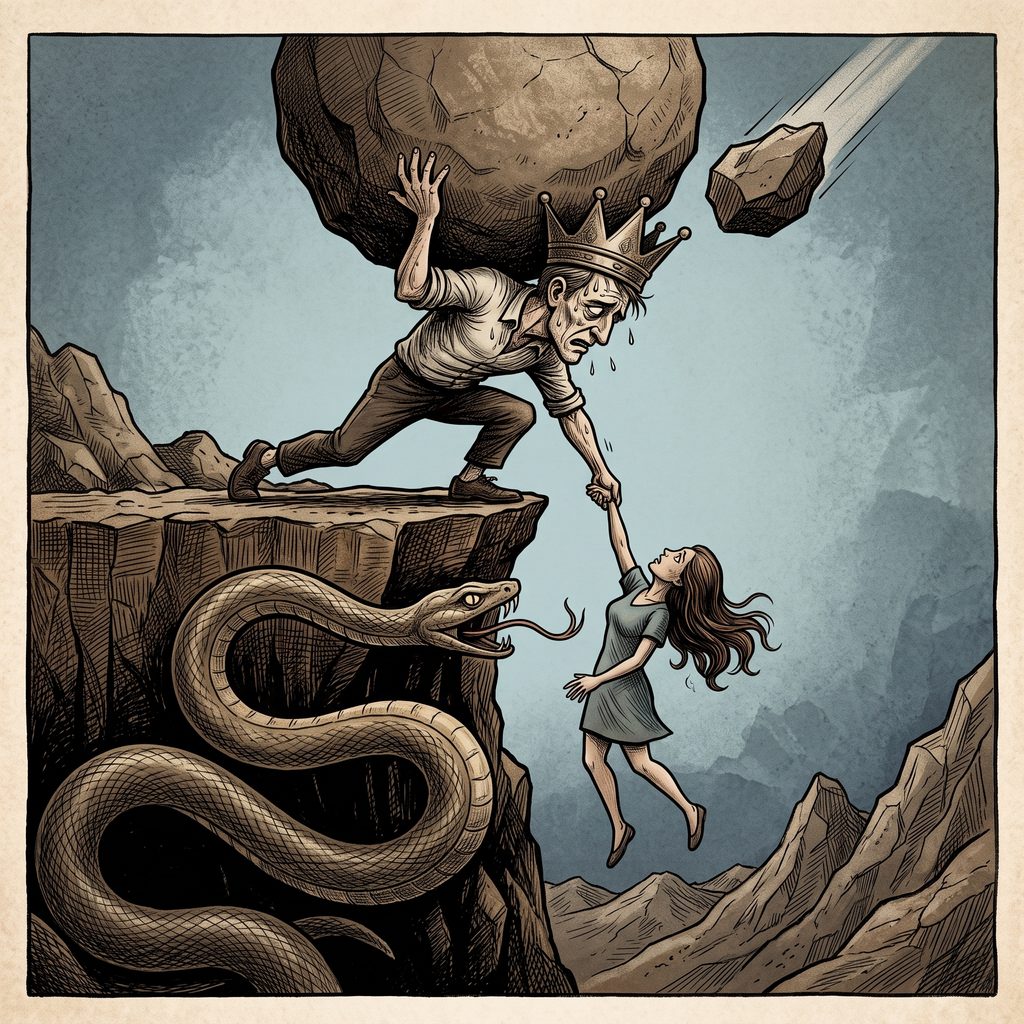
This image, which has circulated on social media for years, is a crude cartoon. A man is holding a massive rock above his head with one arm. The other arm is stretched down a precipice, trying to pull up a woman who is dangling in mid-air.
Beneath the man’s level, inside a crevice he cannot see, a giant snake is poised to strike. From the man’s perspective, he is bearing a load that is quite literally a crushing weight, and he is giving everything he has to pull the woman up.
Beneath the woman, invisible to her, is the giant rock. All she sees is the hand that is supposed to be pulling her, and she’s thinking, “Why aren’t you trying harder? Why don’t you just pull?” She is terrified of falling and being bitten by a snake that the man also cannot see.
The man thinks: “I am in so much pain! I’m still pulling you as much as I can! Why can’t you try and climb a little harder?”
The moral of this crude, perfect image is simple: “You can’t see the pressure the other party is under, and the other party can’t see the pain you’re in.”
Sarah, quite simply, was the person with the rock on top of her.
Her board member, incensed about the typo, was the woman, focused only on the part that affected them (the organization’s image). They didn’t see the crushing, invisible weight that made a single typo seem like an absolute irrelevance.
Her staff members, fighting over the yogurt, were the snakes, poised to bite the very hand that was, with herculean effort, keeping the whole operation from collapsing.
The question the picture begs, and Sarah’s story screams, is: “Do leaders get to be human?”
Our current organizational cultures—from corporate boardrooms to nonprofit agencies—are built on the assumption of leader invincibility. It is a pernicious and damaging myth, often championed by the “Suck it Up, Buttercup” brigade. This philosophy tells us that to be professional is to compartmentalize to the point of deletion. To display emotion is a sign of instability. A leader’s job is to absorb all the pressure and emit only stoic reassurance.
This works fine when the “boulder” is a routine budget variance or a slightly difficult negotiation. It is catastrophic when the boulder is life-altering trauma.
There is no way to truly “compartmentalize” losing your child and your mother in the same month. Your entire endocrine system, your brain chemistry, your capacity for logic—all are hijacked by grief and the stress response. Pretending that doesn’t affect your work is like pretending that having a broken leg won’t affect your morning run. It is a lie.
The picture is so evocative because it applies universally, but in the specific world of nonprofits, it’s a recurring theme.
The Fundraiser’s Invisible Boulder
Let’s look at this from a fundraiser’s perspective. The fundraiser is the person with the boulder. The boulder is a looming, massive fiscal goal. Below them, a major donor—the “woman” to be saved—is expressing hesitation. To the fundraiser, the hesitation is a “snake” that might kill the organization. The fundraiser is trying with all their might to close the deal, feeling a crushing pressure. The donor, meanwhile, doesn’t see the boulder. They just see a “needy” nonprofit that is “pressuring” them for money. They don’t see that the fundraiser’s very job, and the jobs of the twenty other people on staff, might depend on this single conversation. They don’t see the boulder of accountability.
The Volunteer Manager’s Invisible Boulder
The volunteer manager is the person with the boulder. They have twenty crucial shifts to fill for the annual gala, and they are down by fifteen people. They are, internally, carrying a massive weight of potential catastrophic failure. A potential volunteer (the woman) is on the other end of the line, waffling about their availability. The volunteer manager, in a desperate bid to fill the slot, might sound brusque, or intense, or overly demanding. The waffling volunteer is a “snake” that could doom the gala. The volunteer doesn’t see the massive, invisible boulder. All they see is an organizational leader who is being “stressful” and “unprofessional.” They don’t see the invisible pressure.
The Board Member’s Invisible Boulder
Yes, even the board member who got angry at Sarah had their own boulder. We often villainize the critical board member, but let’s look at their side. This person is, themselves, perhaps a high-powered corporate executive. Their “boulder” is their own reputation, their own professional standards, and perhaps an extreme risk-aversion born of a career where a single public mistake has massive consequences. They see the nonprofit as an extension of their public profile. A typo isn’t just a typo; it’s a “snake”—a potential reputational wound that could “bite” them and the whole organization. They don’t see Sarah’s personal trauma-boulder; they see a visible failing that threatens their standard of competence. They are responding to their own invisible pressure.
So, where do we go from here? The model of leadership that mandates complete stoicism in the face of human devastation is broken and inhumane. But the alternative—complete chaotic meltdown—is also not a functional model. We need a third path, one that acknowledges our shared humanity without compromising our responsibility to the mission.
This third path requires new solutions on both a personal and an organizational level.
Personal Level Solutions: Acknowledging the Boulder
- Stop Lying to Yourself. The most insidious part of “Suck it Up, Buttercup” is that we are the ones who enforce it most harshly upon ourselves. Sarah’s internal voices were louder than any external pressure. The first step is to name the trauma. To say, “This is not normal. I am not okay. I cannot ‘just handle this’.”
- Define and Communicate Limits (even crudely). We often fail to communicate our limits until we hit a full-blown crisis. If Sarah had been able to say, even to a trusted advisor, “I am physically and mentally overwhelmed. I will come back, but I can only focus on holiday fundraising. Nothing else can touch my desk,” it would have set a critical boundary.
- Find your own safe harbor. Leaders need spaces where they can be totally vulnerable. Whether it’s a therapist, a support group, or a few truly trusted non-work friends, you must have a “no-judgement zone” where the boulder can be set down.
Organizational Level Solutions: Building Better Support Frameworks
Organizations—especially nonprofit boards—have a duty of care to their leaders. This means moving beyond the expectation of robotic competence.
- Formalize Sabbatical and Mental Health Policies. These should not be seen as a “nice to have” or a special favor; they must be normalized. A leader facing profound trauma should be given a clear, pre-defined path for taking legitimate, restorative time off, without the pressure of “who’s filling the gap” being immediately laid on their lap. Don’t bother with an insurance plan that doesn’t cover mental health.
- Cultivate a Culture of Psychological Safety. This starts from the board down. The board should have asked, “Sarah, what do you need right now, and how can we support the organization so you can have it?” rather than starting with criticism. Board leadership has an obligation to model empathy.
- Redefine “Professionalism”. We need to expand our concept of professionalism to include the ability to say, “I am going through a massive personal crisis, and it is impacting my work, so I am taking these steps to manage it.” This is far more professional than hiding in an office, crying, and pretending it’s business as usual. It’s time to admit that a tear in a meeting, properly contextualized, is not a professional failure; it’s a human data point.
The solution is not to create a workplace where every minor emotion is codified into policy. That leads to other problems. We still have responsibilities to our organizations and to the people we serve. But we must, absolutely, call for a new era of collective empathy.
If we are ever going to be successful in leading organizations—the man with the boulder—we must acknowledge that we can never truly see the pressure anyone else is under. That simple realization must change the fundamental frequency of our leadership.
We must stop assuming the dangling “woman” is being lazy; she might be staring at a snake.
We must stop assuming the “man” with the hand down is not trying hard enough; he might be holding a literal boulder above his head.
When a leader says they need time or help, the answer shouldn’t be “suck it up.” The answer, which will ultimately save both the leader and the organization, should be “We are on your team. How do we help you hold the weight?” The true measure of an organizational leader isn’t their capacity to withstand crushing trauma alone; it’s their wisdom and humility to know when they cannot, and their courage to ask for the help that allows them—and the mission—to survive.