by Dr. Kevin Dean, President & CEO, Tennessee Nonprofit Network
If you have spent more than fifteen minutes in the nonprofit sector, you have likely witnessed the Identity Crisis of the Enthusiastic Board Member. It usually happens on a Tuesday morning. A dedicated board member—let’s call him Gary—stops by the office to help stuff envelopes for the annual gala. Gary is a prince among men. He is a retired VP of logistics, he has a heart of gold, and he is currently elbow-deep in paper cuts and adhesive.
Then, it happens.
Between the third and fourth envelope, Gary looks up at the Executive Director and says, “You know, I was looking at our CRM software this morning, and I really think we need to pivot our entire donor acquisition strategy toward TikTok dances. I’ve drafted a three-month rollout plan. Let’s get the staff on it by Monday.”
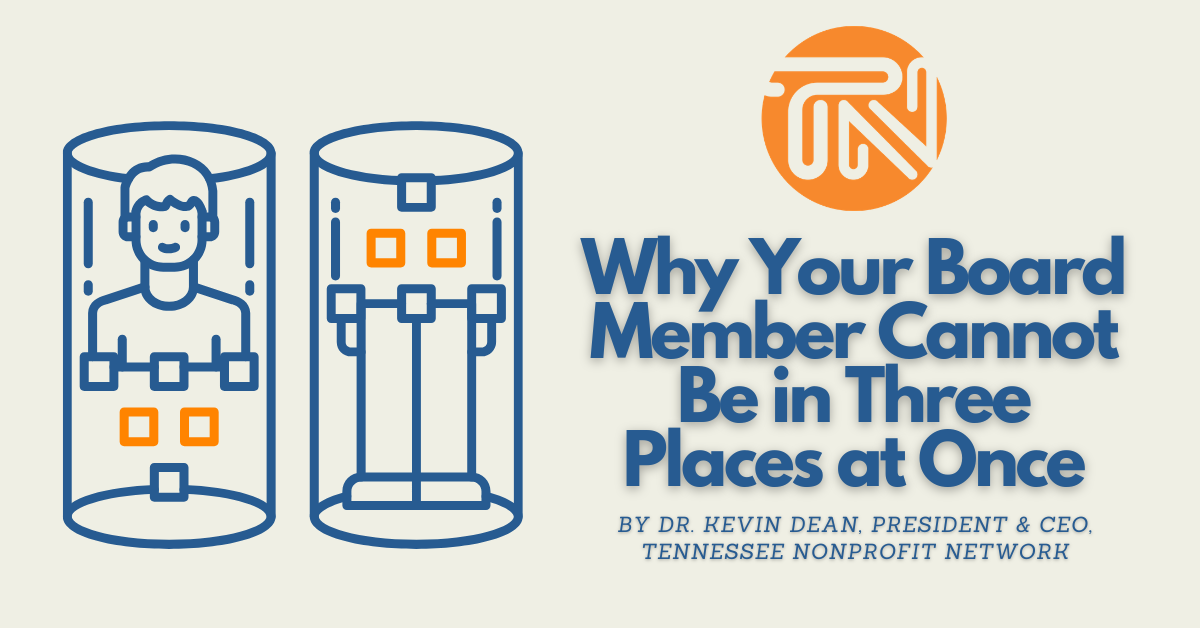
In that moment, the room goes cold. The Executive Director experiences a brief, flickering vision of a career in goat farming. Gary thinks he is being helpful. The ED knows Gary is currently a volunteer, yet he is speaking with the voice of a Governance God. Gary has attempted the impossible: he is trying to occupy three different zones at the same time. Unless Gary has mastered the art of quantum teleportation, this never ends well.
To keep our sanity and our mission intact, we need to talk about the Three Zones rule. In the world of Tennessee Nonprofit Network, we see this struggle often. It is the delicate art of knowing who you are, where you are, and—most importantly—who is actually the boss of whom at 10:00 AM on a Tuesday.
The Governance and Strategy Zone: The High-Altitude Command Center
The Governance and Strategy Zone is the fancy one. It is the high-altitude, oxygen-thin space where board members congregate during the official board meeting. This zone only functions when the group is gathered.
When a board member is operating in the Governance and Strategy Zone, they are part of a collective. They are setting the North Star for the nonprofit. They are reviewing the 2024 Tennessee Nonprofit Compensation Survey Report to ensure the organization is competitive. They are approving budgets, debating long-term strategy, and ensuring the Executive Director isn’t secretly spending the endowment on a fleet of Segways.
However, there is a catch. The power of the Governance and Strategy Zone is like a Wi-Fi signal: it only works inside the boardroom. Once the meeting is adjourned and the motion to end is passed, you have officially exited the zone.
A board member cannot walk into a coffee shop three days later, run into the ED, and say, “As a board member, I am now officially directing you to change the color of the logo to Electric Lime.” That is an unauthorized entry into the zone. Direction for the organization occurs during the meeting only, and it is always a group decision. If you are trying to occupy this zone alone in your car, you are just a person talking to yourself.
The Project Management Zone: The Boots-on-the-Ground Tactical Unit
Sometimes, the board realizes that the entire group cannot possibly do everything. You cannot have twelve people trying to lead a Succession Planning Task Force or sixty people trying to pick out a specific health insurance plan. This is when the Project Management Zone is established.
This is a delegated space. The board, in its collective wisdom, says, “Gary, we trust your logistics background. We grant you the authority to act on our behalf to vet new office space.”
Now, Gary is acting with the authority of the board, but he is operating like a staff member. He has a specific task, a specific timeline, and a specific goal defined by the board’s direction. He isn’t freestyling. He is a temporary extension of the organization’s reach, focused purely on the execution of that one assignment.
The danger here is Scope Creep. Gary starts looking for office space (the assigned task) but then decides he should also probably renegotiate the ED’s contract and fire the cleaning crew while he’s at it. No, Gary. Stay in your tactical unit. You have been given a specific map; do not wander off into the woods of unauthorized HR decisions under the guise of managing the project.
The Volunteer Zone: The Front-Line Service Area
Finally, we have the Volunteer Zone. This is where Gary was when he was stuffing envelopes. This is the zone board members enter when they are standing at the registration desk of your gala.
This is the most dangerous area for a board member because it feels so comfortable. When a board member is volunteering, they are—for all intents and purposes—an unpaid staff member. In this ecosystem, the hierarchy flips.
If the Development Director tells the board member, “Please don’t use the blue pens, use the black pens,” the board member needs to say, “You got it,” and pick up the black pen. They are taking direction from staff.
The most common point of friction in a nonprofit is when a board member in the Volunteer Zone tries to teleport into the Governance and Strategy Zone mid-sentence.
Imagine a volunteer at a hospital who also happens to be on the hospital’s board of directors. If they are tasked with wheeling patients to the exit, they shouldn’t stop halfway down the hall, look at a surgeon, and say, “I’ve been thinking about your incision technique, and I’d like to see some changes by the afternoon shift.”
That is exactly what it feels like when a board member gives an Executive Director guidance while they are supposed to be sorting t-shirts for the 5K. It creates a Dual Reporting nightmare. Does the ED listen to Gary because Gary is their boss in the boardroom? Or does the ED tell Gary to get back to the t-shirts because, right now, the ED is the one running the operation?
Why Crossing the Lines Is a Recipe for Disaster
You might think, “Is it really that big of a deal? Gary has great ideas!”
Gary might have the best ideas since the invention of sliced bread. But when lines are blurred, organizational culture begins to rot.
- Employee Burnout: Nothing kills the morale of an Executive Director faster than being managed by a committee of individuals who aren’t talking to each other. If three different board members give advice while volunteering, the ED is now trying to please three different bosses who may have conflicting visions.
- Mission Drift: If direction happens outside of the formal board meeting, the organization loses its anchor. Decisions become based on whoever happened to be in the office that day, rather than the strategic plan.
- Liability and Risk: There is a reason the Governance and Strategy Zone is a collective one. It ensures check and balances. When a single board member starts directing staff, they are bypassing the very systems designed to protect the nonprofit.
How to Manage the Geography
How do we fix this? It starts with a very honest conversation and perhaps some metaphorical (or literal) signage.
- The Pre-Volunteer Briefing: Before a board member starts a volunteer task, the staff member in charge should say, “We are so glad you’re here to help with the donor calls. For the next two hours, I’ll be your point of contact for any questions on the script.” This subtly sets the hierarchy.
- The “Save it for the Board” Phrase: Executive Directors need to be empowered to say, “Gary, that sounds like a strategic governance issue. Why don’t you add that to the agenda for next month’s meeting so we can discuss it as a full board?”
- The “Which Zone are You In?” Question: If a board member starts giving advice, it is perfectly acceptable to playfully ask, “Are you in the Governance and Strategy Zone or the Volunteer Zone right now?” Most board members are well-meaning and will realize the overstep immediately.
Board members are so important for every nonprofit. Their passion, their time, and their wisdom are what keep the doors open. But remember: you can only occupy one zone at a time. If you try to stand in all three, you’ll just end up doing a very awkward split—and you’ll probably give the Executive Director a headache that no amount of coffee can cure.
Let’s keep the Governance and Strategy in the boardroom, the Project Management in the task force, and the Volunteerism in the trenches. Your nonprofit will be healthier, your ED will be happier, and Gary can finally focus on getting those envelopes stuffed correctly.