
by Dr. Kevin Dean, President & CEO, Tennessee Nonprofit Network
There is a undeniably magical period at the inception of a nonprofit organization. You spot a gaping hole in society, invent a clever mechanism to fix it, and watch your creation blossom. Soon enough, the funding streams begin to trickle in, then flow. The evaluation metrics start whispering sweet nothings about quantifiable community impact. Eager volunteers line up like devotees, and shiny new staff recruits sign on for wages that barely cover rent. Your organization is the talk of the town, and everyone is saying that you are so “noble.”
Before you know it, you are sitting under studio lights on a local morning talk show every four months, wearing your finest business-casual attire to pitch an upcoming annual gala. You look directly into the camera, quietly reflecting on the fact that this organization will form the bedrock of your personal legacy.
It is, in many ways, quite similar to having a child. I do not have a child myself, but people who possess them have described the experience to me in extensive detail. (And, for the record, I am not sold on the idea of having one. You can keep yours, thanks.) From what I gather, raising a human being sounds utterly terrible about half the time and genuinely wonderful the other half. Running a nonprofit follows an almost identical psychological arc.
When you raise a child, you have roughly eighteen years to oversee their transformation into a fully functioning adult. You spend those two decades desperately trying to instill core values, sound judgment, self-awareness, confidence, and a healthy dose of gumption. Then, on a bright morning in late August, you pack a minivan, drive them to a college campus, unload three plastic storage totes, and launch them into the world. You simply cross your fingers and hope those eighteen years took root. You can simply hold your breath and hope that there are no unwanted pregnancies, crystal meth, or bitcoin scams.
Crucially, the exact moment that child turns eighteen, they cease to be legally yours.
This is where the child analogy hits a stark legal boundary. A nonprofit is never legally yours, not even on day one. As a founder, you can quite literally be fired from the entity you created on a random Tuesday afternoon. This happens all the time actually. The very moment an organization achieves official 501(c)3 status, it legally belongs to the public, governed by a board of directors. You might sit on that board or serve as its chief executive, but ultimately, the organization belongs to all of us.
A caveat: I want to make sure I don’t vilify the very people who helped build the organizations we now know and love. Without innovative, slightly obsessive founders, the sector would simply collapse under the weight of unaddressed societal problems. Someone has to see a crisis, invent an intervention, and build the scaffolding to eliminate it. Most people just go about their day, while these folks stepped up. Yet, by a cruel twist of organizational psychology, founders frequently transform into the single greatest threat to their own mission.
Most founders must eventually confront the excruciating task of stepping back, releasing their grip, and allowing the organization to exist without their constant, hovering presence. That requires immense self-awareness—a trait that is, historically speaking, rarely handed out in equal measure with unyielding ambition.
When that self-awareness fails, the organization slips into a well-documented psychological state known as Founder’s Syndrome. This occurs when an institution becomes so utterly entwined with its creator that its operations, culture, and strategic direction are entirely held hostage by the founder’s personal ego, insecurities, and refusal to grant autonomy to anyone else.
If you are a founder wondering whether you might be hovering a bit too close to the helicopter blades, here are five classical ways founders get in their own way.
1. Centering Yourself as the Main Character
It is wildly intoxicating to watch the fruits of your grueling labor pay off. The local business journal gives you a shiny glass plaque, the mayor calls you by your first name at receptions, and donors applaud when you step up to a podium. It is entirely human to enjoy these perks.
The trouble begins when the boundary between your personal brand and the organization’s corporate identity evaporates completely. You are not the nonprofit, and the nonprofit is not you. Unless you have managed to unlock the secret to biological immortality, your tenure at the helm will eventually end.
Centering yourself as the main character is the organizational equivalent of a parent trying to live in their teenager’s dorm room. You cannot monitor their study habits, protect them from peer pressure, or physically swat red solo cups out of their hands at midnight. The entire point of those initial eighteen years was to give the kid a structural blueprint so they could survive without you standing in the doorway.
The goal of founding a nonprofit is to build an independent entity with its own personality, culture, and institutional agency. You need a robust matrix of leaders across the staff, board, and volunteer ranks so that the organization does not vanish into thin air the moment you step out of the spotlight. Far too many founders spend their early years aggressively self-promoting under the guise of public relations, entirely neglecting the quiet, unglamorous work of building institutional capacity.
2. Refusing to Leave the Building
When a founder finally agrees to step down from the executive role, a strange phenomenon often occurs: they refuse to actually leave. They transition into an emeritus board seat, take on a murky consulting role, or simply wander into the breakroom to make coffee and express passive-aggressive opinions about the new office furniture.
Granted, a brief, structured handoff can be necessary to preserve key donor relationships and clear up historical context. But a handoff is intended to be a momentary gesture, not an eternal co-habitation arrangement.
Imagine being eighteen years old, moving into your college dormitory, and realizing your mother has successfully applied to be your resident advisor. You are sitting on a futon trying to make new friends, and she keeps popping her head through the door frame to remind you that you have a smear of toothpaste on your chin and that your pants look absurdly baggy.
That is precisely how a successor executive director feels when a founder lingers in the hallway.
What a college freshman actually wants from a parent is straightforward: send a care package containing non-perishable snacks, answer the frantic phone call when the check engine light comes on, and otherwise stay completely out of the way so they can test their own judgment. Succeeding a beloved founder is difficult enough without having the architect of your misery sitting in the corner taking notes.
3. Treating the Original Vision as Holy Scripture and Micromanaging the Outcome
Yes, it was your original vision. Yes, you sacrificed weekends, sanity, and personal savings to pull this institution out of thin air. But unless your initial concept was forged through an exhaustive, deeply collaborative community process, there is a distinct probability that your original plan will eventually need to be scrapped.
Community needs evolve, demographics shift, and initial program designs often yield disappointing evaluation data. If your intervention is not producing real results, or if the population you serve explicitly tells you that your method is unhelpful, holding tightly to your original vision is not dedication—it is arrogance.
Remember that the Humane Society first served humans, not dogs and cats. Nintendo originally manufactured handmade Hanafuda playing cards before experimenting with ventures like taxi companies and love hotels in the 1960s. Nokia started as a single woodpulp and paper mill, later expanding into rubber boots, tires, and communications cables before making mobile phones. March of Dimes original mission was to cure and eradicate polio but completely pivoted its mission in 1958 to focus on preventing birth defects, infant mortality, and maternal health.
When you build an organization, you must grant it room to transform. That requires stepping back from micro-level program execution and welcoming multiple, diverse voices into the strategic room. If the direction of the organization changes based on real-world evidence and direct community feedback, that is not a defeat. That is what operational success actually looks like. Leaving behind a frozen, rigid program model that refuses to adapt is not a legacy; it is an artifact.
4. Surrounding Yourself with Echoes and Ignoring Feedback
It is extraordinarily comfortable to surround yourself with people who nod sympathetically at your ideas and applaud your strategic wisdom. Constructive criticism, on the other hand, tastes terrible. But no enduring institution was ever constructed by a single genius acting in a vacuum, and people rarely invest their energy into maintaining something they had no hand in shaping.
The healthiest organizations are built through messy, contentious, multi-layered dialogue. Exceptional leaders seek out feedback specifically when they know it will sting, recognizing that personal blind spots are a natural side effect of passion. You do not possess all the answers, nor should you.
As a founder, your primary operational task is to aggregate the collective intelligence of your community, staff, and partners, synthesizing those perspectives into a functional enterprise. If the surrounding community was not actively involved in designing the work, the organization does not actually belong to them. It belongs to your ego.
When a community member offers critical feedback about your programming, your first instinct should be to invite them for a long coffee, not block their email address. When your program staff warns you that an ambitious new initiative is logistically impossible, you need to listen to them. When a volunteer indicates that your operational onboarding is chaotic, you fix the system instead of questioning their loyalty.
5. Treating Succession Planning Like an Insult and Failing to Build Internal Talent
From the very afternoon you sign the organizational paperwork, you should be actively searching for your eventual replacement. Unless human longevity takes a miraculous leap forward in the next few years, your tenure has an expiration date. You may have paid to have your head cryogenically frozen so you might live on for eternity, but that still doesn’t mean you don’t need to find someone to replace you!
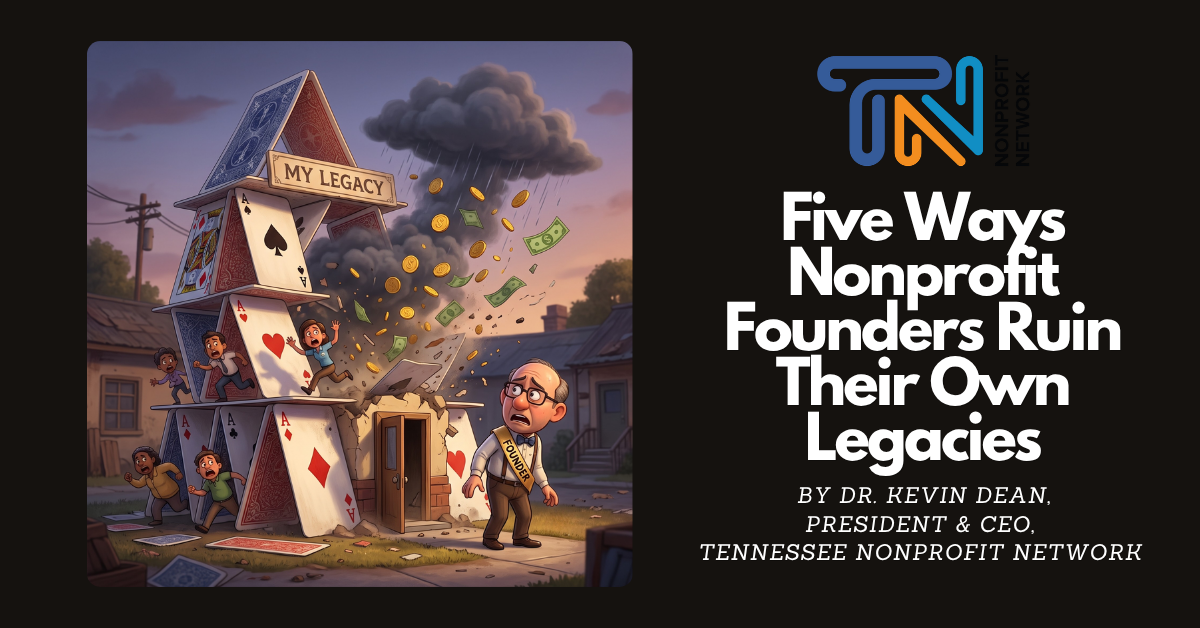
A astonishing number of founders fail to realize that their ultimate reputation hinges almost entirely on what happens to the organization after they depart. If you step down and the nonprofit immediately stumbles, loses its funding, and dissolves into administrative chaos within twelve months, that catastrophe becomes your true legacy. It proves that you built a fragile house of cards designed to support your own presence rather than a sustainable community asset.
This is the structural equivalent of withholding all practical life lessons from your children, handing them the keys to a vehicle with no wheels, and expecting them to navigate a highway safely.
Your overarching priority as a founder must be the relentless development of internal capacity. That means cultivating an independent, highly competent board of directors that understands its fiduciary duty. It means diversifying your funding streams so that major donors do not vanish the moment you stop making the asks. Most importantly, it means investing in your staff, delegating real authority, and putting operational structures in place that keep the lights on long after you have handed over your keys.
Building something that fully outgrows the need for your supervision is not a failure of leadership. It is the only true proof that you succeeded in the first place.