
by Dr. Kevin Dean, President & CEO, Tennessee Nonprofit Network
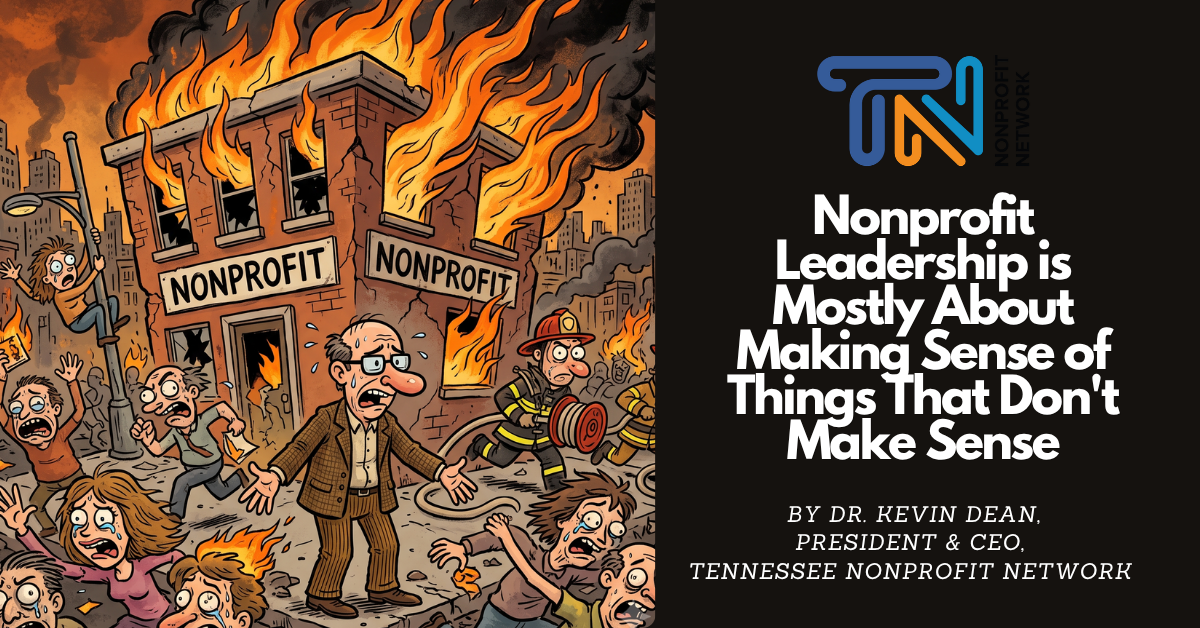
A few years ago, a friend of mine received the kind of news that usually sends a nonprofit executive directly into a tranquilizer-induced coma: her organization’s building had completely burned to the ground.
To anyone who had ever set foot in the structure, the fire was less of a shock and more of a delayed certainty. The building had originally been donated to the organization by a local commercial bank that couldn’t sell it because it was in such appalling physical shape. Naturally, rather than paying millions for demolition, the bank handed the keys over to a tax-exempt entity with a warm handshake, a framed plaque, and a massive tax write-off.
The phrase “beggars cannot be choosers” is often said about nonprofits, but we really shouldn’t accept this. We are routinely treated like institutional scavengers, accepting corporate trash and structural liabilities under the faint, desperate hope that if we smile politely while accepting a water-logged basement full of black mold, the corporation might eventually grace us with a three-figure check for unrestricted operating support down the line.
When the inferno finally claimed the place, it left behind a smoking heap of charred drywall and roasted office furniture. Yet, despite being an absolute structural nightmare that had spent the previous decade actively crumbling in on itself, that building had been a sanctuary for vulnerable clients. It was a place of deep joy, refuge, and community for the staff and the volunteers who occupied it daily.
As the smoke cleared, instant panic set in. Everyone began worrying obsessively about the future of the organization. Where would the clients go? What did this mean for payroll? Would the grant funding evaporate? Was this the end of the universe?
My friend did not have the luxury of hyperventilating. Instead, she slipped directly into sensemaking mode. It was a role she practiced daily out of pure survival. She had to navigate a worry-wart board chair who was convinced the insurance company was going to sue them, a high-strung program director hyperventilating into a organic canvas tote bag, and a sprawling legion of deeply dedicated but remarkably high-maintenance volunteers who demanded immediate answers about the fate of the annual bake sale.
In the nonprofit sector, executive leadership is rarely about managing linear operations or optimizing streamlined supply chains. It is almost exclusively about making sense of things that, quite frankly, do not make an ounce of sense.
The Landscape of Everyday Absurdity
Consider the standard operational climate of a social impact organization, where logic goes to take an extended, unpaid sabbatical.
A local corporation that has quietly funded your youth literacy program for twenty consecutive years suddenly stops responding to emails and pulls its funding without explanation—presumably because a new VP of Marketing decided their tax-deductible passion is now alpaca rescue. A beloved, long-time volunteer who held the secret key to the pantry lock passes away. A veteran staff member who was the only person alive who understood the custom macro holding your donor database together abruptly quits on a Tuesday to move to an eco-commune in Vermont. The executive director of a peer agency retires after thirty-five years, leaving a massive vacuum in a regional coalition that mostly just produced passive-aggressive email threads anyway. A shooting occurs three blocks from your drop-in center. Cash flow problems force an emergency scaling-down of services right as community demand hits a historic high.
None of these events are rational. None of them arrive with a clean user manual or a predictable timeline. Yet, every single one of them demands that someone step up, look at the smoking crater of expectations, and interpret what just happened for everyone else.
This is the work of sensemaking.
What Sensemaking Actually Is
Sensemaking is the process through which we structure the unknown so that we can retain the capacity to act within it. It is the mental architecture leaders build when the ground beneath an organization gives way and everyone is staring at you, waiting for instructions on how to gravity-defy.
In organizational theory, problems generally fall into two categories: technical problems and adaptive problems.
A technical problem is straightforward. The copier is out of toner; you buy toner. A grant report is due on Friday; you fill out the soul-crushing templates. Technical problems have known solutions and established procedures, usually involving a manual or a desperate Google search.
An adaptive problem, however, occurs when the situation itself defies existing frameworks. When your building burns down, or when your primary corporate sponsor dumps you for an alpaca rescue, you are facing an adaptive problem. You cannot fix it with an operational checklist or an inspirational quote on a whiteboard because the environment itself has shifted into the Twilight Zone.
Sensemaking involves coming up with a plausible understanding—a map—of a shifting world. Notice the word here is plausible, not perfect. When a crisis hits a nonprofit, nobody expects the executive director to possess a magical, fully rendered topographical map of the next five years–and if they do, they’re probably the board member who hasn’t shown up for the last four board meetings but is front and center when the fire trucks pull up. What the team needs is a credible working draft of reality that stops them from fleeing into the woods.
Once this map is constructed, the leader tests it with others. They share the interpretation with the board, the staff, the funders, and the community, refining or abandoning the draft based on how credible and functional it proves to be under pressure.
Trying to explain the unknown to others is often the only way a leader figures out how much they actually understand it themselves—a terrifying realization when you realize mid-sentence that your whole plan relies on a prayer and an advance on an invoice. Sensemaking is not a solitary academic exercise conducted in a corner office; it is an iterative, social dialog. It becomes most critically urgent when the world becomes unintelligible in some fundamental way. When the reality everyone took for granted dissolves, the leader must step in and fabricate a new cognitive floor.
Organizational Symbols as Tools of Interpretation
When human beings are deeply disoriented, they do not look at raw data spreadsheets or logic models for comfort; they look for meaning. If logic models actually calmed people down, human resources departments would just hand out pie charts during layoffs. Instead, sensemaking relies heavily on organizational symbols.
Every nonprofit is held together by a web of symbolic elements that give shape to the daily madness:
- Myths, vision, and values that define why the work exists in the first place, usually forged in the crucible of a founder’s garage.
- Heroes and villains, ranging from the legendary founder who started the pantry out of a 1998 Honda Civic to the cold-hearted municipal zoning officer who threatens to shut it down because your ramp is two inches too wide.
- Stories and fairytales passed down through orientation sessions that illustrate how the agency survived against all odds, usually featuring at least one incident with a broken boiler in mid-January.
- Rituals and ceremonies, like the mandatory monthly staff recognition breakfast where people fight over the last damp bagel, or the ceremonial ribbon-cutting for a newly painted hallway named after a millionaire.
- Metaphor, humor, and play, which serve as the essential safety valves that keep overworked human service professionals from silently walking into the ocean.
When my friend stood in front of her panicked staff near the charred remains of their facility, she did not lead with a dry lecture on property casualty insurance subrogation and deductible tiers. That would have caused an immediate mutiny. She relied on symbolic framing. She reminded the team of the mythic origin of the agency: that it had been founded in a living room with two folding chairs, a stolen clipboard, and zero budget. The physical structure was never the heart of the sanctuary; the collective commitment of the people was.
By drawing on established organizational symbols, she reframed the fire. It was transformed from an existential death blow into merely the latest dramatic chapter in the agency’s long, chaotic history of absurd resilience.
Processes as Theater
To understand sensemaking in nonprofits, one must accept a fundamental, slightly uncomfortable truth: much of organizational life is pure, unadulterated theater. Processes often function as elaborate Broadway productions, designed not just to produce operational outputs, but to manage impressions and establish a fragile illusion of control over total chaos.
Consider the classic nonprofit artifacts through this theatrical lens:
- Meetings: Frequently held not to make actual decisions, but to perform collective inclusion and satisfy everyone’s deep psychological need to feel heard for four minutes while someone takes cryptic notes on a easel pad.
- Strategic Planning: A formal, ritualistic dance where staff and board spend six months drafting a fifty-page document that will sit undisturbed on a shelf until the next audit, primarily to convince themselves and institutional funders that the future is a linear, predictable highway.
- Evaluation: The elaborate performance of metrics, survey instruments, and logic models, constructed to signal academic rigor to foundation officers who have never had to manage a client meltdown in a waiting room.
- Collective Bargaining and Power Dynamics: The formal, scripted negotiations through which different factions assert agency within an uncertain system, like actors rehearsing a drama everyone knows the ending to.
When an organization experiences a shock, these theatrical processes become vital staging grounds for sensemaking.
After the building fire, my friend immediately called an emergency board meeting. Mechanically, the board had very little practical work to do in that first forty-eight hours beyond authorizing emergency spending limits that were already painfully small. However, the meeting itself was a crucial performance. It provided a structured, formal stage where the board chair could vent his existential dread, where the treasurer could dramatically shuffle balance sheets, and where the collective impression of authority, stability, and adult supervision could be re-established.
By staging the traditional theater of governance, the leader signals to the community that the ship is still being steered, even if the steering wheel is currently unattached to the boat and melting in a parking lot.
From Sensemaking to Sensegiving
It is not enough for an executive leader to internally make sense of a crisis. A leader who resolves chaos in their own mind while leaving their staff in a state of blind terror is simply an isolated philosopher with a nicer title. The real heavy lifting of executive leadership lies in the transition from sensemaking to sensegiving.
Sensegiving is the active work of leaders to package and disseminate new understandings to aid in follower sensemaking. It is the art of translating raw, confusing horror into a shared, coherent narrative that allows others to stop staring blankly at the wall and actually go back to work.
How setbacks and small wins are understood by an organization is entirely critical to staff morale and retention. A modest grant rejection can be interpreted by a fragile team as absolute proof that the organization is doomed and everybody should update their LinkedIn profiles immediately. Or, it can be framed by a leader as a necessary, character-building feedback step in refining a bold new program strategy. The objective event—a polite rejection letter signed by a program officer—remains identical; the leader’s spin completely changes whether staff go home crying or energized.
To give sense, a leader must first notice and bracket ongoing experience to see an event clearly. Amidst the continuous, deafening noise of daily operations, the leader mentally draws a box around a specific occurrence—a sudden drop in client attendance, a shift in local government policy, or an unexpected building fire—and isolates it for examination like a surgeon prepping a specimen.
Once the event is bracketed, the leader deliberately frames it. Framing involves putting bright neon highlighters over particular interpretations while intentionally sweeping panic-inducing alternative interpretations under the rug. The goal of this framing is to prompt a cognitive shift in followers, moving them from “We are all going to perish” to “Ah, I see, this is just a strategic pivot.”
Crafting the Sensegiving Narrative
People do not interpret raw experiences in a vacuum. They interpret them through the lens of their own personal histories, office politics, past career traumas, and individual anxieties. A program director with a background in clinical social work will interpret a sudden budget cut as a deep moral failing of capitalism, while a board treasurer with a background in corporate banking will interpret it as a lovely opportunity to optimize expenditure efficiency.
Therefore, an effective sensegiving narrative must explicitly account for these wildly divergent perspectives without causing an ideological brawl in the breakroom. The leader must offer an interpretation that acknowledges real fears while steering the collective focus toward a constructive path that doesn’t involve burning down a second building.
To work effectively, a sensegiving narrative must possess two distinct characteristics: it must be credible, and it must be defamiliarizing.
Credibility
A narrative must be accepted as legitimate by the people receiving it. It cannot be crude, Soviet-style propaganda or mindless, pollyannaish optimism. Nonprofit staff have highly tuned sensors for corporate double-speak; if a leader stands in front of a smoking crater and cheerfully asserts that this is “a fantastic team-building opportunity,” they will be eaten alive by their own staff before sunset.
Materiality matters deeply here. Credibility is reader-based, meaning it exists entirely in the perception of the audience, not in the leader’s head. The narrative must visibly acknowledge the concrete, miserable facts of the situation. Yes, the building is gone. Yes, next week will suck. Yes, working out of borrowed church basements with questionable plumbing will test our sanity. Grounding the story in these uncomfortable, unvarnished realities earns the leader the right to guide the interpretation of what comes next.
Defamiliarizing
Simultaneously, the narrative must be defamiliarizing. It must offer a perspective that is novel, clever, and nonobvious. If a leader merely repeats what everyone already knows—that losing a facility is terrible, annoying, and sad—they have provided zero added value. They’re just an expensive narrator of doom.
Defamiliarization disrupts the standard, catastrophic loops of thinking that take hold during an emergency. It forces followers to stop, tilt their heads, and look at a familiar disaster through an entirely unexpected frame.
In the case of my friend’s organization, her defamiliarizing narrative went something like this:
“The bank gave us that building because it was a toxic liability they wanted off their balance sheet. We have spent the last ten years pouring our limited money into fixing antique boilers, patching rotten roofs, and wrestling with asbestos instead of actually serving our clients. The fire is a tragedy for our immediate routine, but structurally, the universe just forcibly liquidated a bad asset that was quietly draining our soul. We aren’t homeless; we’ve been liberated from a real estate prison.”
That single, dryly witty narrative shift completely altered the emotional landscape of the agency. It moved the organization from viewing themselves as helpless victims of bad luck to viewing themselves as an unburdened community agency entering a necessary next stage of growth.
The Constant, Relentless Demand for Sensemaking
The tragic comedy of nonprofit leadership is that sensemaking is never a completed task. You do not construct a brilliant narrative once and then enjoy five years of smooth, operational tranquility.
The exact moment you finish helping your organization make sense of a physical disaster, a major donor decides to redirect their entire family foundation portfolio toward blockchain-based ocean cleanup initiatives. The moment you navigate that funding shift, a local political dispute threatens your municipal contract. The moment you resolve the contract, your board chair decides he wants the agency to embark on an unprompted, multi-million-dollar capital campaign to buy a new building—perhaps by approaching a local bank to see if they have any dilapidated real estate they’d like to donate.
Through it all, the leader stands at the center of the organization, functioning as a human lightning rod in a permanent storm of absurdity.
Nonprofits operate in the fragile, chaotic spaces where societal systems break down. They are built to address massive, systemic problems that the market has abandoned and that the government has failed to solve, usually on a shoestring budget and powered by passion and lukewarm coffee. By their very nature, they operate in environments characterized by high ambiguity, absurdly constrained resources, and deeply unpredictable human behavior.
Leadership in this domain is not about maintaining the delusional illusion that you control the ocean. It is about being the person who can look at an unexpected, fifty-foot wave, turn to a crew that is holding a mop and a bucket, and explain with absolute, deadpan conviction precisely what the wave means, why the boat was actually designed to be upside down, and which rope everyone needs to pull next.