by Dr. Kevin Dean, President & CEO, Tennessee Nonprofit Network
Every sector has its unique archetype, but the nonprofit sector seems to cultivate one specific persona with particular flourishes: the hero. Enter Alex.
Alex is bright, hardworking, and deeply committed to the mission. But if you were to listen to Alex speak for more than three consecutive minutes, you would quickly realize that the entire organization, its budget, its staff, and its community partners are merely supporting characters in the epic, award-winning cinematic universe known as Alex’s Life.
When speaking with donors, community partners, or sitting in routine staff meetings, Alex possesses an uncanny ability to translate collective labor into a heroic solo quest. Standard team accomplishments undergo a dramatic makeover in Alex’s mind. A phrase like, “Our team distributed 5,000 meals this month through our partner agencies,” is reframed as, “I spent 60 hours this week making sure these families didn’t starve.”
If the communications team designs an incredible annual report, Alex casually notes, “I practically gave the designer the entire vision while I was re-writing the copy.” If a grant lands, Alex carried the application across the finish line on raw willpower alone, ignoring the seven people who spent three weeks compiling budget attachments, demographic tables, and audit documentation.
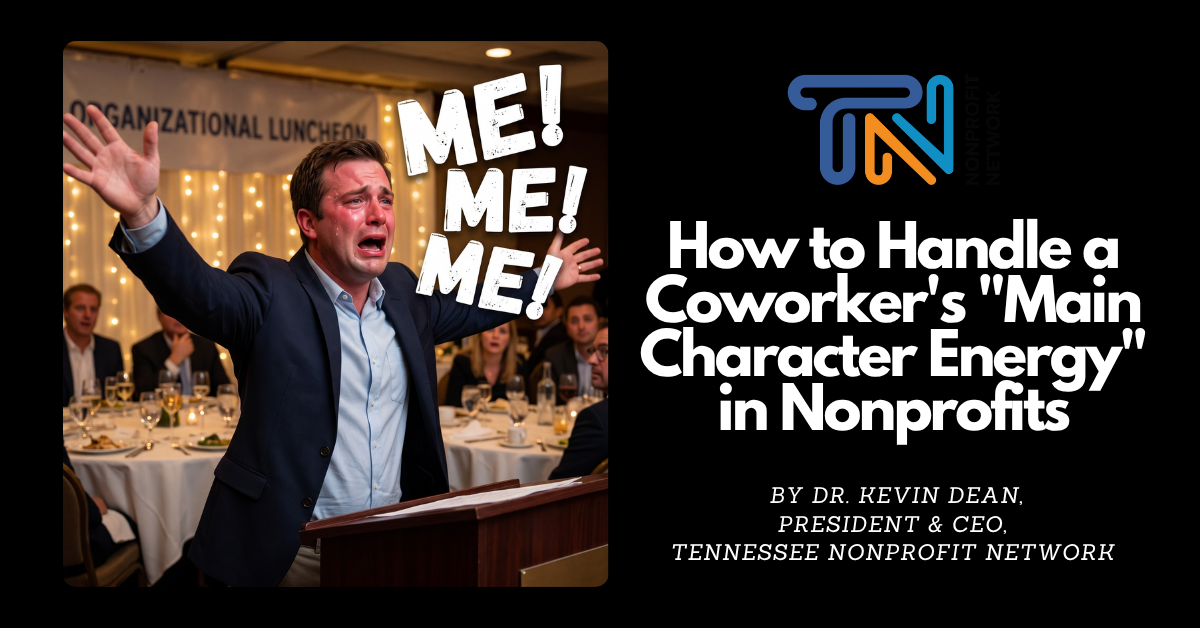
The peak of Alex’s cinematic journey occurred recently at the annual board luncheon. The event was meant to highlight collaborative community efforts, featuring remarks from partner leaders, program participants, and field staff. When Alex stepped up to the microphone to give a quick program update, the air in the room shifted.
Instead of walking through program metrics or acknowledging the five coordinators sitting two tables away who actually ran the day-to-day operations, Alex launched into a dramatic monologue. Draped over the podium with the intensity of an Oscar nominee accepting a lifetime achievement award, Alex detailed personal sacrifices, late-night epiphanies, and single-handed triumphs against insurmountable systemic odds.
At table four, the program coordinators sat frozen, forks poised halfway to their salads, mouths slightly agape. The development director stared intently at a glass of iced tea as if searching for answers in the ice cubes. The executive director sat at the head table, expression hovering in a strange middle zone between mild panic and utter bewilderment, quietly contemplating whether to gently cut the microphone or pretend to have a sudden, urgent coughing fit.
Afterward, the post-luncheon chatter was not about the annual metrics or the donor matching challenge. It was entirely about Alex’s performance. The staff was offended, the partners were bemused, and the executive director was left wringing their hands, wondering how on earth an organization is supposed to address someone whose everyday workplace posture belongs in a summer blockbuster trailer.
Handling this isn’t simple. There is no silver bullet or quick icebreaker game that cures someone of believing they are the central protagonist of the universe. But before you throw your hands up or start plotting a quiet exile to the copier room, it helps to understand what is actually happening.
What Exactly Is Main Character Energy?
In pop culture terms, main character energy refers to someone who behaves as though they are the star of a movie, while everyone around them is merely an extra, a plot device, or an audience member paying for a ticket.
In everyday society, having a little main character energy isn’t inherently evil. It can look like self-confidence, strong personal style, or a flair for storytelling. But in a collaborative work environment, particularly within a nonprofit where work relies heavily on interdisciplinary coordination, shared accountability, and low-ego teamwork, main character energy quickly becomes toxic.
When main character energy enters the workplace, the operational dynamic skews dramatically. A work environment requires a choir; main character energy insists on singing a continuous, operatic solo while turning off everyone else’s microphones.
It manifests as a persistent worldview where:
- Personal effort is exaggerated while collective contribution is erased or minimized.
- Conflict is framed as a personal betrayal by antagonists rather than a standard professional disagreement.
- Feedback is treated as a tragic plot twist designed to test the hero’s resolve, rather than routine operational course correction.
- Attention and visibility are treated as zero-sum resources that must be captured at all costs.
Spotting Main Character Energy in the Wild
Main character energy does not always arrive with a dramatic flourish or a literal cape. Sometimes it creeps into daily operations in subtle, highly specific ways. Here are the primary ways it shows up across nonprofit work environments:
The Soliloquy in Team Meetings
Standard meetings are designed for information exchange, problem-solving, and alignment. For a main character, a meeting is an open mic night. They will turn a simple five-minute update into a fifteen-minute narrative complete with emotional arcs, personal struggles, and dramatic pauses. While the rest of the team is trying to figure out if the van is available on Thursday, the main character is describing their personal journey with vehicle logistics.
Monopolizing the Narrative with Stakeholders
When donors or board members are present, main character energy operates at peak performance. Because external stakeholders often represent validation, visibility, and prestige, the main character will naturally gravitate toward them, positioning themselves as the sole architect of organizational impact. They become the self-appointed translator of the mission, frequently interrupting colleagues or rephrasing other people’s insights to make themselves look like the ultimate authority.
The Tragedy of Minor Inconveniences
To a main character, a minor work setback is never just a minor work setback. A printer jam isn’t a mechanical glitch; it is an active conspiracy by the universe to thwart their vital work. A delayed email reply isn’t a busy colleague; it is an act of disrespect against their timeline. Every challenge is magnified into an obstacle of heroic proportions that only they have the strength to overcome.
Selective Credit Distribution
Success is always personal; failure is always environmental or collective. If a community event draws a huge turnout, it is because of the main character’s personal magnetism and promotional brilliance. If the turnout is low, it is because the marketing team dropped the ball, the weather was uncooperative, or the community just wasn’t ready for their visionary concept.
The Martyr Complex
Nonprofit work already carries a background risk of overwork, but the main character turns overwork into a high-art performance piece. They don’t just stay late; they make sure everyone knows they stayed late. They send emails at 2:14 AM not because the task required it, but because the timestamp serves as evidence of their sacrificial commitment to the cause.
Behind the Director’s Cut: Why People Act Like This
It is easy to label someone like Alex as a pure narcissist and write them off entirely. It is certainly frustrating to sit in a meeting and watch your hard work get absorbed into someone else’s personal mythos. But if we want to deal with this behavior effectively, we have to look behind the curtain with a degree of empathy.
Main character energy is rarely as simple as unadulterated vanity. More often than not, it is a psychological defense mechanism disguised as supreme confidence.
Masking Insecurity and Imposter Syndrome
In many cases, the loudest person in the room is also the most terrified. People who feel deeply inadequate or fearful that they don’t belong in their role will sometimes overcompensate by constructing an unassailable public persona. By loudly claiming credit for everything, they create a protective wall designed to keep scrutiny and self-doubt at bay.
Unprocessed Workplace or Personal Trauma
A history of being ignored, undervalued, or erased in past work environments or personal relationships can create an unhealthy hyper-vigilance around visibility. If someone spent years working in environments where credit was routinely stolen or where their survival depended on constantly proving their worth, they may develop a reflexive habit of claiming credit preemptively.
Survival Tactics in Under-Resourced Systems
The nonprofit sector itself can accidentally encourage this behavior. When organizations operate under scarce resources, high stress, and constant competition for funding or recognition, employees can internalize the belief that only the most visible workers survive. Main character energy becomes an adaptive strategy to secure job security, raises, or professional status in a system that sometimes rewards noise over quiet execution.
Neurodivergence and Communication Style Differences
Sometimes, what looks like self-centeredness is actually a difference in communication style or neurodivergence. Some individuals process thought by relating stories back to their own personal experiences. What feels to others like stealing the spotlight might simply be their attempt to establish connection and demonstrate empathy, even if it lands awkwardly in a group setting.
Understanding these underlying factors doesn’t mean accepting or excusing the behavior. Misattribution of credit and narrative hijacking harm team morale, damage trust, and erode organizational culture. But viewing the behavior through an empathetic lens allows us to address it calmly and strategically, rather than reacting out of pure irritation.
How to Deal with a Main Character Coworker (Peer-to-Peer)
If you are a peer working alongside a main character, you don’t have direct management authority over them, which makes the dynamic tricky. You can’t issue a performance review, but you also shouldn’t sit quietly while your contributions are consistently erased. Here are practical ways to manage the relationship without turning the office into a battleground:
1. Anchor the Facts Early and Publicly
Don’t wait for the post-project wrap-up or the big donor presentation for credit to be assigned. Establish clear roles, deliverables, and ownership publicly at the start of a project. Use shared project management tools, written recaps, and team emails that clearly document who is responsible for what. When the documentation is clear from day one, it becomes much harder for one person to rewrite history later.
2. Practice the Immediate Contextual Reframe
When a main character reframes a team success as an individual effort in a meeting, you don’t need to pick a fight. Instead, use gentle, immediate contextual correction.
If Alex says, “I spent 60 hours making sure these families didn’t starve,” you can follow up smoothly with: “Yes, Alex put in huge hours on transport coordination, which paired perfectly with Maria’s work sourcing the food inventory and the volunteer team’s 100 hours of packing. It was a incredible full-team effort.”
This accomplishes two things: it acknowledges Alex’s actual contribution so they don’t feel attacked, while firmly re-inserting the rest of the team into the narrative.
3. Starve the Drama, Feed the Facts
Main character energy thrives on emotional engagement, audience reaction, and high-stakes drama. If a main character attempts to turn a minor operational hiccup into a personal tragedy, refuse to play the supporting role of the panicking sidekick. Respond with calm, matter-of-fact professionalism. Neutralize dramatic statements with simple, grounded logic.
4. Have a Direct, Low-Drama Conversation
If the behavior is directly impacting your work or erasing your specific contributions, address it privately with the person. Keep it focused on specific behaviors and outcomes rather than character flaws.
Instead of saying, “You always take credit for everything and act like you run the place,” try a direct approach: “In the board meeting yesterday, when the project was introduced, it was presented as an individual effort. I put a lot of work into the data analysis for that initiative, and when my name is left out, it creates the impression I wasn’t involved. Moving forward, I’d like us to present joint projects as a team effort.”
Cue the Director: How Organizational Leaders Must Handle Main Character Energy
While peers can manage boundaries, the ultimate responsibility for curbing main character energy rests with organizational leadership. When executive directors and managers ignore main character behavior, they send a silent message to the rest of the team that self-aggrandizement is the path to recognition.
Here is how leaders must step up and direct the scene:
1. Intervene Early in Public Settings
When a staff member begins hijacking a narrative during a presentation, board meeting, or team discussion, leadership must steer the boat back on course in real-time. A simple intervention from an executive director during a meeting can set the tone for the entire organization: “Thanks for highlighting that aspect, Alex. I also want to make sure the board hears directly from Sarah and Marcus, who designed the framework and managed the community relationships.”
2. Tie Performance Evaluations to Collaboration
If your compensation structure, recognition programs, or performance reviews only measure high-level outcomes without evaluating how those outcomes were achieved, you will naturally breed main characters. Managers should explicitly evaluate staff on teamwork, peer uplift, credit-sharing, and collaborative culture. If someone achieves their program goals but leaves a trail of resentful, erased colleagues in their wake, that is not a successful performance.
3. Provide Private, Direct Feedback
Leaders must address the main character behavior directly in one-on-one supervision sessions. Frame the conversation around professional development and organizational impact.
A manager might say: “Alex, your passion and energy are huge assets to our mission. However, I’ve noticed a pattern in how team achievements are communicated publicly. When success is presented as a solo effort, it demotivates your colleagues and misrepresents how our programs actually run. For you to grow as a leader here, you need to develop the skill of stepping back and spotlighting the team.”
4. Build Safety to Reduce the Need for Masking
If the behavior stems from insecurity or fear of erasure, leaders can help by creating a culture where visibility and appreciation are built into standard operations. When employees know their work is seen, valued, and protected by leadership, the perceived need to shout about their own accomplishments diminishes significantly.
Main character energy will always pop up in mission-driven work because the work attracts people who care deeply and want to make a difference. But a healthy nonprofit isn’t a one-person show or a solo performance. By setting clear boundaries, practicing real-time narrative correction, and maintaining empathy for what lies beneath the surface, organizations can turn star performers back into true ensemble players.