by Dr. Kevin Dean, President & CEO, Tennessee Nonprofit Network
We need to talk. Not a “let’s sit in a circle and do a quick icebreaker” talk, but a real, honest conversation about something that has been quietly decaying right under our noses: customer service.
As nonprofit leaders and workers, we like to think of ourselves as the good guys. We are out here changing the world, tackling systemic issues, feeding the hungry, and advocating for the vulnerable. But lately, I’ve begun to wonder if our entire sector has become a portal to a dimension where basic human manners go to die.
And let’s be clear right from the start: this isn’t just about the person sitting at the front desk or answering the main phone line. This is an organizational culture issue that touches every single layer of what we do. It’s about how development directors handle donors who ask simple questions. It’s about how volunteer coordinators manage people who gave up their Saturday morning to help. It’s about how case managers and program staff treat clients seeking dignity and assistance. From the CEO down to the seasonal intern, customer service is everyone’s job, and too many of us are failing at it.
It turns out that doing good work in the community doesn’t automatically mean we treat people well when they reach out to us. In fact, if we aren’t careful, customer service across our sector is going to look just as bleak as the rest of the world. And the rest of the world is currently setting the bar somewhere in the Earth’s inner core. Try getting your cable fixed with your local cable company or a cheeseburger with no onions in a drive thru line…probably not A++ service.
The Great Secret Agent Experiment
A friend of mine who runs a nonprofit decided to test a theory recently. She recruited three of her friends to act as undercover “secret shoppers” and call her organization’s main lines and department contacts. She wanted to see what the experience was actually like for an outsider trying to connect with her team.
The results were… well, terrifying.
Caller #1 phoned in asking how to make a donation. Now, in the nonprofit world, a caller wanting to give you money is the absolute holy grail. This is the moment where angels should sing and someone should virtually throw confetti. Instead, the caller was coldly told she needed to fill out an online form on the website and then call back. Then came the click of the receiver. No “thank you,” no “we appreciate your support,” just a digital door slammed in her face.
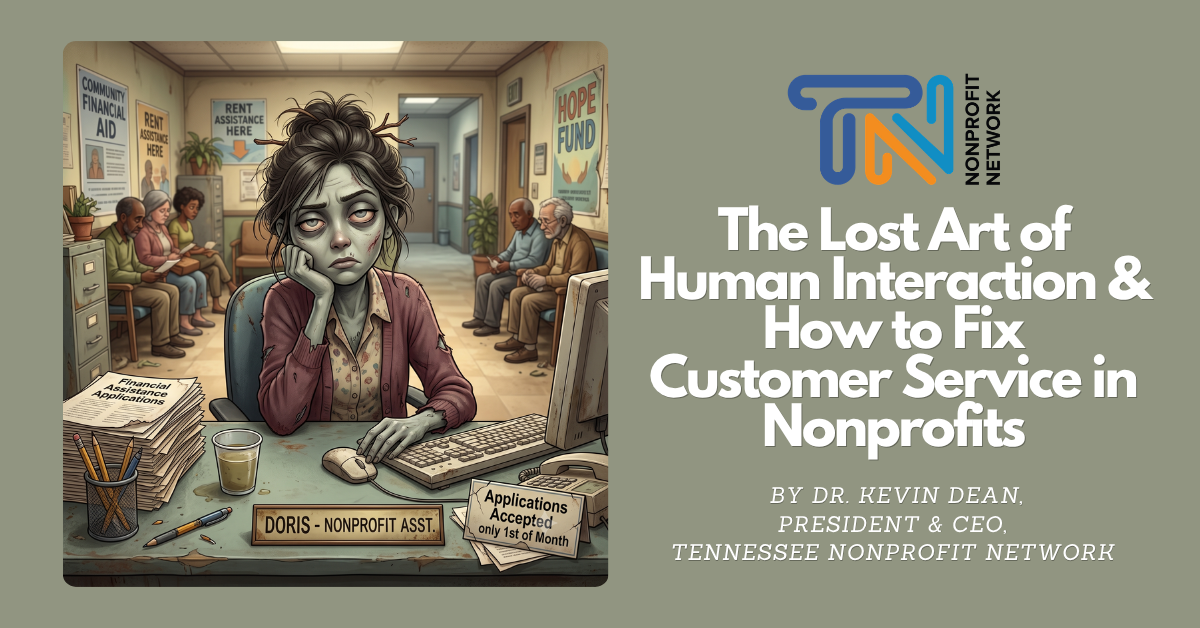
Caller #2 reached out asking for help receiving financial assistance. This was someone acting as a community member in need. The person who answered listened to the request, flatly stated, “We only accept new financial assistance applications on the first of the month,” and immediately hung up. No alternative resources offered, no empathy, no context. Just a dead line.
Caller #3 called asking how to sign up as a volunteer. A willing participant ready to donate their precious time to the mission! The staff member who picked up apparently had no idea what to do with this bizarre concept. She panicked, put the caller on hold, and simply never came back. Legend has it that caller is still on hold to this day, listening to tinny pan flute music in the void.
If a local nonprofit—an organization literally built on human connection—can treat potential donors, clients, and volunteers like minor inconveniences, we have a massive problem on our hands.
The Great Customer Service Decay of the 2020s
To be fair to our colleagues, this isn’t just happening in the social sector. Customer service across every single industry has plummeted off a cliff. I seem to have collected more examples of horrific customer service over the past year than I have in my entire lifetime.
Take, for example, a recent trip I made to grab takeout. I went to my favorite hot chicken joint down the street from Tennessee Nonprofit Network offices (I won’t name names, but if you know the area, you can probably figure out the spot). I walked in, expecting the usual aroma of spices and a quick transaction. Instead, I walked into a scene straight out of a silent movie.
The entire staff was clustered behind the counter, deeply involved in a group conversation. None of them looked up. I stood there at the register for a solid minute, attempting to project “I am a paying customer” energy into the room. Eventually, one of the workers turned around and looked directly at me.
And he just stared. Blankly. Intently. Like a statue carved out of mild indifference.
I guess he was waiting on me to speak first, as if we were playing a high-stakes game of chicken.
“I have a takeout order,” I offered gently.
He continued to stare at me in complete silence.
“My name is Kevin,” I added, hoping the introduction might unlock the next level of the interaction.
He turned around almost like a zombie, slowly grabbed my bag off the counter, handed it to me without ever making eye contact again or uttering a single syllable, and turned right back to his conversation with his coworkers. I haven’t been back since.
A few days later, I went to turn on the utilities at my new house. The woman behind the desk was actively playing a game on her iPhone when I walked up. Without looking up from her screen, she began speaking in a monotone hum that sounded like a vacuum cleaner running in another room. I had to ask her to repeat herself four times just to figure out what document she needed from me. Every time I asked “Pardon?”, she sighed heavily, as if my inability to translate low-frequency mumbling was a personal assault on her Homescapes streak.
Then came the coffee incident. I went to buy a cup of decaf at a local shop, only to find the front door locked tight. An employee was standing right outside the door, leaning against the glass.
“You can’t go in through the front door,” she said.
I waited for the rest of the sentence. Use the side door? We’re drive-thru only today? We’re closed? Nothing. Just complete silence. She provided zero explanation, no alternative entrance, and no instructions on how a person might exchange currency for coffee. I could clearly see other human beings inside drinking espresso, but apparently, the secret to entering was a classified state secret. I turned around and left, completely baffled.
Why Is This Happening, and Why Should Nonprofits Care?
Is it our collective overuse of smartphones? Have our social skills completely atrophied after years of COVID-era social distancing? Is it a fundamental lack of accountability structures in the modern workplace?
It’s probably a toxic cocktail of all three. But while a hot chicken joint or a utility company might be able to survive terrible customer service due to lack of competition or high demand, nonprofits cannot afford this luxury.
When a corporate business displays atrocious customer service, they lose a sale. When a nonprofit displays atrocious customer service, the ripple effects damage every dimension of our mission:
1. Donors Walk Away—Forever
A donor who gets brushed off, ignored, or treated like an interruption isn’t just going to “fill out the online form.” They are going to take their hard-earned money and give it to an organization that makes them feel valued. You will never know how many thousands of dollars in major gifts, recurring support, or legacy gifts were lost because an initial phone call or email felt like an interrogation or a chore.
2. Clients Are Re-Traumatized or Left Without Help
When someone reaches out to a nonprofit for financial assistance, housing support, food, or advocacy, they are often at a vulnerable point in their life. Treating them like a transaction, rushing them off the phone, or abruptly shutting the door in their face strips them of their dignity and can prevent them from seeking the life-saving help they actually need.
3. Volunteer Pipelines Evaporate
Volunteers are giving us their most precious asset: time. If getting onboarded feels like navigating an obstacle course managed by people who act annoyed that you showed up, volunteers will simply take their energy elsewhere or stay home altogether. A bad experience for a volunteer also frequently turns into a lost donor.
4. Community Trust Erodes
Word travels fast. If your organization develops a reputation for being cold, unresponsive, or difficult to work with, your community standing will sour, regardless of how impressive your program outcomes look on paper.
Because we serve the community and our work impacts real lives, we should have the absolute best customer service of any sector. Period.
8 Practical Ways to Fix Customer Service in Your Nonprofit
If we want to build a culture of excellence, we can’t just hope our staff figures it out on their own. We have to teach it, model it, and enforce it across every department. Here is how you can start transforming customer service in your organization today.
1. Launch a “Secret Shopper” Program
Don’t wait for a public crisis to find out how your organization interacts with the outside world. Do what my friend did: recruit a few trusted board members, friends, or colleagues from other organizations to test your systems.
Have someone call or email to inquire about making a donation. Have someone else reach out asking how to access services. Have a third person sign up to volunteer or ask a question about an upcoming event. Track how long it takes to get a response, what the tone of the communication is, and whether the person’s request was handled with warmth and clarity. The results will give you a real baseline of where to improve.
2. Establish Clear Rules and Train During Onboarding
We often assume that because someone chose to work in the nonprofit sector, they automatically know how to communicate professionally, handle an upset visitor, or steward a donor. That is a massive mistake.
Define what great customer service looks like in explicit detail across all roles. Do phone calls get returned within 24 hours? What is the standard greeting for office guests? How do case managers explain eligibility requirements with empathy? Include customer service training in your onboarding process for every single employee, and make it a regular topic of ongoing professional development.
3. Build Accountability Systems
Clear expectations are useless without accountability. If staff routinely ignore messages, speak brusquely to clients, or fail to follow up with volunteers, leadership must address it directly during performance evaluations and check-ins. Celebrate team members who demonstrate exceptional service, and correct bad habits before they become embedded in your culture.
4. Create a Client and Community Bill of Rights
Draft a clear, written statement that outlines how every individual interacting with your organization—whether a client, donor, volunteer, or visitor—can expect to be treated. Post it prominently in your building, feature it on your website, and include it in program handbooks. A Bill of Rights sets a public benchmark for your team and empowers the people you serve to expect dignity and respect.
5. Dedicate Time at Staff Meetings for Discussions
Customer service shouldn’t only come up when someone drops the ball. Make it a regular menu item on your staff meeting agendas. Share real examples of positive interactions, roleplay difficult scenarios, and ask your team what hurdles they face when trying to provide great service. Keeping the topic active helps everyone stay mindful of their daily interactions.
6. Connect Customer Service to Your Mission and Values
Frame customer service not as administrative overhead, but as an active expression of your mission. Treating a donor warmly, listening patiently to a client, or welcoming a volunteer isn’t extra work—it is the work. When staff across every department see that every touchpoint directly advances organizational goals, the overall culture elevates.
7. Build Accessible Feedback Channels
Give your community a clear voice. Create simple ways for clients, volunteers, and donors to share feedback about their experiences. This could be a brief follow-up survey, a suggestion box, or periodic check-in calls. Ensure leadership reviews this feedback regularly so you can catch broken processes or training gaps early.
8. Form a Customer Service Task Force
If your organization needs a broader overhaul, form a short-term task force with representatives from programs, development, operations, and leadership. Task them with mapping out every point of contact a person has with your organization, identifying friction points, and delivering concrete recommendations for improvement.
Moving Forward
We can’t fix the fact that the worker at the hot chicken place stared blankly into the void, or that the utility worker preferred Homescapes over answering basic questions. But we can control how we treat every single person who reaches out to our organizations.
Our work is too important, our missions are too vital, and our communities deserve far better than the modern customer service standard. Let’s build organizations where every donor, volunteer, and client is met with respect, responsiveness, and genuine human connection.