
by Dr. Kevin Dean, President & CEO, Tennessee Nonprofit Network
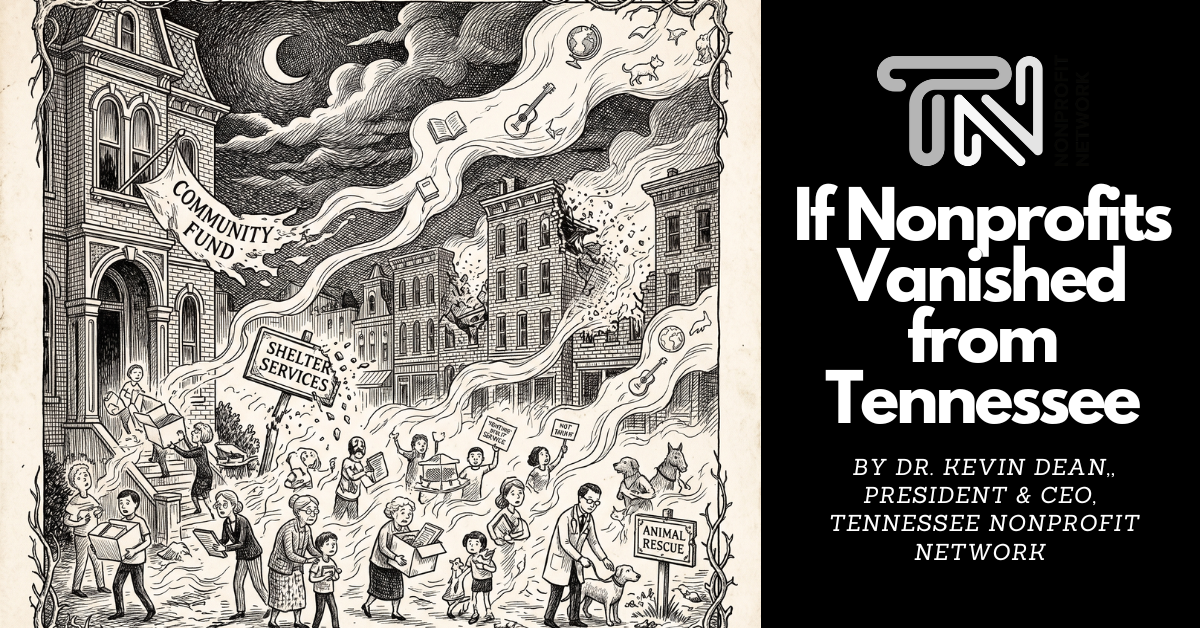
Imagine waking up on a Tuesday morning, pouring a cup of coffee, and discovering that a rapture of the remarkably organized has occurred. Every single 501(c)(3) organization in Tennessee has vanished into thin air. No warning, no exit interviews, no lingering smell of potluck chili or faint echoes of someone asking if you have a minute to talk about public radio. Just gone.
Initially, a certain subset of the population might celebrate. Corporate procurement departments would rejoice at the sudden, unexplained drop in requests for raffle items. Husbands across the state would sigh with relief, realizing they will never again be dragged to a Saturday night charity gala dressed in a tuxedo that smells faintly of cedar and regret, where they are pressured to bid $400 on a gift basket containing artisanal jam and a single yoga class.
But by lunchtime, the joke stops being funny. By Thursday, the state is in a state of absolute, unmitigated chaos.
When people think about nonprofits, they tend to picture a very narrow, highly romanticized slice of the sector. They think of a small group of well-meaning citizens saving stray puppies or distributing winter coats. While those things are real and necessary, they represent just the surface of an massive, invisible infrastructure. The reality is that the modern state cannot function without the nonprofit sector. If you pull that thread, the entire tapestry of Tennessee life unravels so fast it will give you whiplash.
The Day the Labor Market Collapsed
Let’s start with the economic reality check. There is a common misconception that the nonprofit sector is an adorable side hobby fueled entirely by retirees who have nothing better to do. In truth, it is an economic engine.
According to data analyzed by the Urban Institute, Tennessee is home to more than 38,000 nonprofits that collectively employ over 200,000 individuals. That is roughly 8% of the entire private workforce in the state. To put that in perspective, if all those organizations disappear overnight, Tennessee’s unemployment rate would instantly skyrocket from a historically low floor to numbers that would make the Great Depression look like a minor market correction.
Imagine 200,000 gainfully employed, tax-paying Tennesseans suddenly hit the pavement simultaneously. The state’s unemployment insurance portal would melt down within twenty minutes.
But it gets worse. Think about where those people work. We aren’t just talking about the traditional social service offices.
- Major hospital systems like St. Jude Children’s Research Hospital, Vanderbilt University Medical Center, and Baptist Memorial Health Care? Nonprofits.
- Major universities and colleges? Nonprofits.
- Every community clinic, mental health facility, and rural health outpost? Nonprofits.
If all nonprofits disappear, the healthcare system doesn’t just experience a bottleneck; it vaporizes. You can’t just walk into an emergency room in Memphis or Nashville because the emergency room itself, along with the nurses, doctors, billing specialists, and the guy who mops the floors, was part of a nonprofit entity. The sudden elimination of these institutions would instantly wipe out billions of dollars in real GDP. In the Nashville metropolitan area alone, nonprofits account for over $14 billion in real GDP. Pulling that out of the economy is the financial equivalent of dropping an anvil on a glass table.
The Great Tennessee Silence: Arts and Culture Go Dark
If you managed to survive the immediate economic shock, your Friday night plans are officially ruined. Tennessee prides itself on being a global capital of music, storytelling, and culture. But if the nonprofits vanish, the soundtrack of the Volunteer State goes entirely silent.
The Tennessee Arts Commission notes that the nonprofit arts and culture industry generates roughly $1.4 billion in annual economic activity across the state. This isn’t just about elite opera houses or experimental theater troupes. It’s the infrastructure of tourism.
Without nonprofits, the Country Music Hall of Fame and Museum closes its doors permanently. The Grand Ole Opry’s historical preservation efforts vanish. The National Civil Rights Museum in Memphis goes dark. Local community theaters, historic downtown preservation societies, and the small blues and bluegrass festivals that draw millions of out-of-state visitors to rural counties disappear.
Imagine downtown Nashville on a Saturday night without the cultural draws that keep the hotels booked. Tourism spending collapses. The $345 million in local and state tax revenues generated by arts attendees evaporates. Restaurants that depend on pre-show foot traffic suddenly find themselves staring at empty tables. The vibrant, creative energy that defines Tennessee’s global brand is replaced by the hollow hum of empty parking garages.
Crime, Safety, and the Overwhelmed Blue Line
Now let’s look at the dark side of this hypothetical experiment: crime and public safety. When a state budget gets tight, lawmakers love to talk about tough-on-crime initiatives, increased policing, and judicial reform. What rarely gets mentioned is that the frontline defense against rising crime rates isn’t a police cruiser; it’s a nonprofit caseworker.
Consider what happens when the following programs cease to exist:
- After-School Programs: Every Boys & Girls Club, YMCA, and neighborhood youth boxing gym closes at 3:00 PM. Thousands of kids across Memphis, Nashville, Chattanooga, and Knoxville are left with nowhere to go, no hot meal, and no adult supervision during the peak hours for juvenile crime.
- Re-Entry Services: The organizations that help formerly incarcerated individuals find housing, secure stable employment, and manage substance abuse recovery vanish. Recidivism rates would break records within a month. Without a path to legal employment, survival instincts take over.
- Domestic Violence Shelters: Women and children fleeing abusive households suddenly have no safe beds, no legal advocates, and no crisis hotlines. The burden of responding to these domestic crises falls squarely on local police departments, which are already understaffed and ill-equipped to provide long-term trauma care.
- Addiction Treatment: The vast majority of affordable, community-based drug and alcohol rehabilitation centers are run by charitable organizations. In the middle of an ongoing opioid crisis, the safety net is pulled away, leaving thousands of people in active addiction with zero institutional support.
Within weeks, municipal police departments would find themselves drowning. Officers would spend their entire shifts acting as makeshift social workers, mental health counselors, and housing navigators. The justice system would grind to a halt under the weight of an unprecedented surge in property crime, vagrancy, and domestic emergencies. Jail populations would swell past capacity, forcing counties to spend millions of dollars building new facilities to house people who previously just needed a stable outpatient program or a job training placement.
The Literal Hunger Games
If you want to see a community unravel in real-time, take away its food security.
Every single week, massive regional operations like Second Harvest Food Bank of Middle Tennessee, the Mid-South Food Bank in Memphis, and Second Harvest Food Bank of East Tennessee move millions of pounds of food through hundreds of partner agencies. They feed the senior citizen down the road whose Social Security check doesn’t cover both her heart medication and groceries. They feed the line-cook whose hours got cut, and the kids who rely on weekend backpack food programs so they don’t have to wait until Monday morning breakfast at school to eat.
If nonprofits disappear, those food supply chains stop. The warehouses lock up. The trucks sit idle.
The government cannot simply step in and fill this void by Monday morning. The bureaucracy required to approve, procure, and distribute grocery items to hundreds of thousands of food-insecure Tennesseans would take months, if not years, to legislate. In the meantime, hunger turns desperate very quickly. You would see grocery store shoplifting rise, food pantries replaced by long lines outside government offices, and a public health crisis of malnutrition that would swamp the few remaining for-profit clinics.
Animal Chaos in the Streets
On a lighter, but incredibly loud note, let’s talk about the animals.
If you think the local government animal control departments are prepared to handle the state’s pet population without the nonprofit sector, you are profoundly mistaken. Every humane society, private no-kill shelter, foster network, and spay-and-neuter clinic is a nonprofit.
Without them, the thousands of stray dogs and cats pulled off Tennessee streets every month have nowhere to go. Municipal shelters, which are legally required to accept animals but operate on shoestring public budgets, would face an impossible influx. Euthanasia rates would skyrocket to horrific levels within days.
The remaining animals would hit the streets. Packs of stray dogs would become a routine sight in suburban neighborhoods and urban alleys. The feral cat population would explode exponentially without trap-neuter-return programs, leading to a massive spike in rabies cases and local wildlife depletion. Your morning jog would look less like a suburban routine and more like a scene from a low-budget post-apocalyptic movie where you have to carry a stick to fend off a territorial golden retriever mix.
The Ultimate Irony: The Government Budget Meltdown
For decades, political rhetoric has often suggested that the private sector and small government should handle social ills, arguing that charity should be left to the community rather than the state. The ultimate irony of a nonprofit-free Tennessee is that it would force the absolute, monstrous expansion of government bureaucracy.
Nonprofits are essentially a massive subsidy for taxpayers. When a nonprofit runs a homeless shelter, a literacy program, or a job training initiative, they do it using a mix of federal grants, private donations, foundation support, and thousands of hours of unpaid volunteer labor.
According to economic impact studies, Tennessee residents give billions of dollars to charity each year, alongside millions of hours of volunteer service. In the Nashville region alone, volunteer hours are historically valued at over $1.1 billion in equivalent wages.
When those organizations disappear, the problems they solve don’t go away. The homeless population still needs shelter; the illiterate still need to learn to read; the disabled still need transportation. The public would look to the only entity left standing: the government.
To keep society from collapsing into absolute anarchy, the state and municipal governments would have to create massive new departments to handle everything from food distribution to mental health housing. Because government entities cannot legally rely on volunteer labor or tax-deductible private donations to fund core operations, they would have to pay full market rate for every single hour of labor, every single brick of real estate, and every single piece of equipment.
The state budget would explode. To fund this massive new apparatus, Tennessee would be forced to make a choice that would break its political identity: either let the state descend into third-world levels of infrastructure decay, or implement a massive, sweeping state income tax to cover the multi-billion-dollar shortfall left by the disappearing third sector.
A Very Quiet, Very Broken Volunteer State
The phrase “The Volunteer State” is painted on highway signs, stamped on license plates, and stitched into football jerseys. It is a point of immense cultural pride. But if you remove Tennessee Nonprofit Network, the thousands of small community foundations, the rural health networks, the urban youth centers, and the faith-based social services, the title becomes an empty historic relic.
Without the nonprofit sector, Tennessee loses its buffer. It loses the invisible padding that sits between the harsh realities of the free market and the rigid, slow-moving gears of government bureaucracy.
We would be left with a state where the hospitals are empty or inaccessible, the stages are dark, the streets are less safe, the jails are full, and the economic foundation is permanently cracked. The next time you see a seemingly mundane request for a donation, a flyer for a community cleanup, or a job posting for a chronically underpaid caseworker, remember that you aren’t looking at a luxury. You are looking at the essential scaffolding holding the state together. If it goes away, we all come crashing down with it.