by Dr. Kevin Dean, President & CEO, Tennessee Nonprofit Network
If you have ever tried to get a room full of Tennesseans to agree on something, you know it is an exercise in profound futility. Ask ten people from Memphis, Nashville, Knoxville, and Chattanooga about the best barbecue, the correct college football team, or whether the interstate system is a grand urban planning experiment or a psychological torture device, and you will spark a generational feud. We are a state deeply divided by geography, musical heritage, and how much sugar belongs in corn bread.
However, extensive polling across the state recently revealed a genuine miracle. Regardless of political affiliation, geographical location, ideological leanings, or demographic backgrounds, three specific messaging frames consistently scored through the roof. It turns out that whether someone lives in a high-rise condo in downtown Nashville or on a multi-acre farm in West Tennessee, their brain processes value in the exact same way.
When it comes to engaging the public, the media, and donors, the traditional appeal of “please help us do good out of the kindness of your heart” is officially dead. In fact, it has been dead for years; we have just been weekend-at-bernie-ing its corpse around the state house. Pleading for scraps gets you treated like a stray dog on a porch: people might throw you a leftover biscuit if they are feeling generous, but they will never invite you inside to look at the budget.
If you want to cut through the noise anywhere from East Tennessee down to the Mississippi River, you need to abandon the charity mindset immediately. Nobody has the emotional bandwidth for vague moral obligations anymore. Instead, you must adopt a strategy built on cold necessity, economic reality, and a healthy dose of existential panic. No, the goal isn’t to scare everyone to death, but we do need to make sure that every Tennessean knows that without nonprofits in this state, their lives will suffer whether they receive services from nonprofits or not.

Before diving into how to deploy these tactics across different subsectors, let us preview the three distinct strategies that completely flipped the script on statewide public opinion:
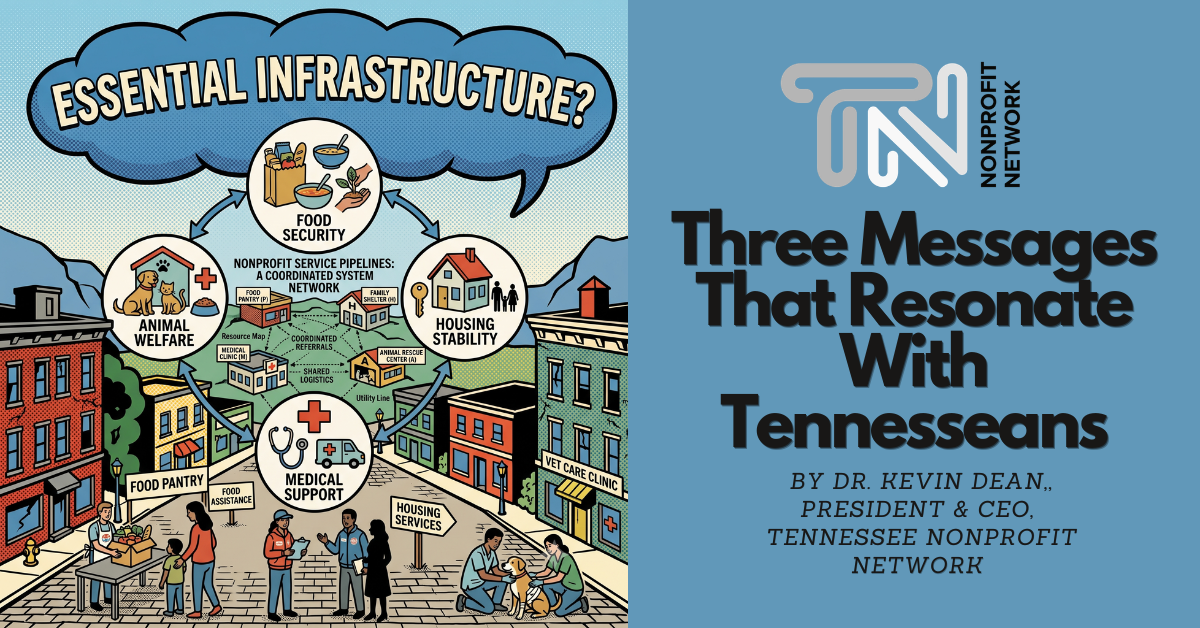
- Essential Infrastructure, Not Charity: This frame shifts your work from an optional, nice-to-have luxury to an absolute necessity. It removes the element of choice and forces the public to view your organization as a permanent, non-negotiable structural fixture. It turns out people do not want to fund your good intentions, but they are terrified of a broken pipe.
- What If We Weren’t Here?: A psychological frame that leverages loss aversion. Instead of highlighting what you do, it forces audiences to confront the immediate, chaotic fallout that would land directly on their doorsteps if your organization instantly vanished. It replaces gentle warm-fuzzies with a sharp jolt of baseline anxiety.
- Economic & Workforce Impact: The corporate and fiscal frame. It drops the emotional pleading and leads entirely with your balance sheet, your payroll, and your direct contribution to local workforce stability and regional consumer spending. It proves that you are not a club of hobbyists; you are an economic engine.
By understanding the mechanics of these three approaches, you can stop asking for favors and start presenting a bill for services rendered to keep civil society from collapsing. Let us break down how each one works, how to pitch it, and how to adapt it to the specific flavor of crisis your subsector manages every single day.
1. Essential Infrastructure, Not Charity
Charity sounds like a boutique clothing store or a premium streaming subscription. It is the very first thing people cut from the budget when inflation ticks up or they realize they are spending too much money on artisanal pickles. Infrastructure, on the other hand, is non-negotiable. Nobody holds a town hall meeting to debate whether a bridge over the Tennessee River is a nice thing to have; they just fix it because without it, the town grinds to a halt and everyone ends up stuck on the wrong side of the water. You must frame your organization exactly the same way.
Strong communities require essential infrastructure. Behind every local solution, there is a community service provider making it happen.
When you use the charity frame, you are standing on the sidewalk with an upturned hat, hoping someone has spare change. When you use the infrastructure frame, you are the utility worker showing up with a wrench to fix the water line. You are not asking for a donation; you are presenting the operational costs of maintaining a functional civilization.
How to use this with the media
When talking to journalists, stop pitching soft, tear-jerking human-interest pieces that position your organization as a band of well-meaning saints who survive on good vibes and donated coffee. Editors are tired of those stories, and readers scroll past them to find out which local restaurant just failed its health inspection. Instead, frame your press releases as operational updates on community stability.
- The Pitch: Our latest quarterly data shows a five percent increase in community service utilization across the region. We are briefing local media on how our organization is managing this increased pressure on the area’s social infrastructure and what it means for municipal capacity.
- The Soundbite: We are not a club of nice people doing nice things on weekends. We are the human safety pipeline for this county. Just like the water department handles the physical pipes, we handle the human infrastructure. If our pipeline cracks, the whole community floods, and city hall does not have enough buckets to catch the water.
How to use this with donors
Donors like to feel important, but major donors especially like to invest in things that will outlive them. They do not want to buy a temporary band-aid; they want to lay asphalt. Shift their mindset from giving alms to investing in a capital project.
- The Appeal Letter: Your investment this year is not a donation to keep a nice program running. It is an investment in the foundational infrastructure of this city. You do not fund the local highway department because you feel a deep, spiritual affection for asphalt; you fund it because you need to drive to work without popping a tire. We are asking you to fund the human infrastructure that keeps our workforce stable, our neighborhoods quiet, and our schools functional.
Subsector Applications
Homeless Shelters
Stop talking about providing a warm bed out of pity. Pity is a resource that dries up faster than a puddle in a Memphis August. Start talking about regional housing logistics and municipal flow.
- The Message: A community cannot attract new business if its public spaces are in crisis. Our shelter operates as the baseline housing infrastructure that prevents public spaces from becoming permanent encampments. We are the logistics managers who keep the human traffic of this city moving toward stability.
Food Banks
If you tell a donor that people are hungry, they will give you twenty dollars and feel good about themselves for an hour. If you tell them you manage a critical node in the state’s agricultural and supply chain network, they will take you seriously.
- The Message: We run the regional supply chain for nutritional stability. You cannot have an educated workforce or a productive factory if the workers are running on empty. We are the food logistics network that keeps the local economy fueled and ready to work.
Afterschool Programs
Stop selling afterschool care as a place where kids do crafts and eat carrot sticks. It is an essential safe educational space for the children of the people who make the economy turn.
- The Message: Childcare is economic infrastructure, pure and simple. Our afterschool facilities are the essential safe and educational spaces that allow the regional workforce to remain at their desks until five o’clock without worrying about their children wandering into traffic. We keep the assembly lines moving by keeping the kids secure.
Literacy Programs
Phonics are great, but literacy is ultimately about economic compatibility.
- The Message: Literacy is the operating system that runs our local economy. If twenty percent of our population cannot read a safety manual, navigate an instructional manual, or pass a commercial driver’s license test, our local industrial infrastructure fails. We build the literacy foundation that allows every other business in this county to operate safely.
Animal Shelters
Do not lead with sad eyes and acoustic guitar music. Lead with public safety and sanitation.
- The Message: Public safety and animal control are foundational to a clean, attractive city. We are the municipal partner managing the animal population infrastructure. We keep rabies rates down, keep stray packs off the sidewalks, and ensure neighborhoods remain safe, walkable, and attractive to property buyers.
2. What If We Weren’t Here?
The second frame relies on making your absence terrifyingly concrete. Human beings are notoriously bad at appreciating things that work perfectly in the background. Nobody stands in their bathroom and applauds the sewer system every morning; they only think about it when the toilet backs up into the hallway.
To make people understand your true value, you must force the media, the public, and your donors to imagine their community tomorrow morning if your organization suddenly vanished into thin air. Do not let them think of your departure as a sad event; make them see it as a structural disaster. Ask the hard questions: Who picks up the slack? What happens to the schools, the local government budgets, the police departments, and the hospitals? Make the absence local, raw, and specific.
How to use this with the media
Force journalists to look at the terrifying math of your absence. If a local news station realizes that your sudden disappearance would cause an immediate crisis at city hall or a traffic jam at the emergency room, they will cover your story with the same urgency they reserve for an approaching tornado.
- The Pitch: If our doors close on Friday, more than four hundred individuals will have nowhere to go on Monday morning. We are hosting a briefing to detail exactly how this sudden gap will impact local emergency room wait times and police department dispatch lines over the weekend.
- The Soundbite: Do not look at us as a charity line item that you can cut when times get tough. Look at us as a shield. If we drop the shield, all of those problems do not just evaporate into the ether; they land directly on the taxpayer’s doorstep, on the desks of the city council, and in the waiting rooms of our local hospitals.
How to use this with donors
Instead of showing donors a picture of a smiling child holding a puppy, show them the metaphorical crater left behind if they stop writing checks. Leverage their natural aversion to chaos.
- The Appeal Letter: Close your eyes and picture this town tomorrow morning if we did not open our doors. Picture the line of parents with nowhere to drop their kids before their shifts start, the elderly citizens missing their medical transports, and the immediate strain placed on our local police force. We are the thin line between a stable community and absolute civic gridlock. Your gift ensures that tomorrow morning, the city still works.
Subsector Applications
Homeless Shelters
If you close a shelter, those individuals do not disappear; they simply change location. Make that location highly specific to the people who hold the purse strings.
- The Message: If our shelter closes tonight, five hundred people will be sleeping on the downtown sidewalks tomorrow morning. The police department will be overwhelmed with nuisance calls, business owners will be clearing storefront steps, and the city will face an immediate public health emergency. We are the buffer keeping that wave from hitting your front door.
Food Banks
Hunger is quiet until it suddenly becomes very loud. Remind people how close they are to that noise.
- The Message: If our trucks stop rolling, fifteen thousand children in this county go to school hungry on Monday. Within forty-eight hours, school behavioral disruptions will spike, grocery store shoplifting will rise, and emergency rooms will see an influx of malnourished toddlers. We are the only thing stopping that wave from crashing through the school district.
Afterschool Programs
Parents who lose childcare do not just figure it out; they drop out of the economy or leave their kids to their own devices.
- The Message: If we lock our doors, three hundred middle school kids will hit the pavement at three o’clock with zero supervision. Juvenile crime rates will tick up, property damage will rise, and working parents will be forced to leave their jobs early, costing local businesses thousands in lost productivity. We keep those kids off the streets and in a classroom so you can keep running your business.
Literacy Programs
Show the long-term compounding interest of neglect.
- The Message: If our program vanishes, the local adults who rely on us to understand their medication labels, fill out job applications, or read street signs are left completely stranded. Local businesses will lose their entry-level applicant pool overnight, and the cycle of generational poverty will lock down even tighter. We are the key to their self-sufficiency; without us, they become permanent dependents on county resources.
Animal Shelters
Remind the community what a town actually looks like when animal management stops.
- The Message: If we stop taking in animals today, the local animal control officers will have nowhere to take strays. Within a month, packs of feral dogs will roam local parks, dog bites will skyrocket at the local clinic, and the city will be forced to spend millions building a municipal holding facility from scratch. We are the wall protecting your neighborhood from a literal public safety nightmare.
3. Economic & Workforce Impact
Nonprofits are businesses. They are not cute little hobbies run by wealthy retirees who have nothing better to do on a Tuesday afternoon. They create local jobs, pay competitive wages, purchase goods and services from local vendors, stimulate regional economies, and provide the exact services that allow the rest of the workforce to actually go to work.
In Tennessee, numbers matter immensely. If you want to impress a room full of business leaders, chamber of commerce executives, or conservative lawmakers, you have to lead with your economic footprint. Stop talking about feelings and start talking about your balance sheet, your payroll, and your return on investment. If you sound like a social worker, they will nod politely and check their watches. If you sound like a CFO, they will sit up and look at your slides.
How to use this with the media
Business reporters rarely cover nonprofits because they think they only belong in the living section of the paper next to the recipes and the wedding announcements. Force your way into the business section by talking about cold, hard cash.
- The Pitch: Our organization is releasing its annual economic impact report, showing that we contributed millions to the regional economy through local purchasing, payroll taxes, and direct employment. We are available to discuss our role as a major economic driver in the county.
- The Soundbite: We are an economic engine. We employ seventy full-time staff members who buy houses, pay taxes, and shop at local grocery stores. We buy our office supplies, our technology, and our fuel from local businesses. If we were a manufacturing plant with this much economic output, the governor would be at our ribbon-cutting ceremony with a giant pair of scissors.
How to use this with donors
Corporate donors and foundation trustees love efficiency and return on investment. They want to know that their money is working hard, not just sitting in a warm bath of sentimentality. Speak their language fluently.
- The Appeal Letter: Every dollar you invest in our organization yields a measurable economic return for this community. By stabilizing families, improving health outcomes, and preparing individuals for employment, we drastically reduce the tax burden on municipal services and expand the local consumer base. This is not a handout; it is a high-yield investment in the financial health of the region.
Subsector Applications
Homeless Shelters
Frame housing as a cost-containment strategy for the taxpayer.
- The Message: An unhoused person utilizing emergency rooms and county jails costs the city an average of forty thousand dollars a year in tax money. By moving them into stable housing and job training through our facility, we save local taxpayers hundreds of thousands of dollars annually while adding productive workers back into the economy. We are a deficit-reduction tool.
Food Banks
Position your operations as a massive, hyper-efficient logistics enterprise.
- The Message: We are a major logistics corporation. We move millions of pounds of inventory through the state every year, contracting with local trucking companies and purchasing directly from regional farmers. We do this at a fraction of the cost of a commercial enterprise, saving the community millions in food insecurity costs while supporting the local agricultural sector.
Afterschool Programs
Talk about workforce retention and corporate absenteeism.
- The Message: Our program is the single biggest workforce retention tool for working parents in this school district. By providing reliable, high-quality care, we prevent absenteeism in local factories and corporate offices, saving regional employers massive amounts of money in turnover, scheduling disruptions, and lost productivity. We keep the engines of commerce staffed.
Literacy Programs
Frame reading skills as workforce development and corporate risk mitigation.
- The Message: Adult low literacy costs the regional economy millions in lost productivity and workplace accidents every single year. By teaching adults to read, we unlock an entirely new pool of workers for local manufacturing plants, driving down corporate training costs and raising household incomes across the county. We are a talent pipeline.
Animal Shelters
Connect pet ownership to consumer spending and the local service economy.
- The Message: The pet industry is a massive economic driver. By placing thousands of animals into local homes each year, we feed a massive local ecosystem of veterinarians, groomers, pet supply stores, and boarding facilities. We are a direct pipeline to consumer spending in the pet services sector, driving sales tax revenue straight back into the county.
The Master Class in Synthesis
To truly master this statewide strategy, you must learn to blend these three frames into a seamless narrative. When you combine infrastructure, the threat of absence, and hard economic data, your message becomes entirely unassailable. You cease being an organization that is asking for a favor, and you become an essential pillar of the community that no one can afford to lose.
Consider this standard, ineffective pitch:
“Please donate to our literacy program. We love helping adults learn to read so they can have a better life and feel proud of themselves.”
It is sweet. It is kind. It makes people feel nice inside, and it results in a twenty-dollar check from someone who will forget your name by dinner time. Now, watch what happens when you synthesize the three statewide strategies into a single, cohesive message:
“Strong regional economies require essential educational infrastructure, and our literacy program is the software that keeps this workforce running. If our doors close this Friday, local manufacturing plants will immediately lose access to their primary pipeline of entry-level talent, and the county will face an immediate spike in workplace safety liabilities. We employ twelve full-time staff members, inject half a million dollars directly into local businesses, and save taxpayers thousands in municipal service costs by moving individuals off assistance and onto local payrolls. We aren’t asking you to fund a charity; we are presenting the budget to keep our workforce functional.”
We have to start shifting the conversation away from standard sentimentality and toward structural reality so that we change the power dynamic entirely. You are no longer standing at the kitchen door hoping for crumbs; you are sitting at the head of the table showing the community exactly how you build the house. Stop apologizing for needing money, stop begging for pity, and start framing your work as the non-negotiable infrastructure that keeps Tennessee running.