
by Dr. Kevin Dean, President & CEO, Tennessee Nonprofit Network
Lately, I have been teaching our Working with the Media: Telling Your Nonprofit’s Story workshop across the state. This course was created as part of a multi-part series designed to help nonprofits tell their story better to the media, their donors, and the community at large. Nonprofits are often the invisible backbone of our country, but we aren’t always great at telling our story. We silently do the work to make sure people don’t fall through the cracks, routinely providing the essential services that government agencies and for-profit companies completely ignore. We are kind of like janitorial staff….overlooked, underpaid, underappreciated, and doing the work no one else wants to do. Do you know what your life would be like if there were no janitorial staff at your work, at Target, at your favorite pizza restaurant? Life would be really smelly. Yet we often forget about them, ignore them, and forget that somebody has to take out the trash every day or your office breakroom would be covered in maggots. (Ew but true!)
Despite being critical to the infrastructure of our nation, nonprofits rarely make the front page of the newspaper. We are almost never the lead story on the nightly news. On the rare occasion that a camera crew does show up at our doors, it is almost exclusively because something went terribly wrong, not because we successfully managed to house, feed, or educate hundreds of people the day before. This reality makes telling our story incredibly challenging. When you are systematically overlooked by the media, your work goes undiscovered by the very people who need to hear about it most.
In the workshop, one of the first activities we tackle is crafting a message that resonates. In corporate-speak, this is what people call the elevator speech: a brief, punchy explanation of what your organization does and why it matters. The theory is charmingly simple. Imagine you step into an elevator with a complete stranger on the ground floor of a very tall building. By the time you reach the penthouse, you are supposed to have delivered a pitch so short, sweet, and profoundly resonant that this stranger will immediately cut you a check or assign a reporter to cover your next gala. True story: I actually had a person write me a check in an elevator once – it can happen!
During these sessions, I ask the participants to craft their own short elevator pitch targeted specifically at the media. What never ceases to amuse and slightly alarm me is that the room is usually packed with seasoned communications professionals, and even they struggle mightily with the assignment. This is not a knock against them. Writing an elevator speech is an existential nightmare. Condensing decades of systemic advocacy, human suffering, and operational logistics into the span of a thirty-second vertical ride is a form of psychological torture.
Over the course of teaching this workshop, I have noticed several recurring traps that trip us up. Here is a breakdown of what keeps getting in our way, along with a few practical suggestions for how to stop sabotaging our own stories.
The Jargon Trap and Nonprofit Word Salad
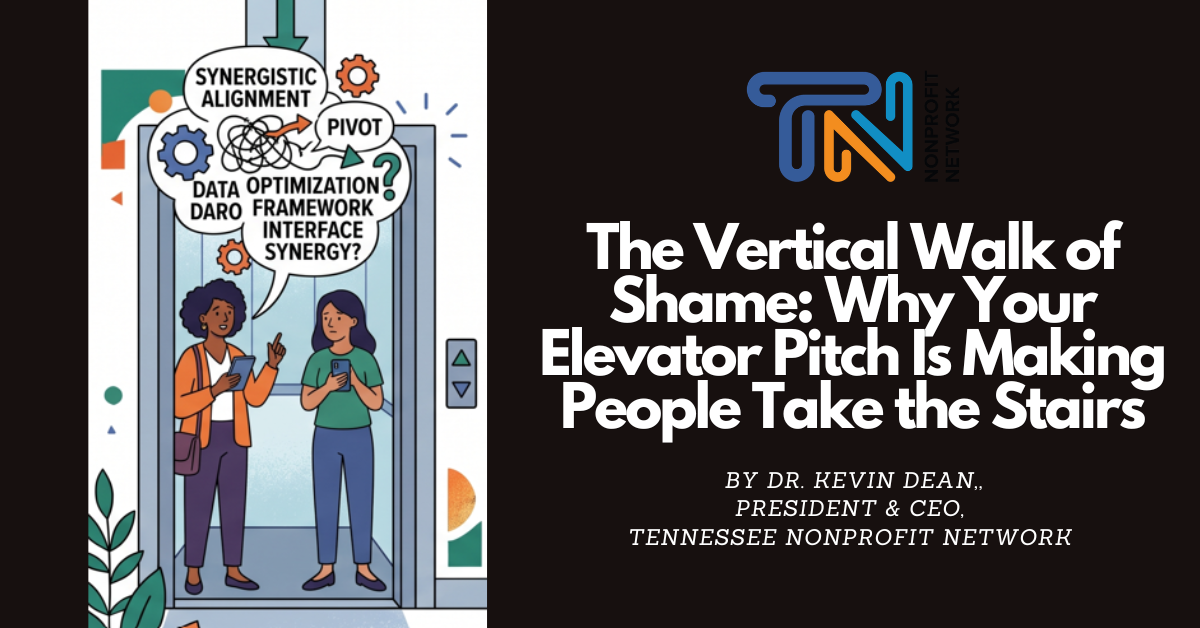
The first obstacle we consistently encounter is our collective addiction to professional vocabulary that means absolutely nothing to anyone outside our specific office building. When asked what they do, many nonprofit professionals open their mouths and release a cloud of linguistic dust: holistic, synergistic, capacity-building, stakeholder engagement, and sustainable ecosystem optimization.
If you tell a stranger in an elevator that your organization “utilizes a multi-tiered, synergistic approach to empower cross-sector stakeholders in building sustainable community ecosystems,” they will not ask how they can help. They will press the button for the very next floor, step out into a hallway they did not intend to visit, and walk away slowly. This kind of language is a defensive mechanism. We use it because we want to sound serious and sophisticated, but it actually functions as a barrier to human connection.
The Alternative
Speak like a normal person who is currently consuming an appetizer at a casual neighborhood restaurant. If your organization provides after-school tutoring for kids from families with low incomes, just say that.
- Instead of: “We operationalize localized interventions to mitigate educational disparities among marginalized youth demographics.”
- Try: “We run free after-school tutoring programs so kids in our neighborhood don’t fall behind in math and reading.”
The second option does not require a glossary to decode. It allows the listener to instantly visualize what you actually do between the hours of three and six in the afternoon.
Politically Charged Language and Fatigue
We live in an era where language is heavily weaponized, and the nonprofit sector is entirely complicit in this trend. When crafting messages, organizations frequently lean on heavily coded political language that immediately alienates half the room. Depending on your organization’s ideological leaning, your pitch might be packed with “woke” academic terminology or, conversely, MAGA-adjacent populist rhetoric.
The problem with using hyper-specific cultural catchphrases is two-fold: it instantly triggers the listener’s political defense mechanisms, and it contributes to massive language fatigue. People are exhausted by the endless culture wars. When a reporter or a donor hears certain buzzwords, they stop listening to your mission and start calculating which political camp you belong to. If your elevator pitch sounds like a cable news commentary segment, you have failed.
The Alternative
Strip away the partisan signaling and focus on shared human realities. Hunger is not a partisan issue. Literacy is not a partisan issue. Clean drinking water should not be a political debate.
If you find your pitch relies heavily on phrases that are currently being debated on social media, replace them with descriptions of actual human behavior and concrete conditions. Speak about the problem itself, not the academic theory surrounding the problem. This keeps the conversation focused on your work rather than the broader national political gridlock.
The Annual Report Robot
Another common pitfall is the presentation that sounds like it was generated by a machine that swallowed an annual report or a foundation grant application. This pitch usually begins with a verbatim recitation of a seventy-word mission statement, immediately followed by three rapidly fired bullet points containing dense statistical data.
“Our mission is to proactively foster equitable access to nutritional sustenance. Last year, we distributed 412,500 pounds of shelf-stable goods, engaged 1,400 volunteer hours, and serviced 42 distinct zip codes.”
While those numbers are impressive to your board of directors and your auditors, they are completely numbing to a stranger in a moving metal box. Statistics do not pull at the heartstrings. Data points provide scale, but they do not provide soul. When you lead with a spreadsheet, you invite the listener to analyze your efficiency rather than connect with your humanity.
The Alternative
Humanize the data by leading with a single narrative element, then use the statistic as a supporting actor rather than the main character.
- Instead of leading with the total poundage of food moved: Start with the empty refrigerator.
- Try: “We make sure parents don’t have to choose between paying rent and buying groceries. Last year, that meant keeping food on the table for thousands of families in our city.”
The statistic is still there implicitly, but it is framed around a choice that any human being can understand.
The Poverty Porn Detour
On the opposite end of the spectrum from the corporate robot is the organization that resorts to what can only be described as poverty porn. This is the pitch that immediately launches into a deeply tragic, highly detailed story about a marginalized individual experiencing their absolute worst moment, followed by a dramatic reveal of how our organization swooped in to rescue them.
While this tactic has been a fundraising staple for decades, it is increasingly problematic and ineffective. It reduces complex human beings to mere props for your organization’s savior narrative. Furthermore, for a journalist or a sophisticated donor, it feels emotionally manipulative. If your pitch relies entirely on shock value or exploitation of trauma to get attention, you are degrading the very people you exist to serve.
The Alternative
Focus on resilience and partnership rather than rescue. Frame the people you serve as the protagonists of their own lives, and position your organization as a resource that helped them overcome an institutional barrier.
Talk about the systemic hurdle that was removed, not just the individual suffering. This approach respects the dignity of your clients while still demonstrating the profound necessity of your services.
Forgetting the Why
Many elevator speeches describe what an organization does in excruciating detail without ever mentioning why the organization needs to exist in the first place. You might spend thirty seconds explaining your intake process, your software system, and your distribution schedule, leaving the listener entirely clear on your daily routine but completely confused about the underlying crisis.
If you do not start with the “why,” you are asking people to care about your logistics before they care about your cause. Simon Sinek made a whole career out of telling people to start with why, and nowhere is this advice more desperately needed than in the nonprofit sector. We need to clearly articulate what would happen to our community if our organization vanished tomorrow morning. What is the root problem we are trying to solve?
The Alternative
Before you mention your programs, clearly state the reality of the problem.
- Example: “In our city, one in five children goes to bed hungry every night. That is why we exist.”
Once you establish that baseline reality, your explanation of your programs suddenly makes sense. The listener now understands that your mobile food trucks are not just a quirky logistical project; they are a direct response to a localized tragedy.
The Modesty Complex: Failing to Situate Ourselves as Experts
Nonprofit workers are notoriously modest. We love to talk about our passion, our hope, and our commitment, but we are terrified of calling ourselves experts. When we talk to the media and often donors, this modesty is fatal. Journalists do not interview people because they are nice; they interview people because they know what they are talking about. Donors do not give to people who they think are sweet; they give to people who they believe can solve the problem.
When your elevator pitch frames your organization as a group of well-meaning volunteers who just really care a lot, you are inadvertently telling the media and donors that you are not a reliable source for a hard news story or worthy of their donation. You are telling them you are a feature story for a slow Sunday morning.
The Alternative
Own your expertise. Use language that conveys authority, data-backed insight, and long-term experience.
Do not say, “We try our best to help with housing.” Say, “We track housing trends across the state and implement the most effective foreclosure prevention strategies available.”
Claim your seat at the table. If you don’t position yourself as the expert, the media will find a university professor or a corporate consultant who has spent a fraction of the time on the ground that you have. And donors will find the nonprofit organization that seems to have the expertise over the good intentions.
Ignoring the Audience in the Elevator
An elevator speech is not a monologue delivered into a void; it is a conversation with a specific person. One of the greatest mistakes we make is failing to understand how the problem we are trying to solve impacts the person standing right next to us.
If you are talking to a business reporter, a local resident, or a corporate donor, they all look at the world through different lenses. If your pitch is entirely self-centered—focused exclusively on what your organization needs rather than how your work improves the shared ecosystem of the city—you will lose them. A business owner might not immediately connect with a youth arts program until you explain that arts education drastically improves high school graduation rates, which directly creates a more stable, qualified local workforce.
The Alternative
Quickly connect the dots between your mission and the listener’s reality. If you are speaking to someone in your community, remind them that a healthy city requires strong safety nets for everyone.
Show how your work reduces the strain on public infrastructure, improves public health, or enriches the cultural fabric that keeps property values stable. Make it impossible for them to say, “That’s nice for those people, but it has nothing to do with me.”
The “We’re Just Like Everyone Else” Blunder
Finally, we regularly fail to set ourselves apart from other organizations or establish our competitive advantage. The nonprofit sector is crowded. In any major city, there are likely dozens of organizations working on housing, education, or food insecurity. When your elevator speech is generic, you blend into the background.
If your pitch is simply, “We are a nonprofit that helps the homeless,” you have given the listener no reason to invest in your specific solution over the shelter down the street. We often avoid talking about our competitive advantage because we think collaboration means pretending everyone does the exact same thing. It doesn’t.
The Alternative
Identify your unique value proposition and state it clearly. Do you have the lowest administrative overhead in the region? Do you use a specific evidence-based model that no one else uses? Do you serve a geographical area that has been completely abandoned by other agencies?
Find that specific differentiator and make it a pillar of your pitch.
- Example: “While most shelters only offer temporary overnight housing, we are the only organization in the county that couples housing with immediate, long-term mental health counseling and job placement under one roof.”
Now, the listener understands exactly where your organization fits into the broader landscape.
Putting It Together
Crafting an elevator pitch is an ongoing process of editing, refining, and stripping away the institutional habits that comfort us but alienate everyone else. If you can avoid the word salads, step away from the political rhetoric, leave the annual report statistics in your briefcase, and speak with the authority of an expert who understands their audience, you might actually get that reporter to stay on the elevator past their floor.