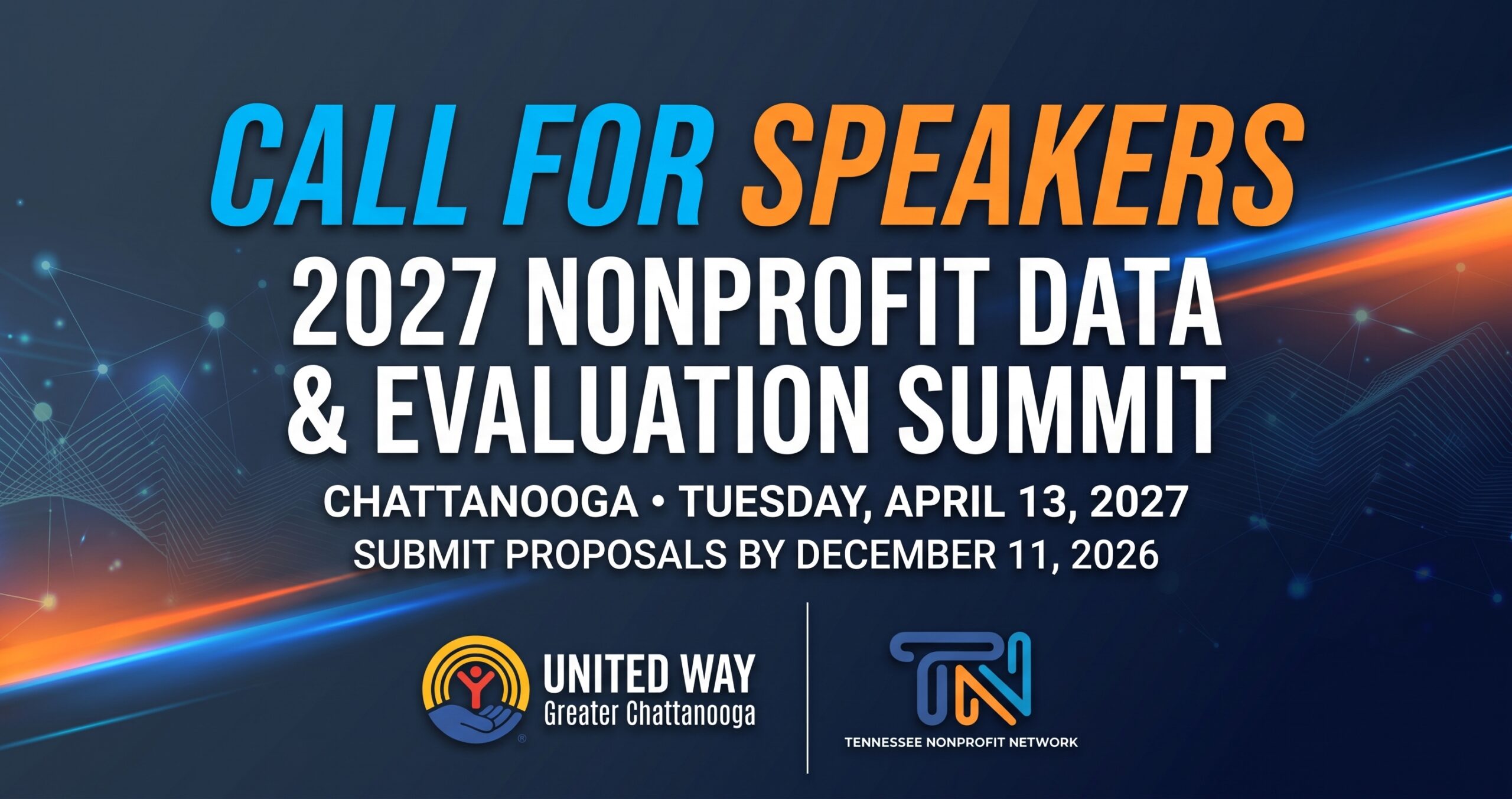
Tennessee Nonprofit Network (TNN), in partnership with United Way of Greater Chattanooga, invites evaluators, practitioners, funders, and nonprofit leaders to submit breakout session proposals for the 2027 Nonprofit Impact & Evaluation Summit in Chattanooga on Tuesday, April 13, 2027.
Nonprofits are being asked to prove their value more clearly than ever. Funders want outcomes, legislators want community and economic impact, boards want data they can govern with, and neighbors want to know the work is making a difference. Yet many organizations still treat data as a compliance task rather than a tool for learning and change.
This summit is designed to meet that moment. It is a one-day gathering for anyone who works with data, evaluation, and impact, from executive directors shaping strategy to program coordinators tracking daily outcomes. We are looking for sessions that help attendees move beyond compliance and into meaningful change: measuring what matters, telling honest stories with data, and using evidence to strengthen programs and communities.
Learn more https://members.tnnonprofits.org/events/nonprofit-impact-and-evaluation-summit
What We’re Looking For
We want sessions that are practical, engaging, and rooted in real experience, not theory alone. Attendees should leave with something they can use the following Monday.
Successful proposals will:
- Move from theory to practice with tools, templates, worksheets, or step-by-step methods attendees can apply right away.
- Right-size the work so it is useful to a two-person nonprofit as well as a large agency.
- Use clear, human-centered language instead of jargon, so data feels approachable rather than intimidating.
- Center community voice and treat the people behind the data with dignity, transparency, and care.
- Show real results through case studies, before-and-after examples, or lessons learned, including what did not work.
- Bring fresh perspectives across communities, geographies, organization sizes, and disciplines, including rural and urban Tennessee.
- Connect clearly to one of the summit’s learning pathways below.
Presenters should demonstrate
- Proven expertise in nonprofit data, evaluation, or impact, through professional practice, research, or lived experience.
- Experience presenting or training, with a facilitation style rooted in adult learning principles. Please don’t simply read from your slides.
- An interactive approach that builds in discussion, reflection, hands-on practice, or small-group work.
- Cultural humility and responsiveness, creating a welcoming, respectful learning space for attendees from all backgrounds.
- Well-designed materials that are visually clear, accessible, and easy to follow.
- Comfort with basic presentation technology.
We welcome first-time presenters with strong practical experience, as well as emerging evaluators and data practitioners early in their careers.
Learning Pathways
The summit is built around five learning pathways. Choose a primary pathway and, if it fits, a second choice. The suggested topics are a starting point; related topics are welcome.
1. Leading with Data: Governance, Strategy & Culture
For executive directors, senior staff, and board members who use evidence to guide decisions and build organizations where data is a strategic asset, not a compliance burden.
2. Telling the Impact Story: Donors, Funders & Policymakers
For development, communications, and policy professionals who turn results into stories that build trust and move resources.
3. Measuring What Matters: Evaluation Design & Methods
For program leaders and evaluators designing evaluation that is rigorous, equitable, and right-sized.
4. Data Tools, Systems & Technology
For operations, data, and technology staff building the systems that make good data possible.
5. Shared Impact: Collaboration & Frontline Practice
For coalition partners, collective impact leaders, and frontline teams who collect and share data every day.
Suggested Session Topics
We are seeking practical, actionable, and engaging sessions tailored to nonprofit professionals across all experience levels and organizational sizes. Proposals may address one of the following nineteen timely topics or introduce a related subject:
- Providing evaluation and impact data to board members for strategic governance.
- Data driven decision making.
- Storytelling with data to engage donors, funders, and community stakeholders.
- Connecting organizational impact measurement to broader public policy initiatives.
- Communicating community impact and economic impact to local and state legislators.
- Practical and ethical applications of artificial intelligence in nonprofit data analysis and reporting.
- Right-sizing evaluation frameworks for small-shop nonprofits with limited budgets and staff.
- Centering community voice and lived experience in equitable evaluation design.
- Moving from tracking program outputs to measuring long-term, sustainable community outcomes.
- Building an internal culture of learning where staff view data as a strategic asset rather than a compliance burden.
- Data privacy, cybersecurity, and ethical data collection when serving vulnerable populations.
- Designing accessible, low-cost data dashboards using everyday tools for real-time decision-making.
- Collaborative data sharing across coalition partners to measure collective community impact.
- Qualitative data collection methods: capturing systematic insights through interviews, focus groups, and case studies.
- Using geographic information systems (GIS) and neighborhood mapping to visualize service gaps and resource allocation.
- Aligning grant reporting requirements with internal strategic performance metrics to eliminate duplicate tracking.
- Designing surveys that yield high response rates and actionable, unbiased feedback from program participants.
- Calculating and communicating social return on investment (SROI) to prospective institutional funders.
- Auditing, cleaning, and migrating legacy CRM and program databases without losing historical impact trends.
- Supporting frontline program staff to collect accurate daily outcomes without adding administrative burnout.
Who Attends
The summit expects up to 250 attendees from across Tennessee, with a strong presence from the Chattanooga region and southeast Tennessee. The audience will be a mix of organization sizes, from all-volunteer groups to multi-site agencies, including:
- Executive directors, CEOs, and senior leaders
- Program directors, managers, and frontline coordinators
- Development, grants, and communications staff
- Evaluation, data, and operations professionals
- Board members
- Funders, United Way partners, and government and policy partners
Experience levels
Please tag your session with up to two experience levels.
Level: Who it serves
Beginner: New to evaluation or data work, or from a small organization just starting to track outcomes
Intermediate: Collects and reports data regularly and wants to use it more strategically
Advanced: Leads evaluation or data systems, or has 10+ years in the field, and wants advanced methods or peer exchange
How Proposals Are Reviewed
A review committee of TNN staff, United Way of Greater Chattanooga representatives, and evaluation practitioners will score each proposal on:
- Relevance to the summit theme and the selected learning pathway
- Practical application: tools, templates, or methods attendees can use right away
- Clear learning objectives that are realistic for a 60-minute session
- Audience fit: content suited to the stated experience level and organization sizes
- Engagement: a session design that invites participation, not just listening
- Evidence and examples: case studies, results, or lessons learned that show real-world impact
- Equity and inclusion: diverse perspectives and respect for the communities behind the data
- Presenter expertise: relevant experience in the topic and in facilitation
- Completeness and clarity of the submission
We expect more proposals than available sessions, so not every strong proposal can be accepted. The committee also works to build a balanced agenda across pathways, experience levels, and regions.
Speaker Honorarium and Policies
There is a set $250 honorarium paid per session. (Co-presenters will be paid one $250 stipend that can be split between them).
There is a maximum of two presenters per session allowed. Any additional presenter will be required to register and pay for the Summit at the current rate.
Presenter Policies
Please review these policies before you submit. By submitting, you agree to them.
- Two presenters maximum per session. Co-presenters must be named at the time of submission and cannot be added after acceptance. Co-presenters should truly co-present, not only support or handle Q&A.
- Honorarium is per session, not per person. Co-presenters split the $250 honorarium. A W-9 is required from all presenters accepting the honorarium.
- Additional guests register and pay. Colleagues, friends, or family who wish to attend must register at the current rate.
- Travel and lodging are your responsibility. TNN does not cover travel, hotel, printing, or shipping costs.
- Learning, not selling. Sessions are for education. Direct promotion of products, services, or consulting is not permitted.
- Deliver what was accepted. Sessions must be presented in the format and with the content approved by the review committee.
- Share materials in advance. Final slides and handouts are due by April 7, 2027..
- Help promote your session. TNN will provide a speaker toolkit with graphics and sample posts.
- Use of your information. Your title, description, bio, and headshot may be edited for length and clarity and used in summit marketing and the program.
- Attendee privacy. Attendee contact information will not be shared with presenters, sponsors, or other attendees.
Proposal Submission Timeline:
Accepting submissions – November 18, 2026
Deadline for submissions – December 11, 2026 at 5PM CST
Selected speakers notified on or around – December 18, 2026
Deadline to accept – December 20, 2026
Public notification of selected speakers – January 5, 2027
Final conference agenda published – January 15, 2027