by Dr. Kevin Dean, President & CEO, Tennessee Nonprofit Network
Arthur was an Executive Director who possessed a magnificent talent for grand vision statements and an equal amount of shear terror whenever someone handed him a Form 990. When he was brought on to lead Hope Horizon Services, he brought two things to the table: an undeniable charismatic presence at fundraising galas and a constant, buzzing anxiety that someone would eventually discover he could not explain indirect cost rates if his life depended on it.
Enter Sarah, the Chief Operating Officer. Sarah was an operational force who possessed a master’s degree in public administration and an uncanny ability to untangle restricted grant funds across six different fiscal years. When Sarah spoke during board finance committee meetings, the room actually paid attention. She spoke with clarity, precision, and an alarming tendency to cite actual audit reports rather than general organizational optimism.
To a secure leader, Sarah was an irreplaceable asset. To Arthur, Sarah was a walking, talking existential threat. Every time she corrected a line-item allocation or reminded a program manager about federal compliance standards, Arthur felt his executive authority slipping away. Instead of sitting down with Sarah and asking her to teach him the mechanics of fund accounting, Arthur did what any profoundly insecure manager would do: he restructured her position out of existence and fired her.
He claimed it was a strategic effort to streamline administrative overhead, handed Sarah a severance check, and returned to his office with a deep sense of relief. He was once again the undisputed authority in the executive suite.
The relief lasted precisely until the annual audit.
Without Sarah managing the fiscal guardrails, Arthur embarked on a spectacular crusade of financial misunderstanding. He miscalculated grant match requirements, drew down federal reimbursement funds improperly, and allocated restricted donor funds into general operating expenses. Within two quarters, the organization faced severe audit findings, a massive grant clawback, and a sudden liquidity crisis that threatened payroll. During an emergency session, the board of directors demanded to know how a thriving organization had landed on the brink of fiscal collapse. Arthur sat in silence, realizing too late that Sarah’s operational brilliance would not have exposed his weaknesses. It would have hidden them. Her expertise would have kept the organization thriving and, in doing so, made Arthur look like a brilliant executive leader.
The Insecurity Engine and the Talent Vacuum
Arthur’s mistake is all too common across the sector. It is the predictable outcome of insecure leadership. Insecure nonprofit leadership is driven by a strange fear: the belief that if someone on your staff is smarter, faster, or more skilled than you, your own value as a leader disappears.
This mindset creates a dangerous dynamic. Driven by ego preservation, insecure managers systematically hire downwards. They recruit staff who are capable enough to process basic paperwork, but not skilled enough to challenge the status quo or outshine the boss. Management consultant Guy Kawasaki famously described this as the Bozo Explosion, where top talent hires exceptional talent, but mediocre managers hire even weaker talent to protect their standing.
In a sector dedicated to public good, this dynamic creates an organizational talent vacuum. The office becomes a place where innovation stalls out, replaced by a cautious environment where staff constantly wait for direction from a leader who lacks the technical knowledge to give it.
The Smartest Person in the Room Paradox
There is an old leadership adage worth repeating: if you are the smartest person in every room you enter, you are in the wrong room, or you have built a remarkably boring room.
When an Executive Director or CEO surrounds themselves exclusively with staff who know less than they do, they construct an echo chamber of continuous agreement. It feels comfortable, but it is disastrous for the mission.
Data from organizational research consistently demonstrates the cost of poor management. According to extensive workplace research by the Gallup organization, the quality of a direct manager accounts for at least seventy percent of the variance in team engagement. In the social sector, where staff burnout and turnover are already persistent challenges, working under an insecure leader who blocks growth is a primary driver of talent flight. When high performers realize their expertise is viewed as a threat rather than a resource, they leave for organizations that value their capabilities.
When you intentionally build a team where no one can challenge your thinking, you trade impact for flattery. You become the bottleneck for every project, the ceiling for organizational growth, and the single point of operational failure.
The Hard Data on Fragile Egos
The decision to hire weaker subordinates is not just poor judgment; it actively undermines organizational health according to peer-reviewed research.
A study published in the Academy of Management Journal revealed that when leaders experience status anxiety, they actively suppress constructive voice and initiative from highly competent subordinates. Rather than leveraging employee expertise, insecure leaders perceive proactive, skilled team members as threats to their authority. As a result, they reject innovative ideas, dismiss critical feedback, and destroy psychological safety across the organization.
Furthermore, research from Harvard Business School on workplace dynamics demonstrates that teams with high psychological safety and strong technical expertise achieve a forty percent increase in innovative problem-solving and a significant reduction in voluntary staff turnover. Conversely, organizations managed by defensive leaders experience severe operational stagnation.
Consider the practical reality of running a modern nonprofit organization. No single leader possesses the technical bandwidth to be an expert in board governance, major gifts fundraising, federal grant compliance, employment law, community organizing, brand strategy, and complex financial modeling simultaneously. A leader who insists on being the ultimate authority across all these disciplines simply guarantees mediocrity across most of them.
A Tale of Two Circles: Sycophants vs. Heavyweights
The contrast between insecure and secure leaders becomes most obvious when examining their inner circle of directors, staff, and advisors.
Look at the staff dynamics surrounding an insecure leader. It often resembles an old court where survival depends on agreeing with the executive’s ideas. You will find a collection of agreeable staff whose main skill is anticipating the leader’s preferences and repeating them back in staff meetings. Team members are chosen for compliance rather than capability. In this environment, dissenting data is treated as disloyalty, and critical questions are treated as attacks.
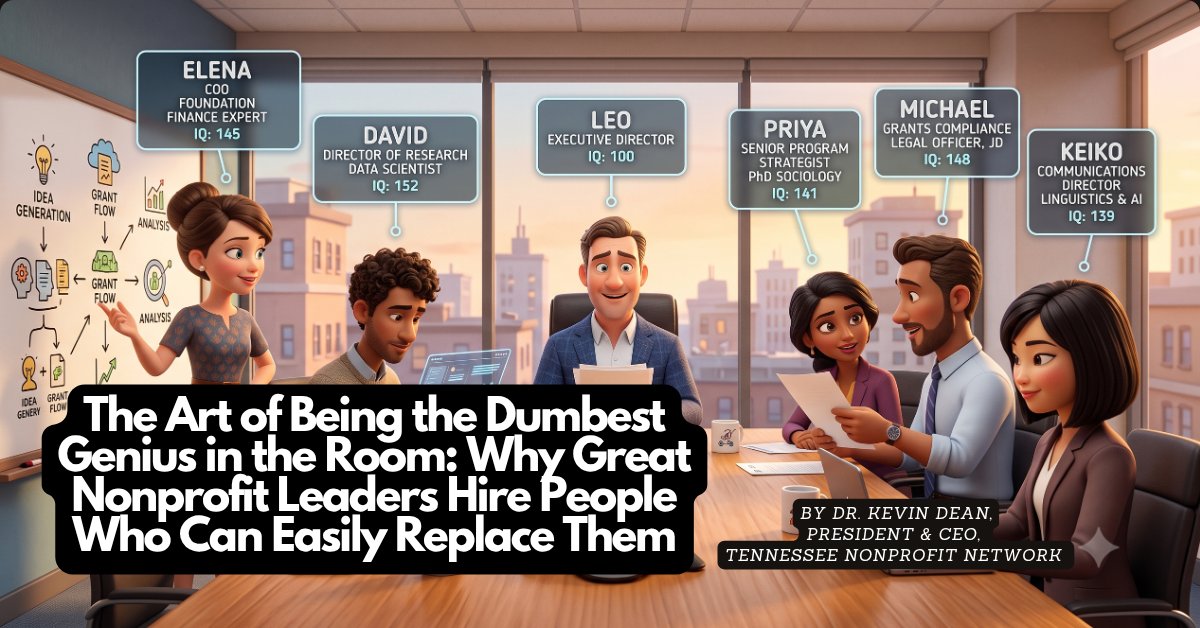
Now look at the executive team of a secure leader. It looks like a high-stakes problem-solving group. A secure leader deliberately hires team members who make them stretch. Their leadership team is populated by program experts, financial strategists, and operations directors who are not afraid to point out when a proposed plan is unworkable or financially unsound.
Secure leaders understand that constant agreement is easy, but constructive challenge creates progress. They actively seek out staff whose technical abilities exceed their own. They do not want head-nodders; they want rigorous strategic partners. They recognize that an executive team comprised of people who are smarter than the CEO in their respective areas is not a threat; it is the most effective way to advance the mission.
The Conductor’s Symphony
To understand how high-level leadership functions, consider the role of an orchestral conductor.
The conductor stands on the podium during a performance. The conductor does not play the violin, the oboe, the drums, or the brass. In fact, if the conductor suddenly panicked, ran across the stage, and tried to play every instrument at the same time, the performance would be a catastrophe. The audience would watch in disbelief as an executive knocked over music stands, dropped a cello, and blew an out-of-tune squeak on a clarinet before falling over the percussion section.
The conductor’s talent does not lie in playing every instrument better than the musicians. The principal violinist has spent decades mastering their craft. The oboist understands their instrument with a precision the conductor cannot replicate. The conductor’s talent lies entirely in assembling exceptional musicians, establishing tempo, creating alignment, and allowing each artist to play their absolute best.
When a musician delivers a stunning solo, the conductor does not feel threatened. They do not stand on the podium feeling jealous that the musician outshone them. Instead, the conductor smiles, gestures toward the soloist, and invites the entire room to applaud them.
Because the conductor understands that bringing together extraordinary talent and creating the environment for them to succeed is the true measure of leadership. When someone on your team outperforms you in a specific domain, that is not a threat to your standing; it is a victory for your judgment in building a remarkable team. Their success is literally your success.
Embracing the Glory of Being Replaceable
The ultimate hallmark of a secure leader is the willingness—and active commitment—to hire and develop people who could easily step into their role.
Insecure leaders hoard information, gatekeep relationships with donors or board members, and create fragile operational systems that collapse whenever they take a few days off. They operate under the delusion that making themselves indispensable provides job security. In reality, it prevents organizational sustainability and makes long-term success impossible. If an organization cannot function for a week without your direct involvement, you have not built a resilient organization; you have built a fragile dependency.
Secure leaders, by contrast, prioritize succession planning and leadership development from day one. They recruit individuals with the strategic vision, operational competence, and emotional intelligence to lead the organization forward. They recognize that building an enterprise that thrives independently is the highest mark of professional leadership.
When you hire people who are smarter, faster, and more capable than you, several important things happen:
- Your operational stress drops because you no longer have to oversee every detail or guess your way through technical tasks.
- Organizational impact accelerates because experts complete in minutes what takes non-experts days to research.
- The entire organization elevates its performance, expanding mission reach and building long-term sustainability.
If you are currently sitting at the head of a table surrounded by staff who agree with every proposal and look to you for every single solution, take a moment to evaluate your environment. You have built a room that is comfortable and predictable, but fundamentally limited. It is time to open the doors, invite stronger talent into the building, and surround yourself with people who are exceptionally skilled at what they do. Your ego might take a temporary back seat, but your mission will be infinitely better for it.