
by Dr. Kevin Dean, President & CEO, Tennessee Nonprofit Network

I have always liked being liked. It is entirely natural to want to be liked. Human beings are social creatures who survived the ice age by huddling together in caves, and being cast out of the cave because you were unpleasant was a death sentence. Imagine the Pleistocene epoch for a moment. You are sitting near the fire, chewing on a piece of tough mammoth meat, and your cave-mate decides your attitude needs work. Before you know it, you are locked outside in a snowstorm while a saber-toothed cat takes a professional interest in your left leg. Approval was not a personality trait back then; it was a basic health and safety strategy.
Over time, however, I learned a crucial distinction: while I used to prioritize being liked, I realized I like being respected far more. You can easily be liked by all, but respected by none. And being liked is not a successful strategy for achieving your mission (just don’t be a butthead, ok?).
Having grown up in a WASP-y Southern household, I was taught never to be unpleasant or make anyone uncomfortable. In that environment, direct conflict is treated with the same sheer terror as a public scandal. You do not raise your voice, you do not point out an error directly, and you certainly do not tell someone that their behavior is problematic. No, you hold your tongue and maybe instead be passive aggressive about things or just not say anything, even to my own detriment or the detriment of the other person. You simply smile, offer a refill on iced tea, and save the genuine assessment for a quiet whisper six months later to an aunt who was not even involved.
When you bring this deeply ingrained cultural reflex into the workplace, particularly into the management of a nonprofit, the results are predictably catastrophic. We owe it to the people around us and the mission of our organization to give honest and productive feedback to one another when things aren’t going right or someone has room for improvement.
The Verbal Cookie Bakery of Management
Consequently, many new managers develop an overwhelming urge to be everyone’s favorite neighbor, handing out verbal cookies and pretending that every terrible report is a masterpiece of modern literature.
I was the same way. I wanted all of my donors to like me, my coworkers to like me, my boss to like me, my volunteers to like me. And when someone didn’t like me, I worked even harder to make sure they liked me. If an employee turned in a grant application that looked as though it had been dictated to a parrot and then translated into Latin and back, I would read it, swallow my panic, and say something encouraging about the choice of font. If a volunteer showed up three hours late to a fundraising event wearing flip-flops and carrying a cold sandwich, I would thank them profusely for their heroic commitment to the cause.
I avoided hard conversations, would not give feedback, and would be deferential even when I sometimes had strong opinions otherwise. If a board member suggested that our organization solve community housing shortages by organizing a series of interpretive dance workshops, I would nod thoughtfully and pretend to write it down in my notebook. I convinced myself that this was leadership. I thought I was creating a warm, supportive, conflict-free sanctuary where everyone felt cherished.
The Elephant in the Nostril
What a mistake. Not only is that unfair to the other person to withhold feedback and the truth, it’s also deeply selfish. When you don’t share honest, constructive feedback with someone, you’re ensuring you remain comfortable. You aren’t really helping the other person. You are simply protecting your own nervous system from thirty seconds of awkward silence.
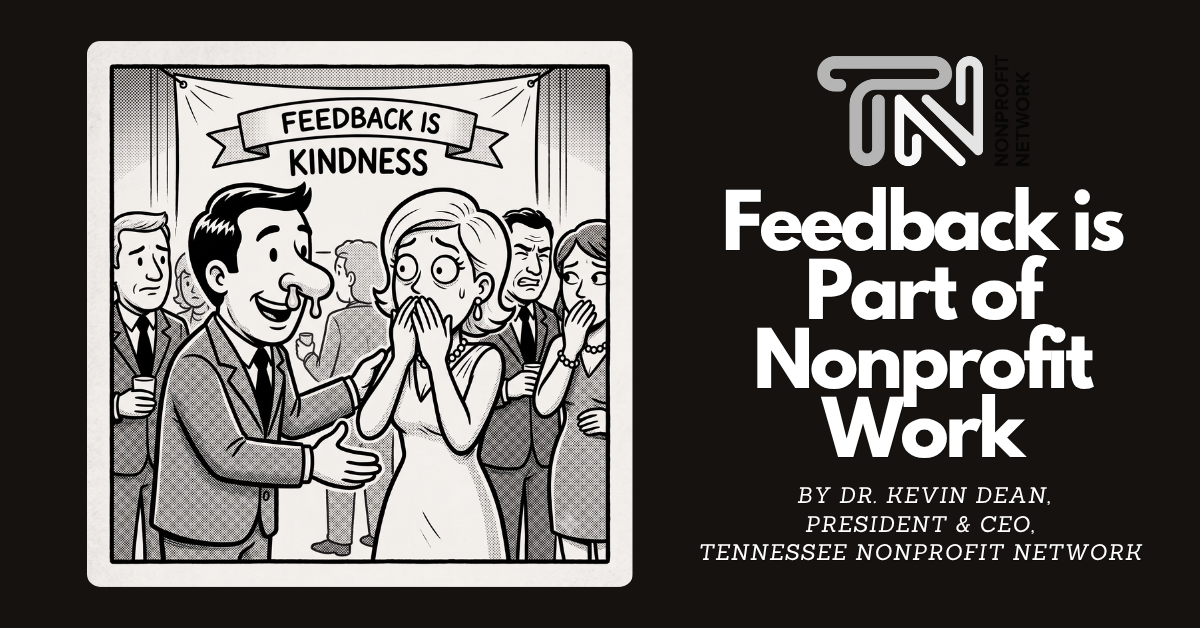
Avoiding difficult conversations in the name of kindness is like letting someone walk around all day with a massive booger hanging out of their nose because you were too polite to mention it. It is not kindness; it is conflict avoidance wrapped in a shiny ribbon of fake diplomacy.
Consider that nose for a moment. The person goes about their entire day. They present to the board. They meet with major donors. They pose for photos at the annual luncheon. All the while, a formidable, gravity-defying specimen is sitting front and center. Everyone sees it. Everyone notices it. Everyone leaves the room and talks about it. And when that person finally looks in the bathroom mirror at five o’clock, they do not think back on you with gratitude and affection. They do not say to themselves, what a sweet manager I have, who loved me too much to ruin my afternoon. They think, why on earth did my supervisor let me stand in front of foundation executives looking like a primary school science experiment?
By keeping quiet, you saved yourself three seconds of slight discomfort at nine in the morning, while condemning your colleague to twelve hours of professional humiliation. That is self-preservation masquerading as politeness.
At its core, giving honest and constructive feedback is ultimately about the mission itself. We must speak up and give feedback because it is essential to achieving our purpose. When we choose silence over clarity, we do a profound detriment to our mission and to the very people we serve. Achieving our goals and serving our community effectively is infinitely more important than managing a few seconds of momentary discomfort. The good news is that once you commit to having these conversations, it becomes easier and easier over time. What starts as a daunting hurdle eventually becomes an effortless, baseline part of a healthy workplace culture.
Mustache-Twirling Villains vs. Actual Leadership
Real leadership reframes feedback as a high-value calibration tool. Delivering constructive critique does not mean transforming into a cartoon villain who twirls a mustache while firing people. It means sitting down with a colleague, looking at the work objectively, and discussing where things stand, where they need to be, and how to bridge the gap.
Now, I am certainly not suggesting that we all start acting like jerks to one another under the guise of transparency. Directness is not an excuse for bad manners or gratuitous roughness. Being direct and giving clear feedback is actually deeply kind. It is precisely what true friends and allies in this work do for one another when they care about each other’s success and the ultimate outcome of the mission.
When you treat feedback as a gift designed to help someone grow rather than a weapon designed to wound, the anxiety vanishes. You stop worrying about being the villain of the story and start becoming the catalyst for someone’s actual progress.
In the nonprofit sector, we are often terrified of critique because we confuse our work with our identity. Because people enter this field out of a desire to do good, any suggestion that their work needs improvement feels like an indictment of their moral character. If you tell a program officer that their quarterly report is disorganized, they do not hear that their paragraphs need restructuring. They hear that you think they hate humanity and wish ill upon the community.
As a manager, your job is to separate the person from the process. You are not critiquing their soul; you are critiquing a spreadsheet. The moment you make that distinction clear, the temperature in the room drops by twenty degrees. You are no longer two opposing combatants in an arena of feelings; you are two professionals looking at a piece of work on a table between you, trying to make it better.
Constructive Feedback vs. The Noise of Unhelpful Opinions
To deliver feedback effectively, one must first learn to distinguish between genuine constructive critique and the endless background noise of unhelpful personal opinions. The nonprofit world is uniquely inundated with opinions. Because our work belongs to the community, almost everyone feels entitled to weigh in on how it should be executed.
An unhelpful opinion is subjective, vague, and usually focused on personal preference rather than functional outcomes. Examples of unhelpful opinions include statements like the following:
- This brochure just does not feel inspiring to me.
- I am not sure I like the vibe of this community meeting outline.
- Can we make the logo look a bit more cheerful?
- My spouse read this grant narrative and thought it was a little dry.
None of those comments provide actionable direction. They force the recipient to play a guessing game, attempting to adjust their work to match the internal, unspoken aesthetic preferences of the speaker.
Constructive feedback, by contrast, is objective, specific, and tied directly to measurable goals or standards. Constructive feedback looks like this:
- The second paragraph of this report contradicts the budget figures on page four. We need to align these numbers before sending it to the foundation.
- Our outreach target for this campaign is senior citizens, but the font size on these flyers is too small for easy readability.
- The draft of this proposal misses three of the specific criteria listed in the grant guidelines on page two. Let us add those sections back in.
Notice the difference. Constructive feedback does not ask the employee to read your mind or apologize for their taste. It identifies a clear discrepancy between the current state of the work and the desired outcome, providing a direct path forward.
How to Deliver Constructive Feedback Without Prompting a Defense Mechanism
If you wish to give constructive feedback without causing your colleague to retreat into a self-defensive fortress, you must throw away the ancient management rulebook, starting with the compliment sandwich.
Everyone knows the compliment sandwich. It is the practice of squeezing a piece of bad news between two insincere compliments. You call an employee into your office and say: You have a wonderful smile, your event budget is ten thousand dollars over limit and we are going broke, and I really love the color of your sweater.
This method fails completely. If the employee is anxious, they will only hear the outer layers of praise and leave your office entirely unaware that the budget is collapsing. If the employee is perceptive, they will instantly recognize the compliments as cheap wrapping paper and learn to distrust every nice thing you ever say to them.
Instead, try a far more straightforward approach built on clarity and curiosity.
First, name the issue directly and calmly, without dramatic flourish or emotional charge. State the observable facts. Do not say, you are always late with your reports and it shows a total lack of respect for the team. Say, the monthly progress report was due on Tuesday, and I received it on Thursday morning.
Second, explain the functional impact of the issue. People rarely fix behaviors if they do not understand why the behavior matters. Explain how the error affects the organization, the team, or the mission. For instance: When that report comes in late, the finance director cannot reconcile our grant allocations on time, which delays our reimbursement requests.
Third, pivot to curiosity and problem-solving. Ask what happened and how the system can be fixed. Instead of asking, why did you do this, which immediately triggers defensiveness, ask, what obstacles did you run into with this deadline, and what do we need to adjust so it happens on time next month?
This approach removes the drama. It shifts the conversation away from personal guilt and toward operational performance. You are not attacking their character; you are inviting them to help you solve an operational problem.
The Art of Receiving Feedback Without Fainting
Of course, feedback is a two-way street. It is impossible to build a culture of honest feedback if you personally crumble into a puddle of self-pity every time someone points out a flaw in your own work.
For those of us raised to believe that mistakes are fatal social blunders, receiving feedback can feel like an existential threat. When a board member or direct report offers critique, our natural instinct is often to do one of three things: defend ourselves frantically, counter-attack, or agree immediately while secretly wallowing in shame.
None of these responses are useful. When receiving feedback, your primary task is to sit still, breathe, and listen without immediately trying to build a legal defense case in your head.
When someone gives you feedback, follow a simple three-step protocol:
- Pause and collect yourself. Resist the immediate urge to explain why you did what you did. Explanations usually sound like excuses, even when they are factually accurate.
- Ask clarifying questions to ensure you understand the core of the issue. Ask for specific examples if the feedback is vague.
- Thank the person for bringing it to your attention, and take time to process it before responding fully.
You do not have to accept every piece of feedback you receive. Some of it will be unhelpful, incorrect, or driven by someone else’s bad day. But you must be willing to inspect it objectively before deciding what to keep and what to discard.
The Quiet Joy of an Honest Workplace
When you stop trying to be the world’s most beloved manager and start focusing on being an honest, clear, and supportive leader, something remarkable happens. The background tension in your office begins to dissipate.
People stop wasting energy trying to decode passive-aggressive hints. They stop worrying about whether you are secretly unhappy with their performance, because they know that if there were a problem, you would tell them directly, calmly, and kindly. The workplace ceases to be a delicate theater of artificial politeness and becomes a productive environment built on mutual respect.
You do not need to hand out verbal cookies to be a good leader. You do not need to praise terrible work to prove that you care about your team. You simply need to care enough about their long-term success to tell them the truth, early and clearly.
The next time you see a colleague struggling with a project, failing to meet a standard, or making a clear error, remember the lesson of the visible nose obstruction. Do not smile, look away, and pretend everything is perfect just to keep your own morning peaceful. Take a deep breath, lean in, and politely hand them a tissue. They might feel a brief moment of embarrassment, but tomorrow, they will trust you entirely.