
by Dr. Kevin Dean, President & CEO, Tennessee Nonprofit Network
There is a distinct, fleeting pleasure in updating your email signature. Adding three or four capitalized words after a comma feels remarkably like receiving a knighthood, minus the risk of an actual sword near your neck.
When I was thirty-one years old, I experienced this specific brand of vanity for the first time. I had just been hired as an Executive Director. Friends, former colleagues, and distant relatives whom I had not spoken to since the bush administration reached out to offer their glowing congratulations. They spoke about the prestige. They used words like vision, leader, and cornerstone. They seemed to imagine that my daily routine would consist of sipping espresso behind a hand-carved mahogany desk, gazing pensively out a floor-to-ceiling window, and making sweeping decrees that transformed the community by lunch.
The reality, as anyone who has ever occupied an executive office in the sector knows, arrived with swift, unvarnished efficiency.
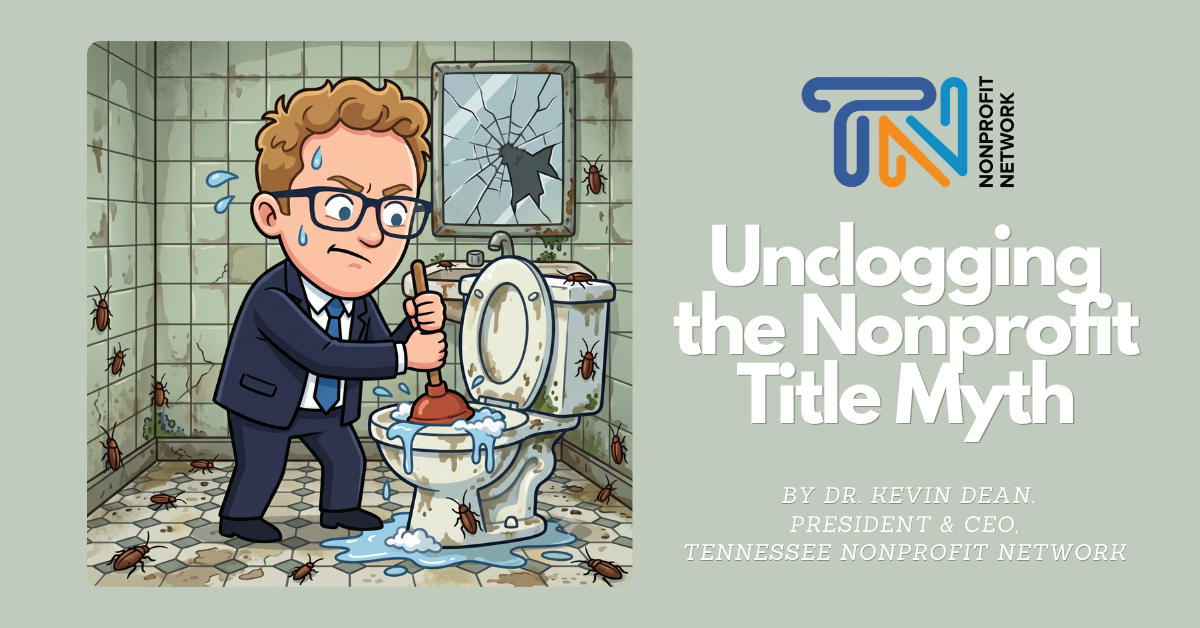
My mahogany desk was a donated, broken piece of office furniture that leaned so heavily to one side it required three old board packets wedged underneath just to keep a cup of coffee level. The copy machine was a permanent monument to mechanical dysfunction that refused to print, copy, or acknowledge human presence. The carpet was less flooring and more of a thriving petri dish, holding biological evidence from at least three prior executive directors. And as for our staff headcount, the local roach population easily outnumbered the actual human employees by a conservative factor of 100,000 to one.
And on my third morning as a prestigious community leader, I found myself standing in the single-stall office restroom at eight in the morning, holding a heavy-duty plunger while sewage crept toward the cuffs of my sensible loafers. Someone had attempted to flush an entire cloth napkin down the toilet. There was no facilities department to call. There was no operations crew. There was only me, thirty-one years old, wearing my best suit, attempting to establish hydraulic seal pressure while contemplating my life choices.
The prestige did not end with plumbing. Later that same week, I spent forty-five minutes being berated by an angry volunteer because we wouldn’t replace the moldy carpet. She informed me, with absolute sincerity, that this betrayal was destroying the moral fabric of our mission. Meanwhile, I could barely afford to pay the bills.
A month later came the true initiation into nonprofit executive leadership: the midnight payroll panic. I sat at my kitchen table staring at a spreadsheet line forty-two, staring at a bank balance of twelve thousand dollars, and staring at a payroll demand of fourteen thousand dollars due in forty-eight hours. The prestige was nowhere to be found when I decided to voluntarily withhold my own paycheck so my program coordinators could pay their rent. Sitting in the dark at two in the morning eating store-brand crackers while calculating how many days I could stretch a half-gallon of milk is not a scene usually featured in leadership memoirs, but it is the honest core of the job.
The Illusion of the Brass Plaque
The title of Executive Director, Vice President, or Senior Director is merely fancy wrapping paper on a box that turns out to be unexpectedly heavy. In our sector, job titles are frequently handed out like party favors in lieu of actual cost-of-living raises. We have all seen organizations with three employees where every single person carries a title that sounds like they command a fleet of naval ships. We have Vice Presidents of Synergy who are also responsible for buying the toilet paper, and Directors of First Impressions whose primary duty is answering a telephone that has not stopped ringing since 1998.
Being enamored with job titles is a dangerous condition. It tricks people into believing that the title bestows competence, authority, or respect. It does none of these things. Here are a few concrete reasons why worshiping the nameplate is a fundamental mistake:
- Titles carry zero operational magic. An impressive string of capitalized letters after your name will not make a thirty-thousand-dollar budget deficit disappear. It will not write the narrative report for a federal grant. It will not make the roof stop leaking during a thunderstorm.
- Titles attract accountability, not immunity. The higher your title, the less you get to blame other people when things go sideways. When a grant deadline is missed, the board does not ask what the program assistant was doing; they look at the person whose name is on the front page of the website.
- Titles often mean doing less of the work you actually enjoy. The moment you become the boss, you spend significantly less time helping human beings and significantly more time reading insurance policies, negotiating copier leases, and mediating disputes about who left an unlabeled salad dressing in the refrigerator until it turned into a new lifeform.
A title gives you permission to speak in meetings, but responsibility is what keeps you awake at three in the morning wondering if the budget for next quarter makes sense or if you accidentally carried an error over from line forty-two.
Leading from Wherever You Sit
If a title does not make you a leader, then the inverse must also be true: the absence of a title does not prevent you from leading.
The idea that leadership only flows downward from the top of an organizational chart is one of the most destructive myths in workplace culture. In most nonprofits, the organizational chart is a work of speculative fiction anyway. It depicts neat boxes and tidy arrows, whereas the actual work is accomplished through a web of informal relationships, shared panic, and whoever happens to know where the backup key to the supply closet is hidden.
Real leadership is an action, not an altitude. You can lead from the very middle, the side, or the bottom of the organizational chart without asking anyone for permission.
Consider the Development Coordinator who notices that the donor database is organized like an unsolved criminal investigation. Instead of complaining about it at staff meetings for six months, she quietly builds a standardized data-entry template, tests it, and shows her team how it saves two hours of work a week. That is leadership.
Consider the Case Manager who notices that clients are repeatedly getting confused by an overly complicated intake form. He takes thirty minutes to rewrite the instructions in clear, plain language, prints twenty copies, and leaves them on the front desk. That is leadership.
Consider the Operations Assistant who notices that a team member is visibly drowning under a deadline and quietly steps in to take three administrative tasks off their plate without being asked and without filing a claim for public credit. That is leadership.
None of these actions require a brass plaque on a door. None of them require an inflated title or a corner office. They simply require a person who has chosen to stop acting like a spectator in their own workplace. When you shift your focus from chasing the crown to carrying the weight, something marvelous happens. You realize you do not need to parade around like a gilded monarch. You become the person who makes sure the ship stays afloat, which is far more satisfying than simply wearing the captain’s hat while standing on a sinking deck.
How Respect Is Actually Earned
Respect is not a complimentary gift that comes packaged with your initial employment offer. It cannot be demanded by pointing at a chart, and it certainly cannot be enforced by writing memo titles in ALL CAPS. Respect is a slow, methodical accumulation of social capital earned through consistent, unglamorous action over time.
To build genuine credibility across your professional orbit, the recipe is remarkably simple, though consistently difficult to execute.
Earning Respect from Coworkers and Staff
Protect their time with aggressive discipline. Do not call a ninety-minute meeting to discuss something that could have been resolved in a three-paragraph email. If you must have a meeting, start on time, have an agenda, and end early. Nothing communicates respect for people faster than showing that you value their life hours.
Take the blame, export the credit. When a project succeeds, stand back and make sure the people who did the heavy lifting get the public applause. When a project fails, step out in front and take the hit. If your team knows you will throw them under the bus the moment a funder or board member asks a difficult question, they will perform the absolute minimum required to avoid being noticed.
Do the dirty work when necessary. If the event setup requires carrying twenty folding tables across a gymnasium at seven on a Saturday morning, put down your clipboard and grab a table. Leaders who consider certain tasks beneath their dignity quickly find that their staff considers loyalty beneath theirs.
Earning Respect from Board Members
Treat them like partners, not judges or toddlers. Board members are frequently either micromanaged or completely isolated until it is time to ask for money. Earn their respect by giving them clear, unvarnished truth. If a program is struggling, tell them early, present two potential solutions, and ask for their strategic input.
Respect their volunteer status by being prepared. Do not send a sixty-page board packet at ten o’clock the night before a morning meeting and expect them to have digested it. Provide concise, clean metrics that tell the true financial and operational story of the organization without hiding behind jargon.
Earning Respect from Clients and Community Members
Abandon the savior complex entirely. The people walking through your doors seeking services are not metrics for your next grant narrative, nor are they props for your annual gala slide deck. They are human beings navigating complex systems. Earn their respect by listening more than you speak and by designing services alongside them rather than imposing solutions upon them.
Show up consistently without a camera crew. Real community trust is built in the unscripted moments when there are no major donors in the room and no local reporters looking for a photo opportunity. Show up to the neighborhood meetings, stay until the end, and do what you said you were going to do.
The Anchor Holding the Tent Down
It is easy to be enamored with the idea of authority when the weather is clear. When the grants are coming in, the audit is clean, and the local newspaper runs a flattering profile on your organization’s mission, wearing the title feels effortless.
But nonprofit work is rarely a prolonged stretch of clear weather. The winds kick up regularly. A major foundation shifts its funding priorities overnight. A key staff member resigns in the middle of peak program season. An unexpected building repair consumes the contingency reserve.
In those moments, no one cares what your email signature says. No one is impressed by your title, your educational credentials, or how nicely framed your diploma looks on the wall. The only thing that matters is whether you are willing to step up and hold the structure together while the storm passes.
Acknowledge that you do not need a fancy moniker to begin acting with accountability. You do not need to wait for a promotion, a raise, or a formal endorsement from senior leadership to start solving problems, treating people with dignity, and taking responsibility for the outcomes around you.
The glory of leadership is not in the title; it is in the quiet satisfaction of knowing that when the winds kick up, you are the anchor holding the tent down. And if that holding down happens to involve a plunger at eight o’clock on a Tuesday morning, so be it. At least the tent is still standing.