by Dr. Kevin Dean, President & CEO, Tennessee Nonprofit Network
Note that this is an expansion of a component of a previous blog post.
Every sector has its sacred traditions, but the social sector has elevated tradition to a competitive sport. Somewhere along the way, nonprofit culture adopted the belief that an organization’s founding document is an immutable cosmic contract. We wring our hands and salivate at that dusty strategic plan on the shelf, squealing, “My precious!” If a group of well-meaning citizens gathered in a basement in 1988 to distribute faxed newsletters about wetland conservation, then by god, that organization must continue faxing those newsletters until the end of recorded time.
We cling to our original program models with a tenacity usually reserved for extreme survivalists. We update our bylaws with the enthusiasm of someone scheduling a root canal, and we treat any suggestion of shifting our strategy like a betrayal of our ancestor’s memory. Change is hard, but not changing is the absolute best way to fail.
Meanwhile, the rest of the world is executing pivots so dramatic they border on absurdity.
Consider the corporate realm for a moment. Ferruccio Lamborghini made farm equipment. He spent his early career covered in grease, building heavy diesel tractors for Italian farmers. Had he stuck strictly to his founding charter, the name Lamborghini would today be synonymous with rugged, low-speed soil tilling. Instead, after getting frustrated with the clutch in his personal Ferrari, he decided his tractor company should start manufacturing hyper-luxurious, low-profile supercars capable of tearing down the Autobahn at terrifying speeds.
Samsung did not begin as an electronics behemoth pushing high-definition displays and foldable smartphones. It started in 1938 as a local trading shop selling dried fish, locally grown vegetables, and noodles.
LG, before it became a household giant in consumer electronics, was a cosmetics business selling facial cream under the name Lucky Chemical.
IKEA began with a teenager selling fountain pens, watches, and Christmas cards door-to-door before deciding that the true calling of humanity was attempting to assemble a bookcase using a tiny L-shaped wrench on a rainy Saturday afternoon. (Insert snarky message here from the grumpy Memphian who is still mourning the loss of IKEA.)
Restoration Hardware spent its early days as an actual hardware store, stocking authentic antique door knobs, brass latches, and obscure home repair fixtures for old Victorian houses. They didn’t start out selling six-thousand-dollar cloud couches or opening lavish, multi-story dining galleries in historic mansions. They sold drawer pulls and varnish. Today you can pay $26 for four cocktail shrimp in their restaurant in Green Hills before spending two hours wandering around their multistory showroom wondering why you didn’t become a country music star so you could afford a lush off-white sectional that cost as much as your 2011 Toyota Camry.
If commercial enterprises can transition from dried fish to microchips, from door knobs to luxury lifestyle galas, or from farm tractors to mid-engine sports cars, why are nonprofits so convinced they must spend forty years running the exact same annual silent auction to fund the exact same outdated pamphlet program?
Sector Icons Who Changed the Plan
You might look at corporate examples and think, “Sure, but business corporations exist solely to make money. They can sell whatever pays the bills. Nonprofits have sacred missions.”
That is a fair objection, right up until you look at the actual history of iconic nonprofits. The social sector’s greatest success stories are built on massive, unpologetic pivots.
Take March of Dimes. Founded in 1938 by Franklin D. Roosevelt as the National Foundation for Infantile Paralysis, its sole mission was to cure and eradicate polio. Through relentless fundraising, advocacy, and funding research, they backed Dr. Jonas Salk as he developed the polio vaccine.
By the late 1950s, the vaccine worked, polio cases plummeted, and the primary objective of the organization was accomplished.
Under standard nonprofit logic, March of Dimes should have thrown a nice retirement dinner, turned off the lights, and disbanded. Or worse, they should have spent the next fifty years aggressively hunting down the last three theoretical polio cases in America while ignoring every other child health crisis.
Instead, leadership looked around the room and said, “We built an extraordinary nationwide fundraising and advocacy engine. What else needs fixing?” They pivoted their entire operational focus to preventing birth defects, premature births, and infant mortality. They didn’t cling to their original disease focus out of sentimentality; they repurposed their organizational capability to serve an evolving need.
Look at the humane society movement. In the late nineteenth century, early humane societies were founded primarily to address the horrific abuse of working animals in industrial cities. Their primary day-to-day operations revolved around urban cart horses—rescuing collapsed horses, regulating heavy loads on cobblestone streets, and building public water troughs.
When internal combustion engines replaced urban horse transportation in the early twentieth century, humane societies faced an existential crossroads. They could have spent decades trying to protect a rapidly disappearing population of street horses, stubbornly insisting that draft horses were their founding identity.
Instead, they pivoted to address companion animal welfare, shelter systems, spay/neuter public health initiatives, and farm animal protections. The mission—preventing cruelty—remained, but the entire delivery model shifted because society changed.
If March of Dimes could pivot from polio to premature birth, and if humane societies could pivot from street horses to shelter networks, your nonprofit can probably survive changing its Tuesday afternoon workshop schedule.
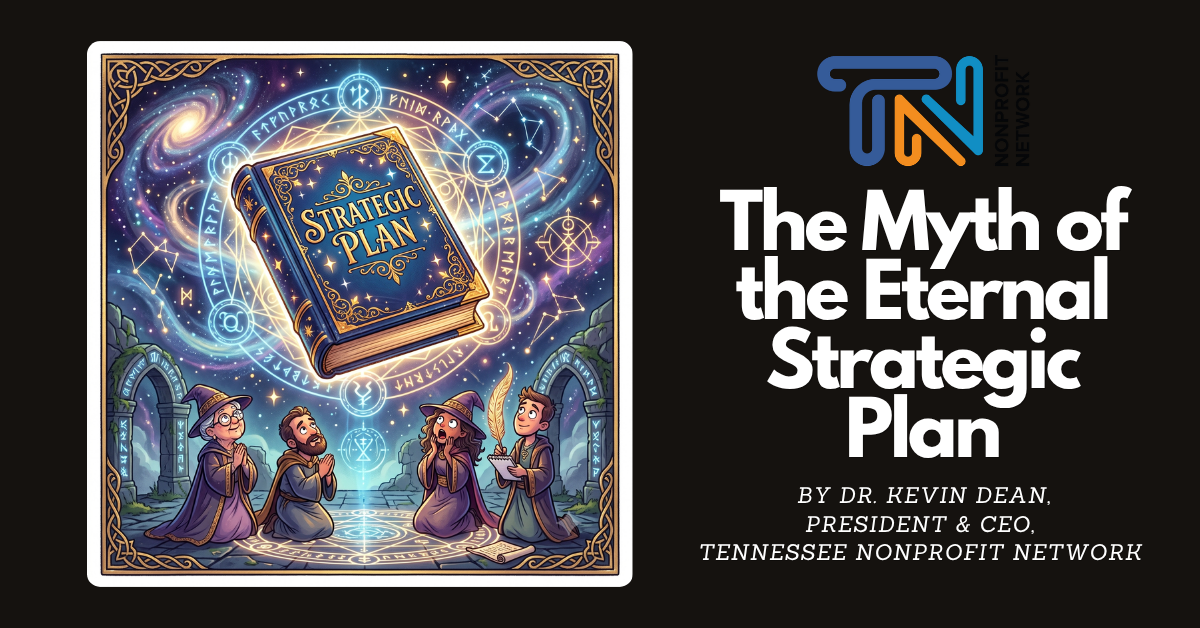
The Myth of the Eternal Strategic Plan
In the nonprofit world, there is a pervasive fear that changing your delivery model means you failed. If a program is scaled back, retooled, or completely retired, executive directors often feel compelled to offer profound apologies to their boards, their founders, and their community stakeholders.
We treat strategic plans like sacred relics rather than hypotheses. But a strategic plan is not a prophecy; it is simply an educated guess made by a group of tired people sitting in a conference room eating catered sandwiches on a Tuesday afternoon. How do you plan for a global pandemic, a federal grants pause, a hurricane….in Tennessee and North Carolina???
When circumstances change, when community needs evolve, or when a delivery method proves utterly ineffective, holding onto the original plan isn’t dedication. It is stubbornness wrapped in institutional nostalgia.
Imagine if Samsung had refused to pivot because the Board of Directors felt a deep, emotional attachment to the dried fish department. Imagine if March of Dimes insisted on ignoring maternal health because “our founder had polio.” Imagine the press release: “While infant mortality is a pressing issue, our core identity remains strictly tied to iron lungs.”
That sounds ridiculous, yet nonprofit leaders do it constantly. We maintain legacy programs that serve six people a year simply because the program founder’s cousin sits on the governance committee. We continue printing three-hundred-page annual reports that nobody reads because “we’ve always printed the report.” We spend countless staff hours coordinating massive, low-yield fundraising events that yield a net profit of forty-seven dollars after catering costs, purely out of habit.
Your current operational state is not your permanent identity. It is merely where you happen to be standing right now.
The Fear of the Unforgiving Funder
To be fair to nonprofit leaders, the reluctance to innovate isn’t entirely self-inflicted. The funding ecosystem actively rewards predictability and penalizes experimentation.
Grants are frequently written with rigid deliverables that demand zero deviation. If you promise a grant maker that you will conduct twelve in-person workshops for two hundred participants, you are locked into those twelve workshops, even if mid-way through the grant year you discover that your target audience would benefit vastly more from an interactive mobile application or a peer-to-peer mentoring network.
The fear of losing funding creates an environment where staying the course, even a failing course, feels safer than attempting a brilliant pivot. Nonprofits are routinely asked to solve the most complex, systemic, and stubborn problems in human history, yet they are expected to do so using risk-averse methodologies that haven’t changed since the mid-nineties.
This creates a paradox. We want transformational outcomes, but we insist on transactional, non-threatening operations.
To break out of this loop, nonprofit leadership must start treating innovation not as a high-risk gamble, but as an ongoing operational necessity. When you talk to donors, grant makers, and board members, the narrative needs to shift from “look at this rigid plan we executed flawlessly” to “look at how we adapted our approach based on real-world evidence.”
Funder expectations will only change when nonprofit leaders stop pretending that their first draft was perfect.
The Power of the One Percent Improvement
When people talk about innovation, they often picture a cinematic revelation: a lightbulb moment where an executive director leaps out of bed, rushes to a whiteboard, and completely re-invents the sector overnight.
Real innovation almost never looks like that. It is messy, quiet, and frequently unglamorous.
Innovation is rarely about abandoning your entire mission to sell luxury supercars or high-end chandeliers. More often, it is about committing to getting one percent better every week. It is about relentless, small-scale testing.
- Test a new way to onboard volunteers so they don’t drop out after two weeks.
- Test a shorter, clearer communication style that actually gets read by busy community members.
- Test a new service delivery schedule that accommodates working families instead of operating strictly from nine to five.
- Test retiring a legacy project that consumes thirty percent of staff capacity while producing five percent of your impact.
If you make a one percent improvement in your processes, your culture, and your program delivery every few weeks, the compounding effect over two or three years is astronomical. You look back and realize you are no longer running the same organization. You have quietly, systematically pivoted into a lean, highly effective operation.
Failure is an essential ingredient in this process. If every single experiment you conduct succeeds, your experiments are far too conservative. Lamborghini undoubtedly made some terrible tractors before they made great sports cars. Samsung probably had batches of dried fish that didn’t sell. Restoration Hardware certainly had hardware lines that gathered dust on the shelf.
If your organization hasn’t had a well-intentioned, thoughtfully executed pilot project collapse under its own weight recently, you aren’t innovating. You are just coasting.
Escaping the Trap of Humble Beginnings
Many nonprofits suffer from an organizational version of imposter syndrome. Because an organization started in a garage with a tiny budget and a secondhand printer, its leadership internalizes the idea that small, struggling, and resource-scarce is its natural state.
There is a strange honor culture in the social sector that equates extreme frugality with moral purity. We wear our broken office chairs, ancient software, and overworked staff like badges of honor.
Starting from humble beginnings is a great origin story, but staying in humble operational conditions forever is a tragic strategic choice.
Humble beginnings are meant to be the launchpad, not the destination. The fact that your organization started with limited resources does not mean you are obligated to remain under-resourced, technologically impaired, and structurally fragile forever.
Every major enterprise that currently shapes global culture started as a tiny, vulnerable, slightly chaotic operation. They didn’t grow by obsessively preserving their original limitations; they grew by identifying what worked, shedding what didn’t, and ruthlessly adapting to modern realities.
Your nonprofit deserves modern tools. It deserves efficient processes. It deserves leadership that is willing to say, “The way we solved this problem five years ago is no longer good enough for the people we serve today.”
Permission to Build Your Supercar
If your nonprofit is currently stuck in the metaphorical tractor era—or still trying to sell vintage wood screws out of a tiny storefront—this is your authorization to look up from the counter.
You do not owe allegiance to outdated program designs. You do not owe allegiance to inefficient processes just because someone spent three months designing them a decade ago. Your sole responsibility is to maximize positive impact for the people and causes you represent.
If maximizing that impact means pivoting from physical service locations to digital networks, do it. If it means shuttering three underperforming programs to pour all your energy into one revolutionary initiative, do it. If it means changing your entire operational model to ensure your staff isn’t burned out and running on fumes, do it.
Where your organization stands today is merely a baseline. It is the raw material from which your future impact will be built.
Keep testing new ideas. Keep refining your approach. Embrace the small, incremental improvements that compound over time. Most importantly, stop letting your history dictate your horizon.
Your humble beginning was necessary, and your current situation is temporary. What you decide to build next is entirely up to you.